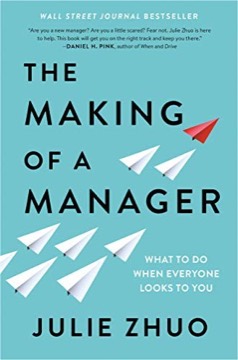
The Making of a Manager
Julie Zhuo's account of becoming a manager in her twenties at a fast-growing technology company — written for the first-time manager, and unusually candid about the parts that were bewildering.
- First published
- 2019
- Publisher
- Ebury Publishing
- Pages
- 312
- Shelf
- Leadership
- Level
- Entry
- ISBN-13
- 9780735219564
Record checked against
Catalogue note
- Reads as
- PracticalWritten to be applied, not only understood.
- Level
- Accessible / FoundationalNo prior reading assumed.
- Approach
- Practical
- Written for
- Managers, Newcomers to the subject
Saved in this browser only — no account, nothing sent anywhere. My library
Read this if
- You are responsible for other people's work as well as your own.
- You are building something new and want to know why most new things fail.
- You want something to apply, not only something to think about.
- You are starting from scratch here and want a way in that assumes no prior reading.
What management actually is
Her working definition, borrowed and sharpened: a manager's job is to get better outcomes from a group of people working together, and everything else is a means to that.
She organises the job into three levers — purpose, people and process — and her argument is that a struggling team has a problem in one of the three, and that identifying which is most of the work.
Purpose, people, process. A struggling team has a problem in one, and naming which is most of the job.
Devmark’s reading — not a quotation from the book
The first three months
Her account of the transition is the book's most distinctive material, because she is honest about how disorienting it is: the loss of a clear personal output, the discovery that your calendar is not yours, and the uncertainty about whether you are contributing at all.
She distinguishes the common paths in — apprentice, pioneer, new boss, successor — and notes that each has a different first problem, which is a useful framing nobody else provides.
Trust as the precondition
Her position that nothing else works without it, and her practical tests: do reports tell you bad news early, do they disagree with you in the room, do they tell you when they are struggling.
Her recommendation to ask directly — what could I do to be a better manager for you — with the discipline of sitting through the silence afterwards, is the most transferable instruction in the book.
Feedback
Her framing is that feedback is a gift whose delivery determines whether it is received, and her practical rules are specific: make it concrete, make it timely, separate the behaviour from the person, and be clear about whether you are sharing an observation or making a request.
Her observation that new managers wait too long and then deliver accumulated feedback at once is accurate and common.
Hiring
Her chapter is unusually practical for a first-time manager: define the role before meeting anyone, treat hiring as a continuous activity rather than a reaction to a vacancy, and recognise that interviewing is a skill that requires deliberate practice.
She is also direct that a bad hire is expensive in ways that do not appear on any budget, which first-time managers routinely underestimate.
A bad hire costs the team in ways that appear on no budget line, which is why new managers underrate it.
Devmark’s reading — not a quotation from the book
Meetings that work
Her rules: know what the meeting is for, invite only the people needed for that purpose, and end with clear ownership.
Her most useful distinction is between meetings for deciding, for informing, for generating ideas and for building relationships — and her observation that most bad meetings are attempting two of these at once.
Managing yourself
Her chapter on impostor feelings, and the reason many readers recommend the book. She is specific about the experience of not knowing whether you are good at the job and about the gap between how competent you feel and how competent you appear.
Her practical advice — know your strengths precisely, ask for help visibly, and find peers doing the same job — is unglamorous and correct.
Growing the team
Her later chapters cover scaling: delegating properly rather than abdicating, the shift from managing people to managing managers, and the recognition that a team's ceiling is set by hiring and development rather than by the manager's own effort.
The delegation material is the strongest — her distinction between handing over a task and handing over an outcome is the one most first-time managers need.
Where it is limited
It is written from one context: a large, fast-growing, well-resourced technology company with abundant hiring and a strong internal culture.
Managers in slower-growing organisations, in constrained budgets, or in functions without a strong development tradition will find several prescriptions assume conditions they do not have.
Who it is for
Genuinely the best first book for someone who has just become a manager, particularly someone who feels out of their depth, because it normalises that experience without excusing it.
Less useful for experienced managers, who will find most of it familiar, and for anyone looking for an organisational theory rather than a practical account.
What to take away
- 01Diagnose purpose, people or processA struggling team has a problem in one of the three, and naming which is most of the job.
- 02Trust is measured by bad newsWhether reports tell you problems early is the test, not whether the relationship feels pleasant.
- 03Ask, then sit through the silence'What could I do to be a better manager for you' only works if you do not fill the pause.
- 04Delegate outcomes, not tasksThe distinction most first-time managers need, and the one that separates delegation from abdication.
- 05Most bad meetings are two meetingsDeciding, informing, generating and relationship-building need different formats and get combined.