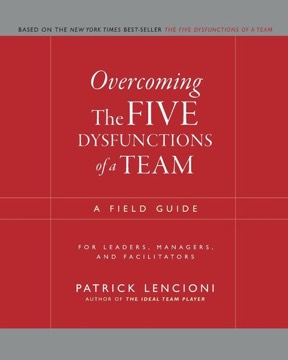
The Five Dysfunctions of a Team
Patrick Lencioni's short business fable arguing that team failure is not usually a matter of talent or strategy but of five interlocking behaviours — each one caused by the one beneath it — starting with an absence of trust.
- First published
- 2002
- Publisher
- Jossey-Bass
- Pages
- 240
- Shelf
- Leadership
- Level
- Entry
- ISBN-13
- 9780787960759
Record checked against
Catalogue note
- Reads as
- ReflectiveChanges how you see rather than what you do.
- Level
- Accessible / FoundationalNo prior reading assumed.
- Approach
- Theoretical
- Written for
- Managers, Newcomers to the subject
Saved in this browser only — no account, nothing sent anywhere. My library
Read this if
- You are responsible for other people's work as well as your own.
- You want to understand what makes people willing to follow a decision.
- You read for the writing as much as for the argument.
- You want a book that changes how you see things rather than what you do tomorrow.
- You are starting from scratch here and want a way in that assumes no prior reading.
The core idea
Lencioni's claim is that the five dysfunctions are a single structure rather than a list. Each one is produced by the one below, so treating the symptom at the top without addressing the base is why so many team interventions fail.
The model, read from the bottom: absence of trust → fear of conflict → lack of commitment → avoidance of accountability → inattention to results.
It is a chain, not a list. Fix the top and it re-forms; fix the bottom and the rest becomes possible.
Devmark’s reading — not a quotation from the book
The form: a business fable
Most of the book is a story about a fictional executive team and a new chief executive. The model itself occupies a short section at the end.
The form divides readers sharply. It makes the dynamics recognisable and memorable in a way a framework alone would not, and it is also thin as fiction and a little convenient in its resolutions. Read it for the recognition, not the plot.
Absence of trust
Lencioni means something specific and narrower than the usual sense: vulnerability-based trust, the willingness to admit a mistake, a weakness or a gap in knowledge without calculating how it will be used.
Without it, people spend energy managing impressions rather than doing work. His point is that this is invisible on any dashboard and is the single largest tax a team can carry.
Fear of conflict
Teams without trust manufacture artificial harmony. Meetings are polite, nothing is resolved, and the real disagreement moves to corridors and private messages afterwards.
Lencioni's position is that productive ideological conflict — direct argument about ideas, not about people — is a requirement rather than a risk, and that a team which never argues in the room is not aligned but silent.
Lack of commitment
People do not commit to decisions they have not had a chance to argue with. This is the hinge connecting conflict to execution, and the book's most practically useful observation.
Lencioni distinguishes consensus from buy-in: the requirement is not that everyone agrees, but that everyone was genuinely heard. He is direct that waiting for certainty is a common failure, and that a clear decision made on incomplete information beats an unresolved one.
Avoidance of accountability
Without commitment, no one can hold anyone to anything, because the standard was never really agreed. Peer accountability then collapses into escalation to the manager.
Lencioni argues that peer pressure is the most effective accountability mechanism a team has, and that its absence is what turns a manager into a bottleneck for every difficult conversation.
A team that escalates every difficult conversation to its manager has not delegated authority. It has delegated discomfort.
Devmark’s reading — not a quotation from the book
Inattention to results
The top of the pyramid is the point where individual status, career advancement or departmental goals displace the team's collective outcome.
Lencioni's remedy is unglamorous: make the collective result public and specific, so that it is harder to quietly substitute a personal one. He is also clear that this is the only dysfunction whose cost is usually visible from outside the team, which is why it is the one most often treated first.
Where the evidence is thin
This should be stated directly. The model is drawn from consulting experience, not research. There is no study behind it, the causal ordering between the five is asserted rather than demonstrated, and the fable provides illustration rather than evidence.
That does not make it useless — practitioner models often encode real pattern recognition — but it should not be cited as a finding, and a reader should notice that its plausibility comes from recognition rather than from data.
Where it gets misapplied
The most common failure is running a trust exercise and declaring the base addressed. Lencioni's trust is built by leaders going first with genuine vulnerability, repeatedly, over time — not by an offsite.
The second is using the model to pathologise a team whose actual problem is structural: unclear ownership, conflicting incentives, or too little authority to act. The framework has no vocabulary for those, and will misdiagnose them as behavioural.
What it is good for
As a shared vocabulary it is genuinely valuable. Naming artificial harmony in a meeting, or the distinction between consensus and buy-in, lets a team discuss its own dynamics without it becoming personal.
It is short, it is honest about being a model rather than a science, and its central insight — that unspoken disagreement becomes uncommitted execution — is one most people recognise immediately from their own experience.
What to take away
- 01The five are a chainEach dysfunction is produced by the one beneath it, which is why top-down fixes do not hold.
- 02Trust here means admitted weaknessNot reliability — the willingness to say 'I got that wrong' without calculating the cost.
- 03Silence is not alignmentA team that never argues in the room is arguing somewhere else, later, without you.
- 04Buy-in does not require agreementIt requires having been genuinely heard. Waiting for consensus is how decisions rot.
- 05Peer accountability beats escalationWhen every hard conversation routes through the manager, the manager has become the bottleneck.