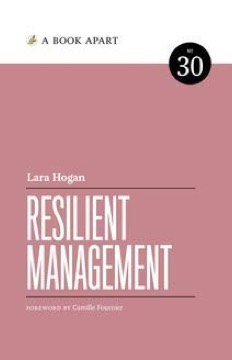
Resilient Management
Lara Hogan's short, practical handbook for new engineering managers, built around team development stages and the specific conversations a manager has to run.
- First published
- 2019
- Publisher
- A Book Apart, LLC
- Pages
- 105
- Shelf
- Leadership
- Level
- Entry
- ISBN-13
- 9781937557829
Record checked against
Only one source carried a publication date for this work, so the year is uncorroborated.
Catalogue note
- Reads as
- PracticalWritten to be applied, not only understood.
- Level
- Accessible / FoundationalNo prior reading assumed.
- Approach
- Practical
- Written for
- Managers, Newcomers to the subject
- Ideas
Saved in this browser only — no account, nothing sent anywhere. My library
Read this if
- You are responsible for other people's work as well as your own.
- You want something to apply, not only something to think about.
- You are starting from scratch here and want a way in that assumes no prior reading.
The structure
Hogan organises around Tuckman's forming, storming, norming and performing, and gives each stage the manager's actual job: what to do, what to say, and what usually goes wrong.
Her framing device is BICEPS — belonging, improvement, choice, equality, predictability and significance — six core needs she uses to diagnose why a person is reacting more strongly than a situation seems to warrant.
BICEPS is a diagnostic: when someone reacts disproportionately, one of six needs is usually threatened.
Devmark’s reading — not a quotation from the book
The practical material
Scripts and structures for one-on-ones, feedback, delegation, and what she calls the manager's mental model of each report — their strengths, their growth areas and their motivations, written down and revisited.
The chapter on communicating change is the most immediately usable: who hears what, in what order, and why announcing to everyone simultaneously usually fails.
Who it is for
Explicitly written for new managers, especially engineering managers, and short enough to read in an afternoon. It is a handbook rather than a theory of leadership.
Hogan ran engineering at Kickstarter and Etsy, and the examples are drawn from that context, though most of the content generalises to any team of knowledge workers.
Short, specific and written for someone who was promoted six weeks ago.
Devmark’s reading — not a quotation from the book
Why it is about resilience
Hogan's title points at the manager rather than the team. Her argument is that a new manager's failure mode is absorbing every problem personally, which works briefly and then does not.
The structures she gives — written mental models, regular one-on-ones with an agenda, explicit delegation — are presented as load-bearing rather than as best practice: they exist so that the manager is not the single point of failure for a team's functioning.
Written for the first-time manager
Hogan's audience is specific: someone recently promoted from individual contributor, usually in software, now responsible for a small team and given no training. The book's scope is deliberately narrow and that is its strength — it addresses the first eighteen months rather than management in general.
Tuckman as scaffolding
The structure follows the familiar stages of team development — forming, storming, norming, performing — and assigns different managerial work to each. The model is old and imprecise, and Hogan uses it as an organising device rather than as science, which is the appropriate weight to give it.
Knowing your people
The most practical material in the book concerns building an accurate picture of each individual on the team: what actually motivates them, what they want to be doing in two years, how they prefer to receive difficult feedback, and what they are currently avoiding. Hogan supplies the specific questions to ask in a one-to-one rather than simply advising that you ought to be holding them.
Most new managers hold the meeting. Very few arrive with the question they need answered.
Devmark’s reading — not a quotation from the book
Feedback in the moment
Her guidance is to deliver small, specific, immediate observations close to the event rather than saving anything up for a formal review cycle months later, and to separate carefully the description of a behaviour from any judgement about the person who produced it. It is conventional advice, and what makes it usable here is that she scripts the opening sentence for you.
Managing during change
A substantial section covers reorganisations, layoffs, resignations and abruptly shifting priorities, on the reasonable grounds that these are the conditions in which most first-time managers actually find themselves operating. Her position throughout is that plain transparency about what you do not yet know is more durable than reassurance you will not be able to support in three weeks.
Its length
It is very short, closer to a long pamphlet than a book, with no research and few examples. That is deliberate — it is meant to be read in an evening before the first one-to-one — and readers wanting depth on strategy, hiring or organisational design will need something else entirely.
What to take away
- 01BICEPSSix core needs used to diagnose outsized reactions.
- 02Stages have jobsEach Tuckman stage gets the manager's specific task.
- 03A written mental modelStrengths, growth and motivation per report, revisited.
- 04Sequencing changeWho hears what in which order, and why simultaneity fails.
- 05An afternoonDeliberately short and aimed at the newly promoted.