Leadership Is Language
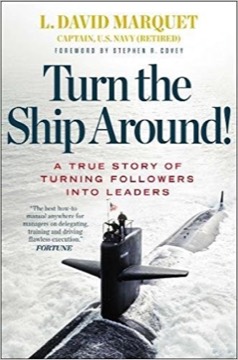
L. David Marquet's follow-up to Turn the Ship Around, arguing that the specific words a leader uses determine whether a team thinks or merely complies. Built around the loss of the El Faro.
- First published
- 2020
- Publisher
- Penguin Books, Limited
- Pages
- 272
- Shelf
- Leadership
- Level
- Core
- ISBN-13
- 9780241373675
Record checked against
Only one source carried a publication date for this work, so the year is uncorroborated.
Catalogue note
- Reads as
- PracticalWritten to be applied, not only understood.
- Level
- Core / BuildingAssumes general familiarity with the subject.
- Approach
- Practical
- Written for
- Managers, Readers with some grounding
Saved in this browser only — no account, nothing sent anywhere. My library
Read this if
- You want to understand what makes people willing to follow a decision.
- You want to be understood the first time.
- You want something to apply, not only something to think about.
- You know roughly how the subject works and want the fuller account.
The framing
Marquet, a former submarine commander, opens with the 2015 sinking of the cargo ship El Faro, which sailed into a hurricane with all thirty-three hands lost. The voyage data recorder captured the bridge conversations, and crew members raised concerns repeatedly without changing the outcome.
His reading is that the language available to them made disagreement socially impossible, and that this is a design problem rather than a character one.
The El Faro crew said what they thought. The available language made it impossible to hear as dissent.
Devmark’s reading — not a quotation from the book
The model
Marquet splits work into redwork — execution, which needs conformity — and bluework — thinking, which needs variability, and argues most organisations run everything as redwork.
The six plays are his prescription: control the clock rather than obey it, collaborate rather than coerce, commit rather than comply, complete rather than continue, improve rather than prove, and connect rather than conform.
The practical part
The most usable material is on question form. Asking "does anyone see a problem?" invites silence; asking "how safe is this, one to five?" produces a number, and a number can be discussed.
Similarly, voting before discussing prevents the first speaker from setting the range, which is a small change with a documented effect.
Ask for a number rather than for agreement, and vote before anyone speaks.
Devmark’s reading — not a quotation from the book
The transcript
The book is built around the voyage recorder of a cargo ship that sailed into a hurricane and was lost with all hands. Marquet uses the recovered conversations as primary evidence: crew members raised concerns in forms that allowed the captain to dismiss them without engaging, and the language patterns are visible sentence by sentence.
Redwork and bluework
His model separates execution, which benefits from conformity and reduced variability, from thinking, which requires the opposite. The failure he diagnoses is organisations locked permanently in execution mode, where the language of doing is the only register available and there is no sanctioned moment for reconsidering.
Control the clock
The first and most practical play is the deliberate pause: an explicit, pre-agreed mechanism for anyone to stop the operation and move the group into thinking mode. Marquet's argument is that without a named, cheap, low-status way to call a halt, stopping requires a level of confidence that junior people will not have at the moment it matters.
If stopping the work requires courage, it will not happen at the moment it is needed.
Devmark’s reading — not a quotation from the book
Vote first, then discuss
His most testable recommendation addresses anchoring: have everyone commit a position privately and simultaneously before any discussion, because the first opinion spoken — usually the most senior — compresses the range of everything said afterwards. It is a small procedural change with a well-established psychological basis.
Ask how much, not whether
The material on question form is the most immediately usable. "Does anyone see a problem?" invites silence and makes objection binary and confrontational. "How safe is this, on a scale of one to five?" requires a non-zero answer, makes reservation expressible in degrees, and removes the need to accuse anyone of being wrong.
Complete, not continue
He argues for marking the end of work units deliberately rather than rolling continuously forward, on the grounds that a completed unit creates the natural occasion for review and for celebration, and that continuous operation removes both. The related play is improving rather than proving — treating each cycle as an opportunity to change the method instead of to demonstrate competence.
Where it is limited
The evidence is one extended case plus the author's own command experience, and the prescriptions are presented with more confidence than that base supports. The six plays overlap and the naming is heavier than the content requires. It is strongest read as a set of concrete verbal substitutions rather than as a management theory.
What to take away
- 01Redwork and blueworkExecution needs conformity; thinking needs variability. Most places run only the first.
- 02The El FaroA documented case where concerns were voiced and could not register as dissent.
- 03Ask for a scaleA one-to-five answer is discussable; a yes-or-no question invites silence.
- 04Vote before discussingPrevents the first speaker from anchoring everyone else.
- 05Commit, do not complyMarquet's distinction between agreement and obedience.