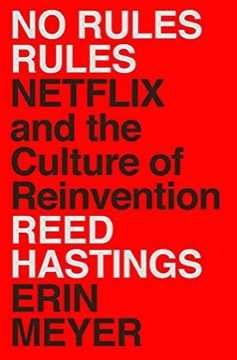
No Rules Rules
Reed Hastings and Erin Meyer's account of Netflix's culture — talent density, radical candour and the removal of controls — written jointly by the chief executive and an academic who interviewed employees independently.
- First published
- 2020
- Publisher
- Diversified Publishing
- Pages
- 320
- Shelf
- Leadership
- Level
- Entry
- ISBN-13
- 9780753553657
Record checked against
Only one source carried a publication date for this work, so the year is uncorroborated.
Catalogue note
- Reads as
- StrategicAbout choosing between options under uncertainty.
- Level
- Accessible / FoundationalNo prior reading assumed.
- Approach
- Applied
- Written for
- Managers, Newcomers to the subject
Saved in this browser only — no account, nothing sent anywhere. My library
Read this if
- You want to understand what makes people willing to follow a decision.
- You are starting or growing a company and want the unglamorous parts.
- You are weighing options and want a way to think about the trade-offs.
- You are starting from scratch here and want a way in that assumes no prior reading.
The sequence, which is the argument
The book's structure is a repeated three-step cycle: increase talent density, then increase candour, then remove a control. Each step is only safe because the previous ones happened.
This ordering is the most important thing in the book and the part most often ignored by imitators, who remove controls first and discover that freedom without talent density and feedback produces chaos rather than performance.
Talent density, then candour, then remove a control. Doing the third without the first two is how this fails.
Devmark’s reading — not a quotation from the book
Talent density
Their foundational claim: a team of consistently excellent performers produces more than a larger team with a mixture, because mediocre performance is contagious and consumes management attention.
Their practice follows brutally — pay at the top of the market, do not run performance improvement processes, and use a generous severance to remove anyone who is merely adequate. The keeper test asks whether you would fight to keep someone who resigned.
The keeper test, examined
The mechanism is honest about what it is: a standing threat that adequate performance results in dismissal, mitigated by a substantial payment.
Meyer's independent interviews surface the cost directly — employees describe persistent anxiety, and the book includes this rather than suppressing it. Whether the trade is worth it is left more open than a purely promotional account would leave it.
Candour
Their feedback practice: frequent, direct, upward as well as downward, and solicited rather than volunteered at moments of the giver's choosing.
Their 4A framework — feedback should aim to assist and be actionable; receiving it should involve appreciation and the choice to accept or discard — is the practical scaffolding, and the explicit permission to discard is what stops it becoming an obligation to comply.
Removing controls
Their signature policies: no vacation policy, no expense policy beyond acting in the company's best interest, no approval chains for most spending.
Their argument is that controls are designed for the small minority who would abuse freedom, and impose a cost on everyone else — and that with sufficient talent density, removing them is cheaper than maintaining them.
Controls exist for the few who would abuse freedom and are paid for by everyone who would not.
Devmark’s reading — not a quotation from the book
Context, not control
Their alternative mechanism for alignment: leaders provide context — strategy, objectives, constraints, the stakes — rather than approving decisions.
Their formulation of the informed captain, where a single named person makes the decision after gathering dissent, addresses the standard failure of consensus cultures, where nobody owns the outcome.
Meyer's contribution
Her role is what distinguishes this from a standard executive memoir. She interviewed employees across countries and includes material that contradicts Hastings, including scepticism about whether the culture travels.
Her cross-cultural analysis — that direct feedback lands very differently in cultures with different norms around confrontation — is the book's most intellectually serious section.
Where it should be read sceptically
It is a company describing its own culture, published while that company was performing well. There is no comparison case, no independent performance attribution, and the people who did not thrive are represented only through the interviews Meyer chose to include.
The model also depends on conditions most companies do not have: enormous margins, a market where top talent is identifiable and purchasable, and work that is genuinely high-leverage per person.
Where it does not travel
The book is honest that the approach suits creative and high-judgement work and is inappropriate where consistency and safety matter more than invention.
Hastings says explicitly that he would not run a hospital or an aircraft manufacturer this way, and readers borrowing the practices should apply the same test to their own context.
What to take from it
The sequencing insight is the durable contribution: freedom is downstream of talent density and candour, and organisations that copy the freedom without the prerequisites reliably fail.
And the keeper test as a self-directed question — would this organisation fight to keep me, and if not, what would have to change — which is more useful applied inward than outward.
What to take away
- 01Freedom comes last in the sequenceTalent density, then candour, then removing controls. Imitators start at the end and get chaos.
- 02Mediocre performance is contagiousAnd it consumes the management attention that would otherwise go to the work.
- 03Feedback must be discardableThe explicit right to reject it is what stops candour becoming an obligation to comply.
- 04Provide context instead of approvalWith a single named decision-maker who gathers dissent, which fixes the consensus-culture ownership problem.
- 05The preconditions are rareEnormous margins, identifiable purchasable talent, and genuinely high-leverage individual work.