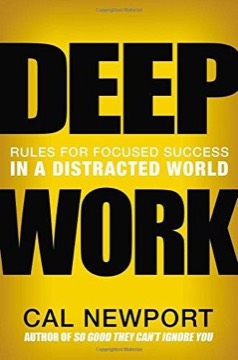
Deep Work
Rules for Focused Success in a Distracted World
Cal Newport argues that the ability to concentrate without distraction on a cognitively demanding task is becoming both more valuable and more rare, and that this combination makes it one of the few genuine advantages left in knowledge work.
- First published
- 2016
- Publisher
- imusti
- Pages
- 303
- Shelf
- Habits
- Level
- Entry
- ISBN-13
- 9783864149351
Record checked against
Catalogue note
- Reads as
- PracticalWritten to be applied, not only understood.
- Level
- Accessible / FoundationalNo prior reading assumed.
- Approach
- Practical
- Written for
- Anyone changing how they work, Newcomers to the subject
Saved in this browser only — no account, nothing sent anywhere. My library
Read this if
- You are losing your attention to things you did not choose.
- You are asking what you should be doing with your working life.
- You want something to apply, not only something to think about.
- You are starting from scratch here and want a way in that assumes no prior reading.
The core idea
Newport divides knowledge work into two kinds. Deep work is performed in a state of distraction-free concentration that pushes cognitive capability to its limit; it creates new value and is hard to replicate. Shallow work is logistical, performable while distracted, and easy to replicate.
His argument has two halves: deep work is becoming more economically valuable as complex skills matter more, and it is becoming rarer as workplaces optimise for responsiveness. Scarcity plus value is the whole thesis.
The ability to concentrate is becoming rarer at exactly the moment it is becoming more valuable.
Devmark’s reading — not a quotation from the book
The problem it addresses
The failure he describes is structural rather than personal. Open offices, instant messaging and an expectation of rapid reply are not accidents; they are the visible output of what Newport calls the metric black hole — the difficulty of measuring the cost of distraction in knowledge work.
Because the cost cannot be measured, organisations default to what looks like activity. Busyness becomes a proxy for productivity precisely where productivity is hardest to see.
Attention residue
The most useful mechanism in the book is attention residue: when you switch tasks, part of your attention stays with the previous one, and performance on the new task suffers for a while.
This reframes the cost of interruption. The damage is not the two minutes spent on the message; it is the degraded state of the following stretch. It also explains why a day fragmented by small interruptions can feel exhausting while producing very little.
Depth as a trainable capacity
Newport treats concentration as a skill that atrophies with disuse rather than a fixed trait. A mind habituated to switching whenever boredom appears cannot simply be told to concentrate.
The practical implication is that depth is trained by removing the escape route: scheduling distraction rather than scheduling focus, so that the default state becomes concentration and distraction becomes the thing that requires an appointment.
Four philosophies of depth
Rather than prescribing one method, Newport offers four. Monastic: eliminate shallow obligations almost entirely. Bimodal: divide time into long stretches of depth and stretches of everything else. Rhythmic: a fixed daily block, the same hours every day. Journalistic: drop into depth whenever a gap appears.
The honest note is that journalistic depth is the hardest and requires a practised mind, while rhythmic is the one most people can actually sustain inside a normal job.
Ritual, and the case for boredom
Newport's rituals are unglamorous and specific: a fixed location, a defined duration, a rule about what is permitted, and a way of supporting the mind — food, walks, sleep. The specificity is the point, because it removes the daily negotiation.
Alongside this sits his argument for embracing boredom. If every idle moment is filled, the reflex to escape discomfort is reinforced all day, and the reflex is what makes concentration difficult when it is finally required.
Do not schedule focus around distraction. Schedule distraction, and let focus be the default.
Devmark’s reading — not a quotation from the book
Quit social media — the narrower claim
The chapter that drew the most reaction makes a more limited argument than its title suggests. Newport's test is the craftsman's approach: identify the factors that determine success in your work, and keep a tool only if its benefits substantially outweigh its costs against those factors.
The point is not that these tools have no value. It is that "some benefit" is too low a bar for something that consumes attention continuously.
Draining the shallows
Newport does not claim shallow work can be eliminated — only that it should be budgeted. He recommends scheduling every minute of the day as a hypothesis to be revised, quantifying the depth of each activity, fixing an end to the working day, and becoming harder to reach.
The most practical suggestion is making people who want your time do more of the work of justifying it, which reduces volume without requiring anyone to be refused.
Where it is contested
The book's advice assumes an unusual degree of control over one's own calendar. For people in roles built on responsiveness — support, clinical work, junior positions, caring responsibilities — much of it is not available, and Newport engages with this only lightly.
A related criticism is that the framing can shade into a moral hierarchy in which collaborative and responsive work is treated as lesser, when for many roles it is the work.
How it has aged
The diagnosis has aged extremely well; if anything the environment has got more hostile to sustained attention since publication. The vocabulary — deep work, shallow work, attention residue — has become standard.
What has aged less well is the assumption of individual control. The most durable reading is that depth is an organisational design problem as much as a personal discipline problem, which is a conclusion the book gestures at more than it argues.
What to take away
- 01Scarcity is the argumentConcentration is valuable because it is rare, and it is rare because workplaces reward responsiveness.
- 02Interruption costs more than it takesAttention residue degrades the stretch after the interruption, not just the minutes during it.
- 03Schedule the distractionMaking focus the default and distraction the exception is the inversion that does the work.
- 04Pick a philosophy you can sustainRhythmic depth — the same hours daily — survives a normal job. Monastic mostly does not.
- 05Budget shallow work, don't deny itThe aim is a known ceiling on the shallow, not its elimination.