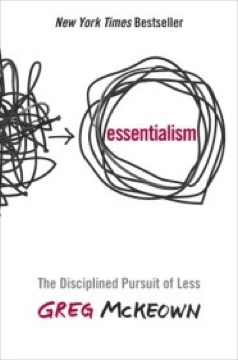
Essentialism
Greg McKeown's argument for the disciplined pursuit of less: that most people spread effort thinly across many things because they have never made saying no a practised skill, and that the alternative is a systematic method for eliminating.
- First published
- 2014
- Publisher
- Currency
- Pages
- 266
- Shelf
- Habits
- Level
- Entry
- ISBN-13
- 9780753555163
Record checked against
Only one source carried a publication date for this work, so the year is uncorroborated.
Catalogue note
- Reads as
- PracticalWritten to be applied, not only understood.
- Level
- Accessible / FoundationalNo prior reading assumed.
- Approach
- Practical
- Written for
- Anyone changing how they work, Newcomers to the subject
- Ideas
Saved in this browser only — no account, nothing sent anywhere. My library
Read this if
- You are losing your attention to things you did not choose.
- You want something to apply, not only something to think about.
- You are starting from scratch here and want a way in that assumes no prior reading.
The core idea
McKeown's distinction is between the Essentialist and the Nonessentialist. The second reacts to whatever arrives, says yes to avoid friction, and makes a millimetre of progress in a million directions. The first pauses to ask which things are genuinely important and deliberately abandons the rest.
The reframing that does the work is a change of question: not "how can I fit this in?" but "what is the one thing I would trade everything else for?"
The question is not how to fit more in. It is what you would trade everything else to protect.
Devmark’s reading — not a quotation from the book
The three assumptions to abandon
McKeown names the beliefs that make overcommitment feel obligatory: I have to; it is all important; I can do both. Each is replaced with a sentence that is harder to argue with: I choose to; only a few things really matter; I can do anything but not everything.
The middle one is the load-bearing claim. If the value of possible activities is very unevenly distributed, then treating them as roughly equal is not balanced but simply inaccurate.
Explore before committing
The counter-intuitive part of the method is that essentialists explore *more* options, not fewer, before committing to any. Narrowing early means committing to whatever happened to be in front of you.
The tools are ordinary and underused: protected time to think, deliberate play, sufficient sleep treated as a performance input rather than a residual, and a habit of looking for the signal in what is already known rather than gathering more.
The 90 per cent rule
The book's most usable single technique. When evaluating an option, identify the single most important criterion and score it out of a hundred. Anything below ninety is a zero.
The rule works because it removes the middle. A merely good option is the real enemy of an excellent one, since it is attractive enough to consume the capacity the better thing would have needed.
Saying no gracefully
McKeown treats refusal as a skill with techniques rather than a matter of nerve: separating the decision from the relationship, offering an alternative, using a pause before answering, and the observation that declining a request is not declining the person.
His most practical point is that the awkwardness of saying no is brief and concentrated, while the cost of saying yes is diffuse and long — which is exactly the shape that makes people choose badly.
Uncommitting
The chapters on reversing existing commitments are the strongest in the book, because this is where most people are actually stuck. He deals directly with sunk cost, the endowment effect, and the status quo bias that keeps a commitment alive purely because it already exists.
The reverse pilot is the sharpest tool here: quietly stop doing something and observe whether anyone notices. Most organisations carry a surprising amount of activity that survives only because nobody has tested it.
Quietly stop it and see who notices. A great deal of work survives only because it was never tested for absence.
Devmark’s reading — not a quotation from the book
Buffer, subtract and progress
Three habits carry the execution section. Build buffers — McKeown's suggestion to add fifty per cent to estimates is crude but corrects a consistent bias. Identify and remove the constraint rather than adding effort elsewhere. And favour small visible progress over large launches.
The advice is unoriginal individually; the contribution is placing it inside a coherent argument about scarcity of attention.
Where it is vulnerable
The most serious criticism is that the method assumes autonomy the reader may not have. Much of the book's advice presumes the power to decline work, which is unevenly distributed and correlates with seniority.
It is also repetitive. The core argument is made early and then restated through many short chapters and anecdotes, which is a common shape in the genre and does not improve the argument.
Where it gets misread
Essentialism is not minimalism and is not about doing less for its own sake. McKeown's argument is about concentration of effort, and an essentialist may work extremely hard — on fewer things.
It is also not an argument against collaboration or service. The book is about which commitments are chosen, not about avoiding obligation, though the aphoristic tone makes the selfish reading easy to arrive at.
What to take from it
Three things transfer cleanly: the 90 per cent rule for new commitments, the reverse pilot for existing ones, and the reframing of every yes as a simultaneous no to everything it displaces.
Best paired with something that handles the constraints McKeown skips — Burkeman's *Four Thousand Weeks* makes the philosophical case for the same conclusion while being considerably more honest about what cannot be declined.
What to take away
- 01Value is unevenly distributedTreating activities as roughly equally important is not balance; it is an inaccurate model.
- 02Below ninety is a zeroA merely good option is the enemy of an excellent one because it consumes the same capacity.
- 03Explore widely, then commit narrowlyNarrowing early commits you to whatever happened to be in front of you at the time.
- 04Run a reverse pilotQuietly stop something and observe. Most organisations carry work that survives only by never being tested.
- 05Every yes is a noThe discomfort of declining is brief and concentrated; the cost of accepting is diffuse and long.