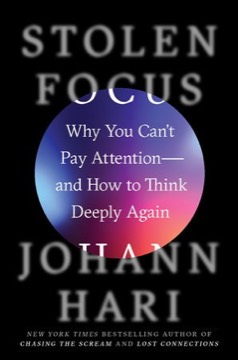
Stolen Focus
Johann Hari on why sustained attention has become harder, arguing that the causes are largely environmental and commercial rather than personal failures of discipline.
- First published
- 2022
- Publisher
- Bloomsbury Publishing Plc
- Pages
- 352
- Shelf
- Mind
- Level
- Core
- ISBN-13
- 9780593138526
Record checked against
Catalogue note
- Reads as
- ConceptualExplains how something works before what to do about it.
- Level
- Core / BuildingAssumes general familiarity with the subject.
- Approach
- Theoretical
- Written for
- Curious general readers, Readers with some grounding
Saved in this browser only — no account, nothing sent anywhere. My library
Read this if
- You are losing your attention to things you did not choose.
- You want to understand how power is taken, kept and lost.
- You want to understand how it works before deciding what to do about it.
- You know roughly how the subject works and want the fuller account.
The argument
Hari's position is that the collapse in attention is not a moral failing to be solved by willpower or app blockers, but the predictable result of an economy that profits from interruption, combined with conditions — sleep deprivation, poor diet, chronic stress, pollution — that independently degrade focus.
He identifies twelve causes, of which surveillance advertising is the one he treats as structural rather than personal.
The argument is that attention was taken rather than lost, and by identifiable parties.
Devmark’s reading — not a quotation from the book
The reporting
The book's method is interview-led across researchers and industry figures, including a much-discussed three-month period Hari spent offline in Provincetown.
The material on flow states, on the effect of sleep loss on attention, and on children's loss of unsupervised play is well sourced. The pieces on attention-span decline in the population are the least secure and were disputed by some of the researchers quoted.
How to take it
Its most useful contribution is the reframe from individual discipline to environment design: changing what is within reach rather than resolving to resist it.
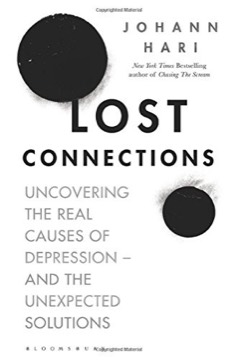
As with Lost Connections, verify the striking claims. Several researchers publicly contested how their work was characterised, and the book is stronger where it reports conditions than where it reports trends.
The reframe from willpower to environment is the durable part; several cited researchers disputed the trend claims.
Devmark’s reading — not a quotation from the book
Twelve causes, not one
Hari organises the book around a list rather than a thesis: speed and switching, the collapse of flow, physical and mental exhaustion, the erosion of sustained reading, technology built to capture attention, chronic stress, diet and pollutants, rising ADHD diagnoses, and the confinement of children. Separating them matters, because the evidence behind each varies considerably.
Switching, not multitasking
The best-supported chapter reports that what people experience as doing two things at once is rapid alternation with a measurable reconfiguration cost each time, and that the cost is paid in errors and in time to resume. This is standard cognitive psychology and the strongest ground the book stands on.
Nobody is doing two things. Everybody is paying a toll to switch between them.
Devmark’s reading — not a quotation from the book
The collective attention study
The finding that topics hold public attention for shorter periods than they used to is frequently reported as proof that individual attention spans have shrunk. It is not the same claim, and the researchers behind it say so. Hari uses it carefully in the text and less carefully in the framing.
Children and play
A strong section argues that the disappearance of unsupervised outdoor play, driven by traffic, parental fear of abduction and the scheduling of childhood into supervised activities, has removed the main setting in which children once practised sustained, self-directed, uninterrupted attention. The argument stands independently of the technology case and does not depend on it, which makes it one of the more durable chapters.
The ADHD chapter
The most contested material questions how much of the rise in diagnosis reflects changed environments rather than changed biology. Clinicians have pushed back hard, warning that the framing can be read as scepticism about a real condition. Hari includes their objections; readers should weigh them rather than take the chapter alone.
Why it ends in politics
The conclusion rejects individual solutions — apps, detoxes, discipline — as inadequate to a problem it argues is structural, and calls for regulation of surveillance-based business models and shorter working hours. It follows logically from the diagnosis and it is where the book stops being about the reader.
How to read Hari
He is a skilled narrative journalist with a documented history of fabricated quotation earlier in his career, and both facts are relevant. The researchers are real and named and the reporting is extensive; the risk is in compression, where a qualified finding becomes a clean story. Check the strong claims before repeating them.
What to take away
- 01Taken, not lostAttention as something extracted by a business model.
- 02Environment over willpowerChange what is reachable rather than resolving to resist it.
- 03Sleep and dietWell-evidenced physical contributors that get little attention.
- 04Play and childhoodThe loss of unsupervised play treated as an attention question.
- 05Disputed trendsSome cited researchers objected to how their work was presented.