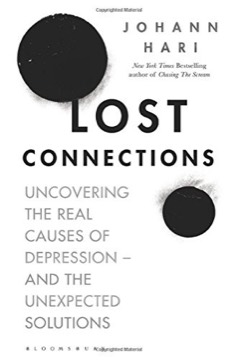
Lost Connections
Johann Hari's argument that depression and anxiety are driven substantially by social and environmental conditions rather than by brain chemistry alone, and that treatment should reflect that.
- First published
- 2018
- Publisher
- Bloomsbury Publishing Plc
- Pages
- 336
- Shelf
- Mind
- Level
- Core
- ISBN-13
- 9781408878705
Record checked against
Only one source carried a publication date for this work, so the year is uncorroborated.
Catalogue note
- Reads as
- ConceptualExplains how something works before what to do about it.
- Level
- Core / BuildingAssumes general familiarity with the subject.
- Approach
- Theoretical
- Written for
- Curious general readers, Readers with some grounding
Saved in this browser only — no account, nothing sent anywhere. My library
Read this if
- You want evidence about why people behave as they do, not folklore.
- You want to understand how power is taken, kept and lost.
- You want to understand how it works before deciding what to do about it.
- You know roughly how the subject works and want the fuller account.
The argument
Hari's case is that the dominant explanation — a chemical imbalance correctable by medication — was always weaker than the public was told, and that it displaced attention from conditions that are well evidenced as causes.
He proposes nine such disconnections, including from meaningful work, from other people, from meaningful values, from status and respect, and from the natural world, alongside genuine biological factors he does not dismiss.
His claim is not that biology is irrelevant. It is that biology was allowed to crowd out everything else.
Devmark’s reading — not a quotation from the book
The strongest material
The chapters on work — drawing on Michael Marmot's Whitehall studies of control and health — and on loneliness, using John Cacioppo's research, are the best evidenced and least contested.
The section on childhood adversity and the ACE studies is similarly solid, and the reporting on Kotti, a Berlin housing protest, is the book's most memorable illustration of a social intervention with a psychological effect.
Where to be careful
Hari's account of antidepressant efficacy is contested by psychiatrists, and the book has been criticised for overstating the case against medication. Hari says explicitly that readers should not stop taking anything, but the framing is more sceptical than the trial evidence supports.
He also has a documented history of fabrication and plagiarism in earlier journalism, which is a fair reason to check claims rather than accept them. Read it as a well-argued case to investigate, not as a settled account.
The author's earlier record is a reason to verify rather than to dismiss, and the sources are given.
Devmark’s reading — not a quotation from the book
The nine causes
Hari organises the book around disconnections rather than deficits: from meaningful work, from other people, from meaningful values, from childhood trauma, from status and respect, from the natural world, and from a secure future — plus two chapters conceding the real but partial role of genes and of changes in the brain. The structure is the argument: depression as something largely happening between a person and their conditions.
Control at work
The strongest evidence he marshals concerns autonomy. Long-running studies of civil servants found that health outcomes tracked position in the hierarchy, with the degree of control a person had over their own work emerging as a better predictor than workload. It supports a specific claim — that powerlessness rather than pressure is the toxic ingredient — and Hari uses it carefully.
It was not how much work. It was how little say.
Devmark’s reading — not a quotation from the book
Childhood and the body's ledger
He draws heavily on research linking adverse experiences in childhood to adult physical and mental illness at dose-dependent rates. The finding is well-replicated and genuinely reframes depression as sometimes a reasonable response to a history rather than a malfunction, though Hari moves faster than the literature does from population correlation to individual explanation.
The antidepressant chapter
The most contested section argues, following a particular meta-analytic tradition, that antidepressant benefit over placebo is smaller than generally believed. Practising psychiatrists pushed back hard on both the reading of the evidence and the framing, and the dispute is real rather than manufactured. Anyone taking medication should read this chapter alongside the criticism of it, not instead.
Where the book ends up
The conclusions are social and political: a rent strike that held a community together, experiments in unconditional income, work redesigned around autonomy, prescriptions for gardening and group activity. It is a coherent consequence of the argument — if the causes are largely environmental, the remedies will be collective — and it is also where the book stops being about the reader.
How to read Hari
He is a persuasive narrative journalist with a documented history of fabricated quotation earlier in his career, and both facts matter here. The book is heavily reported and the underlying researchers are real and named; the risk is in the compression, where a qualified finding becomes a clean story. Check the strong claims against the source before repeating them.
What to take from it
The durable contribution is the widening of the question: if you are miserable, what in your life has been removed — control, company, purpose, security — rather than only what is wrong with you. That reframe is useful and does not require accepting his position on medication.
What to take away
- 01Nine disconnectionsWork, people, values, status, nature and others, framed as causes.
- 02Whitehall and controlMarmot's finding that autonomy at work predicts health outcomes.
- 03Loneliness as physiologyCacioppo's research on isolation as a bodily state.
- 04KottiA Berlin housing protest used as a case of social intervention with mental-health effects.
- 05Contested on medicationThe scepticism runs ahead of the trial evidence; check the sources.