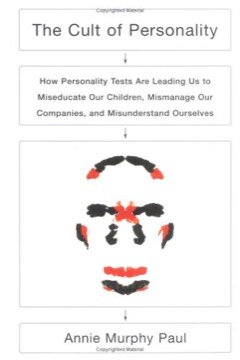
Cult of Personality
Annie Murphy Paul's investigation of personality testing — Myers-Briggs, the Rorschach, and their descendants — and of how instruments with weak evidence came to govern hiring, schooling and self-understanding.
- First published
- 2004
- Publisher
- Free Press
- Pages
- 320
- Shelf
- Business
- Level
- Core
- ISBN-13
- 9780743243568
Record checked against
Only one source carried a publication date for this work, so the year is uncorroborated.
Catalogue note
- Reads as
- StrategicAbout choosing between options under uncertainty.
- Level
- Core / BuildingAssumes general familiarity with the subject.
- Approach
- Applied
- Written for
- Founders and operators, Readers with some grounding
Saved in this browser only — no account, nothing sent anywhere. My library
Read this if
- You want evidence about why people behave as they do, not folklore.
- You want to understand how power is taken, kept and lost.
- You are weighing options and want a way to think about the trade-offs.
- You know roughly how the subject works and want the fuller account.
The argument
Paul's case is that the major personality instruments were built by people without relevant training, on theoretical foundations that were never validated, and that they persist because they are useful commercially and satisfying personally rather than because they work.
Myers-Briggs was constructed by a mother and daughter with no psychological credentials from Jung's untested typology; the Rorschach was a set of inkblots its creator died before validating.
The most-used instrument in corporate life was built by two people with no training in psychology.
Devmark’s reading — not a quotation from the book
The evidence problem
She works through test-retest reliability — a substantial fraction of people get a different Myers-Briggs type weeks later — and through the absence of predictive validity for job performance.
The book also covers the Minnesota Multiphasic Personality Inventory and the use of tests in custody cases and criminal justice, where the stakes make the weak validation considerably more serious.
What survives
Paul is clear that personality research itself is not the target. The five-factor model has genuine empirical support; it is simply not what the commercial instruments measure.
The book is from 2004 and the industry has grown since, which has made it more relevant rather than less. It is the standard sceptical account.
Personality science is fine. The commercial instruments are not measuring it.
Devmark’s reading — not a quotation from the book
Why the tests survive
Paul's answer to the obvious question — if the evidence is this weak, why is the industry this large — is that the instruments sell something the evidence is irrelevant to.
For an organisation they provide a defensible-looking record for decisions that were made on other grounds. For an individual they provide a flattering and non-falsifiable account of the self. Neither purpose requires the test to predict anything.
Where the type indicator came from
Paul's most damaging chapter traces the most widely used personality instrument to a mother and daughter with no training in psychology, who built it from a reading of Jung and marketed it through a personnel office during the Second World War. The origin is not an argument against it, and it explains a great deal about its construction.
It was assembled by two people with no psychological training, from one reading of Jung.
Devmark’s reading — not a quotation from the book
Reliability
The core technical objection she reports is that a substantial proportion of people retake such instruments within weeks and receive a different type, which is fatal for a classification system: a measure that does not return the same answer cannot be measuring a stable property.
Types are not real
A related and more fundamental problem is that the underlying traits these instruments measure are distributed continuously rather than in clumps, with the largest number of people clustered around the middle of each scale. Sorting a continuous distribution into binary categories therefore cuts directly through the densest part of it, so two people scoring one point apart receive opposite labels and are told they are different types.
Rorschach and the projective tests
The chapters on inkblot tests and similar projective instruments document decades of courtroom testimony, clinical diagnosis and child custody decisions made on the basis of evidence with very weak demonstrated validity, alongside sustained professional resistance to admitting as much. This is the book's strongest and most serious material, because the consequences were immediate, irreversible and fell on people with no say in the matter.
Why organisations keep using them
Paul's explanation for the persistence of these instruments is institutional rather than scientific. They supply a defensible-looking, quantified basis for decisions that would otherwise have to be admitted as somebody's judgement, they are extremely profitable to license, and a large certification and consulting industry depends entirely on them. Accuracy, she argues, is simply not the property being purchased.
What she is not arguing
Paul does not claim that personality is unmeasurable or that the field is worthless, and it is worth being clear about that because the book is often summarised as though she does. The five-factor model has substantially better test-retest reliability and predictive validity, and it is the accepted research standard. It is also, notably, not the instrument most workplaces have bought. Her target is bad instruments sold with unearned confidence.
What to take away
- 01Built by amateursMyers-Briggs came from two untrained enthusiasts and an untested typology.
- 02Reliability failureA large share of takers get a different type on retest.
- 03No predictive validityThe tests do not forecast job performance.
- 04High-stakes useCustody and criminal cases rely on instruments with weak validation.
- 05Five factors are differentGenuine personality science exists; the commercial tools are not it.