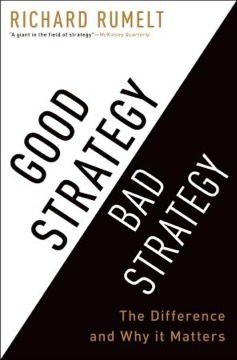
Good Strategy Bad Strategy
Richard Rumelt's argument is that most documents called strategy contain no strategy at all — they are goals, aspirations and slogans — and that real strategy is a specific, arguable claim about why a particular set of actions will work.
- First published
- 2011
- Publisher
- Recorded Books on Brilliance Audio
- Pages
- 329
- Shelf
- Business
- Level
- Core
- ISBN-13
- 9781846684807
Record checked against
Only one source carried a publication date for this work, so the year is uncorroborated.
Catalogue note
- Reads as
- StrategicAbout choosing between options under uncertainty.
- Level
- Core / BuildingAssumes general familiarity with the subject.
- Approach
- Applied
- Written for
- Founders and operators, Readers with some grounding
Saved in this browser only — no account, nothing sent anywhere. My library
Read this if
- You have to choose what not to do, and want a way to think about it.
- You want to decide better when the information is incomplete.
- You are weighing options and want a way to think about the trade-offs.
- You know roughly how the subject works and want the fuller account.
The core idea
Strategy, for Rumelt, is not a goal and not a vision. It is a coherent response to a difficulty: a diagnosis of what is actually in the way, a guiding policy for dealing with it, and coherent actions that carry the policy out. He calls this the kernel, and insists that anything missing one of the three is not strategy.
The definition is deliberately narrow, and its value is in what it excludes. A great deal of what organisations call strategy fails the test immediately.
A strategy is an argument: this is the obstacle, this is how we will get past it, and this is what we will therefore do.
Devmark’s reading — not a quotation from the book
What bad strategy looks like
Rumelt identifies bad strategy by its symptoms rather than its results. Fluff: restating the obvious in inflated language to sound sophisticated. Failure to face the challenge: no diagnosis, so nothing can be evaluated. Mistaking goals for strategy: stating the destination and calling it the route.
The fourth is bad strategic objectives — targets that are unconnected to any theory of what would produce them. His point is that these are not rare failures but the normal output of a process that rewards inclusiveness and optimism over argument.
The kernel: diagnosis
Diagnosis is the step organisations most often skip, and the one that does the most work. A good diagnosis replaces the overwhelming complexity of a situation with a simplified account that identifies what is critical — and in doing so it already implies a class of responses.
Rumelt notes that a diagnosis is a judgement, not a fact, and can be wrong. That is a feature: a diagnosis that could not be wrong is not telling you anything.
The kernel: guiding policy
The guiding policy is the overall approach chosen to cope with the diagnosed obstacle. It is not a goal and not a detailed plan; it rules things out. Its function is to give coherence to the actions that follow, so that they reinforce rather than merely coexist.
A guiding policy that forbids nothing is not a policy. Rumelt is consistently interested in the moment where strategy becomes uncomfortable — the point at which something the organisation likes doing has to stop.
The kernel: coherent action
The third element is the one most often left as an exercise for the reader. Actions must be coordinated with each other, not merely each defensible on its own terms. Rumelt's recurring observation is that organisations produce lists of initiatives that are individually reasonable and collectively incoherent, because each was agreed with a different constituency.
Coherence has a cost: it means some parts of the organisation get less so that others can get more, and that is precisely why it is rare.
A list of good initiatives is not a strategy. Coherence means some of them must lose so others can win.
Devmark’s reading — not a quotation from the book
Leverage, proximate objectives and chain-link systems
Several of Rumelt's sources of power are worth separating. Leverage is the concentration of effort on a pivot point where it will have disproportionate effect. A proximate objective is a goal close enough to be achievable — converting an ambiguous situation into a solvable problem.
Chain-link systems are those whose performance is limited by their weakest link, where improving any other link yields nothing. His conclusion is that such systems cannot be fixed incrementally and require deliberate, simultaneous attention to the constraint.
Why bad strategy persists
Rumelt's explanation is institutional rather than personal. Making a real choice requires saying no inside an organisation, which creates conflict. Template-style strategy — vision, mission, values, objectives — avoids conflict by committing to nothing, and produces a document everyone can sign.
He is also direct about the role of charismatic leadership and of strategy as performance, where the purpose of the document is to reassure rather than to decide.
Thinking like a strategist
The later part of the book is about cognition: how to keep a judgement honest. Rumelt recommends treating your first idea as one candidate among several, constructing an explicit argument for it, and then attacking that argument as an outsider would.
He is particularly good on the problem of the inside view — the tendency to assess a plan by its internal logic rather than by the base rate of similar plans — and on writing the reasoning down, because unwritten reasoning cannot be examined.
Where it is limited
The book is far stronger at diagnosis than at generation. It gives sharp tools for recognising and dismantling bad strategy, and comparatively little method for producing a good one beyond judgement, knowledge and practice. Rumelt would likely say that is honest rather than incomplete.
Its case studies also lean on hindsight, and a reader can fairly ask whether a diagnosis looked as clear at the time as it does in the retelling.
How it has aged
It has aged well, in part because the failure mode it attacks has not gone away. The vocabulary of strategy has continued to inflate, and Rumelt's test — can you state the obstacle, the approach and the actions? — remains the fastest available way to tell whether a document says anything.
Its most portable contribution is a habit rather than a framework: asking, of any plan, what difficulty it is a response to. Plans that cannot answer usually turn out to be wishes.
What to take away
- 01Strategy is a response to a difficultyNo obstacle named, no strategy. A destination without a route is a goal.
- 02Diagnosis is the workSimplifying a messy situation into what is actually critical already narrows the possible responses.
- 03A policy must forbid somethingIf a guiding policy rules nothing out, it is not guiding anything.
- 04Coherence costs something internallyCoordinated action means some parts of the organisation deliberately get less.
- 05Find the chain's weakest linkIn a chain-link system, improving anything but the constraint produces no gain at all.