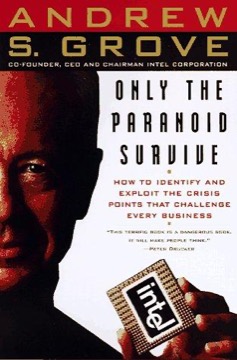
Only the Paranoid Survive
Andy Grove's account of the strategic inflection point — the moment when the fundamentals of a business change so much that the old way of competing stops working — written from inside Intel's exit from the memory business.
- First published
- 1996
- Publisher
- Currency/Doubleday
- Pages
- 217
- Shelf
- Business
- Level
- Core
- ISBN-13
- 9780385483827
Record checked against
Only one source carried a publication date for this work, so the year is uncorroborated.
Catalogue note
- Reads as
- StrategicAbout choosing between options under uncertainty.
- Level
- Core / BuildingAssumes general familiarity with the subject.
- Approach
- Applied
- Written for
- Founders and operators, Readers with some grounding
Saved in this browser only — no account, nothing sent anywhere. My library
Read this if
- You have to choose what not to do, and want a way to think about it.
- You are responsible for other people's work as well as your own.
- You want to understand what technology is doing to how we live.
- You are weighing options and want a way to think about the trade-offs.
- You know roughly how the subject works and want the fuller account.
What a strategic inflection point is
Grove defines it as a time in the life of a business when its fundamentals are about to change: a change of such magnitude that the way the company has competed no longer applies.
His key structural observation is that it is not a single event but a period, and that it is only unambiguously identifiable in retrospect — which is precisely what makes it dangerous.
You can only be certain it was an inflection point afterwards. The decision has to be made before that.
Devmark’s reading — not a quotation from the book
The sixth force
Grove adapts Porter's five forces and adds one he considers decisive: the power, vigour and competence of complementors — businesses whose products make yours more valuable.
His argument is that a change in a complementor's position can reshape an industry as thoroughly as a competitor's, and that companies watch rivals closely while barely noticing the businesses they depend on.
10X change
His test for whether something is an inflection point: has one of the forces become roughly ten times what it was? A competitor ten times stronger, a technology ten times cheaper, a regulatory change of that magnitude.
The number is deliberately imprecise. Its function is to distinguish a change that requires a different strategy from one that requires better execution of the current strategy, which is the distinction managers most often get wrong.
Signal versus noise
Grove is unusually honest about the central difficulty: an inflection point looks exactly like ordinary market noise while it is happening, and acting too early is as costly as acting too late.
His practical guidance is to listen hardest to the people at the periphery — salespeople, engineers close to customers, middle managers — who see the change before the data does, and to notice when your own explanations for bad news are becoming more elaborate.
The Intel memory decision
The book's central case, told from inside. Intel's identity was built on memory, the business was losing to Japanese competitors, and the company spent a long time not deciding.
Grove's account of asking Gordon Moore what a new management brought in from outside would do — and the answer, to get out of memory — is the most quoted passage, and the reason it works is the follow-up: why don't we walk out the door, come back, and do it ourselves?
If a new management would exit the business, what exactly is stopping you from exiting it?
Devmark’s reading — not a quotation from the book
The valley of death
His name for the traverse between the old way of operating and the new one: a period of declining performance, internal disagreement and genuine uncertainty about whether the new direction is right.
Grove's contribution is insisting that the traverse requires a clear picture of the destination communicated relentlessly, because the organisation cannot navigate ambiguity for long and will otherwise drift back.
Disagreement before decision
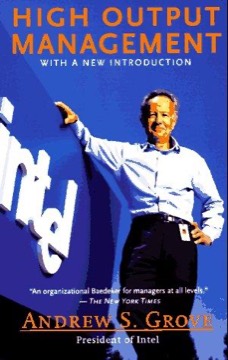
Grove's management practice, consistent with *High Output Management*: encourage vigorous debate while the decision is open, then demand full commitment once it is made.
At an inflection point he argues this is not optional, because the information needed to decide is distributed across people who will not volunteer it in a culture where disagreement is costly.
Career inflection points
The later chapters apply the same model to an individual's working life, arguing that careers have inflection points too and that the same denial mechanisms operate.
This section is thinner than the corporate material and reads as an extension rather than a developed argument, but the core instruction — notice when your skills are becoming ten times less scarce — has aged uncomfortably well.
Where it shows its age
The examples are from the semiconductor and PC industries of the 1980s and 1990s, and several of the illustrative predictions did not come out as Grove expected.
Intel's own later difficulties are also a fair thing to weigh against a book written at the height of its success by the person running it. The framework survives that; the confident tone reads differently now.
Why it holds up
Because it addresses a specific, recurring and badly handled situation: the moment when a company's success formula stops working and everyone can feel it before anyone can prove it.
It is short, written by a practitioner about a decision he actually made, and unusually candid about how long the deciding took. That candour is what distinguishes it from most executive books about vision.
What to take away
- 01Certainty arrives after the decision must be madeAn inflection point is only unambiguous in retrospect, which is what makes it dangerous.
- 02Watch your complementorsCompanies monitor competitors obsessively and barely notice the businesses they depend on.
- 03Apply the 10X testIt separates 'needs a different strategy' from 'needs better execution' — the distinction most often missed.
- 04Ask what a new management would doThen ask what is stopping you from doing that yourself.
- 05Listen to the peripherySalespeople and front-line engineers see the change before it reaches the data.