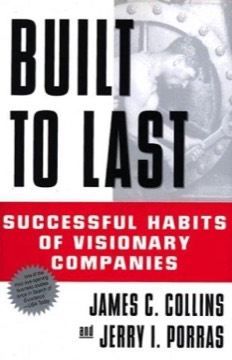
Built to Last
Successful Habits of Visionary Companies
Collins and Jerry Porras's earlier study of eighteen 'visionary' companies that had endured for decades, examining what distinguished them from a comparison company in the same industry founded in the same era.
- First published
- 1994
- Publisher
- William Collins, Sons
- Pages
- 355
- Shelf
- Business
- Level
- Core
- ISBN-13
- 9780060516406
Record checked against
Catalogue note
- Reads as
- StrategicAbout choosing between options under uncertainty.
- Level
- Core / BuildingAssumes general familiarity with the subject.
- Approach
- Applied
- Written for
- Founders and operators, Readers with some grounding
Saved in this browser only — no account, nothing sent anywhere. My library
Read this if
- You are responsible for other people's work as well as your own.
- You are starting or growing a company and want the unglamorous parts.
- You are weighing options and want a way to think about the trade-offs.
- You know roughly how the subject works and want the fuller account.
The design
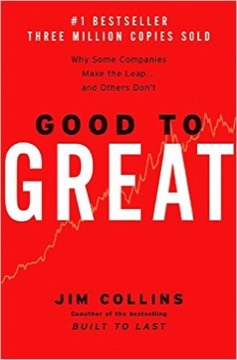
Where *Good to Great* studied a transition, this studies longevity. The criteria were demanding: premier in its industry, widely admired, a lasting imprint on the world, multiple generations of leadership, multiple product cycles, and founded before 1950.
Each visionary company was paired with a comparison founded around the same time in the same business — a control that makes the differences attributable to something other than industry or era.
Every finding is a difference between two companies that started in the same place at the same time.
Devmark’s reading — not a quotation from the book
Clock building, not time telling
The book's organising metaphor. Telling the time is having a great idea or being a charismatic leader; building a clock is creating an organisation that produces great ideas and leaders long after any individual has gone.
The visionary companies were disproportionately clock builders. This reframes the founder's job from having the vision to constructing the thing that keeps generating one.
The Genius of AND
Their term for rejecting what they call the Tyranny of OR — the belief that you must choose between profit and purpose, stability and change, conservatism and boldness.
The visionary companies consistently held both. Collins and Porras argue this is not compromise or balance but an insistence on having both ends of an apparent contradiction, and that the comparison companies more often chose.
Core ideology and the envisioned future
The most influential distinction in the book: core values and core purpose, which do not change, versus practices and strategies, which should change constantly.
Their finding is that *which* values a company holds mattered far less than whether it held them consistently, believed them genuinely, and aligned its behaviour to them. This is an uncomfortable result for anyone hoping the research would identify the right values.
The content of the values mattered less than whether the company actually meant them.
Devmark’s reading — not a quotation from the book
Preserve the core, stimulate progress
The pairing that follows from the ideology distinction, and the book's central operating principle. A visionary company is rigid about its core ideology and relentlessly experimental about everything else.
Most organisational dysfunction, in their reading, comes from getting this backwards: treating practices as sacred and values as negotiable.
Big Hairy Audacious Goals
The acronym that escaped the book. A BHAG is a clear, compelling, long-horizon commitment that requires the organisation to become something it is not yet.
The authors' criteria are stricter than the popular usage: it must be obvious when it has been achieved, it must have a finish line, and it must fall outside the comfort zone while remaining believable. Most corporate BHAGs fail all three.
Cult-like cultures
A deliberately uncomfortable finding: visionary companies were harder places to fit, not easier. They indoctrinated more, screened more tightly, and were more willing to eject people who did not share the ideology.
The authors are careful that this is about fit with the core ideology, not about conformity of thought — but it is the finding readers most often recoil from, and they do not soften it.
Try a lot of stuff and keep what works
Their account of innovation is evolutionary rather than visionary. Several of the most celebrated products in the study emerged from unplanned experimentation rather than from strategic foresight.
The organisational implication is to make experimentation cheap and frequent, accept that most attempts fail, act quickly on what works, and keep the core ideology as the selection criterion.
How it has aged
The same methodological objection applies as to *Good to Great* — selecting on outcome — and the same awkward epilogue: several of the eighteen have since had periods of serious difficulty.
The framework has aged better than the case studies. Core ideology versus practices, preserve-the-core/stimulate-progress, and the clock-building metaphor are now standard vocabulary, used by many who have never read the book.
Which of the two to read
*Built to Last* is about endurance; *Good to Great* is about transition. This is the more conceptual book and the less immediately actionable one.
If you are trying to understand what makes an organisation durable, read this. If you are trying to change one, read the other. Both should be read with the selection-on-outcome caveat firmly in mind.
What to take away
- 01Build the clockThe founder's job is constructing an organisation that keeps producing ideas, not having the idea.
- 02Refuse the either/orThe visionary companies held both ends of apparent contradictions instead of choosing between them.
- 03Consistency beats contentWhich values a company held mattered far less than whether it genuinely held them.
- 04Rigid core, fluid everything elseMost dysfunction comes from reversing this — sacred practices and negotiable values.
- 05A real BHAG has a finish lineIf you cannot tell when it has been achieved, it is an aspiration, not a goal.