The Innovator's Solution
Creating and Sustaining Successful Growth
Christensen and Michael Raynor's follow-up to The Innovator's Dilemma, turning a theory of why incumbents lose into a set of decisions for building a business that grows — written for the manager who has accepted the diagnosis and wants a prescription.
- First published
- 2003
- Publisher
- Harvard Business School Press
- Pages
- 288
- Shelf
- Business
- Level
- Deep
- ISBN-13
- 9781578518524
Record checked against
Only one source carried a publication date for this work, so the year is uncorroborated.
Catalogue note
- Reads as
- StrategicAbout choosing between options under uncertainty.
- Level
- Advanced / AdvancedAssumes you have read around the subject already.
- Approach
- Applied
- Written for
- Founders and operators, Specialists and serious readers
Saved in this browser only — no account, nothing sent anywhere. My library
Read this if
- You are building something new and want to know why most new things fail.
- You have to choose what not to do, and want a way to think about it.
- You are starting or growing a company and want the unglamorous parts.
- You are weighing options and want a way to think about the trade-offs.
- You have read around this already and want a book that assumes it.
The shift from diagnosis to prescription
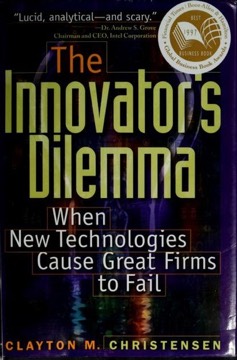
The first book explained why well-run companies are displaced. This one asks the harder question: what should a company do to create disruptive growth deliberately and repeatedly?
The authors are candid that prescription is harder than diagnosis, and that the theory's predictive power is strongest about what will fail rather than what will succeed.
Explaining why incumbents lose is the easier half. This is the attempt at the other one.
Devmark’s reading — not a quotation from the book
Two kinds of disruption
Their most useful addition to the original framework. Low-end disruption attacks the least profitable customers of an incumbent with a good-enough, cheaper offering.
New-market disruption competes against non-consumption, serving people who previously lacked the skill, money or access to do the thing at all. The second is safer, because incumbents feel no pain from losing customers they never had.
Interdependence and modularity
The theory of how industry architecture changes. When a product is not yet good enough, the winning architecture is integrated and proprietary, because performance requires controlling the interfaces.
When it overshoots what customers can use, the basis of competition shifts to speed, convenience and customisation — and modular architectures with standard interfaces win. Profit migrates to wherever the remaining not-good-enough problem sits.
The law of conservation of attractive profits
Their formulation of the above and one of the book's genuinely original ideas: when something becomes modular and commoditised, an adjacent stage of the value chain becomes the constrained one and de-commoditises.
Profit does not disappear; it moves to whatever is now the bottleneck. The strategic instruction is to be positioned where the next constraint will be, not where the current one is.
Commoditisation does not destroy profit. It relocates it to whatever has just become the bottleneck.
Devmark’s reading — not a quotation from the book
Resources, processes and values
Their model of organisational capability, and the most practically useful diagnostic in the book. Resources can be reallocated. Processes are how resources are combined and are much harder to change. Values are the criteria by which priority decisions get made, and are hardest of all.
A company can hire the people for a disruptive business and still fail, because its values — margin thresholds, market-size hurdles — will reject the opportunity at every review.
Good money and bad money
Their argument about capital: money that is patient for growth and impatient for profit is good; money impatient for growth and patient for profit is bad.
The reasoning is that early impatience for profit forces a venture to find a viable business model quickly, while early pressure for scale pushes it to spend before it knows what works — which is the mechanism by which well-funded new ventures fail.
Choosing the customer and the channel
Their guidance on where a disruptive business can be placed: find customers with a job to do who are currently non-consumers, and find a channel whose own economics improve by carrying your product.
The channel argument is underrated. A disruptive product routed through the incumbent's channel will be deprioritised by that channel's own incentives, regardless of how good it is.
The role of senior management
Their prescription is that a chief executive cannot delegate disruptive growth, because every organisational filter is designed to kill it. The sponsor has to be senior enough to override the values.
They also argue for creating separate units with their own cost structures and their own definitions of success — a continuation of the first book's prescription, developed in more operational detail here.
Where it is contested
The same objections as the first book apply, plus one specific to this one: prescription requires prediction, and the theory has proved considerably better at explaining past failures than at identifying future winners.
Christensen's own later ventures applying the theory had mixed results, which is a fair thing for a reader to weigh. The framework is a lens with real explanatory power and a weak track record as a forecasting tool.
How to read it
Denser and less narratively satisfying than *The Innovator's Dilemma*, and genuinely hard going in places. It assumes the first book.
The parts worth the effort are resources/processes/values, the two disruption types, and conservation of attractive profits. Those three transfer to almost any strategic conversation; much of the rest is elaboration.
What to take away
- 01Compete against non-consumptionNew-market disruption is safer because the incumbent feels no pain losing customers it never had.
- 02Profit relocates to the bottleneckWhen one stage commoditises, the adjacent constrained stage de-commoditises. Be positioned there.
- 03Values reject opportunities, not peopleYou can hire the right team and still fail, because the margin and market-size hurdles kill it at review.
- 04Patient for growth, impatient for profitEarly pressure to find a working model beats early pressure to scale one you have not found.
- 05Channels deprioritise by their own economicsA disruptive product in the incumbent's channel loses to that channel's incentives, not to the product.