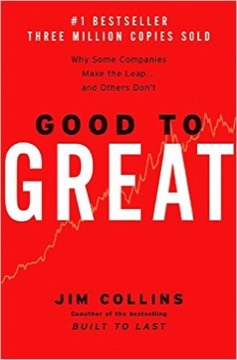
Good to Great
Jim Collins's five-year research project into why a small number of companies made a sustained leap from average to exceptional performance while their direct comparisons did not — and what the eleven that did had in common.
- First published
- 2001
- Publisher
- HarperCollins
- Pages
- 300
- Shelf
- Business
- Level
- Core
- ISBN-13
- 9780694526079
Record checked against
Catalogue note
- Reads as
- StrategicAbout choosing between options under uncertainty.
- Level
- Core / BuildingAssumes general familiarity with the subject.
- Approach
- Applied
- Written for
- Founders and operators, Readers with some grounding
Saved in this browser only — no account, nothing sent anywhere. My library
Read this if
- You are responsible for other people's work as well as your own.
- You are starting or growing a company and want the unglamorous parts.
- You are weighing options and want a way to think about the trade-offs.
- You know roughly how the subject works and want the fuller account.
The question and the method
Collins's team started from a performance screen rather than a hypothesis: companies with fifteen years of average returns followed by fifteen years of returns at least three times the market. Eleven qualified out of 1,435 examined.
Each was paired with a direct comparison — a company in the same industry with similar resources that did not make the leap — and the research asked what was present in one set and absent in the other. The design is the book's main claim to authority, and also where its critics concentrate.
The comparison companies are the experiment. Without them this would be a list of things successful firms also do.
Devmark’s reading — not a quotation from the book
Level 5 leadership
The most counter-intuitive finding. The leaders of the good-to-great companies were not charismatic public figures; they were, in Collins's description, a paradoxical blend of intense professional will and personal humility.
They credited luck and colleagues for success and took responsibility for failure — the inverse of the pattern in the comparison companies. Collins is explicit that he did not expect this and initially told the team to ignore it.
First who, then what
The leap companies got the right people on the team before deciding where to go, on the reasoning that a first-rate team can change direction and a strategy cannot compensate for the wrong people.
Three practical rules follow: when in doubt do not hire; act immediately when you know a personnel change is needed; and put your best people on your biggest opportunities rather than your biggest problems.
Confront the brutal facts
Collins pairs unwavering faith in eventual success with disciplined confrontation of present reality, and names the combination after Admiral James Stockdale, who observed that the optimists in captivity were the ones who did not survive.
The mechanism is organisational: build a climate where the truth is heard, lead with questions rather than answers, and conduct autopsies without blame. A company that cannot hear bad news cannot act on it.
Absolute faith that you will prevail, and absolute honesty about the facts in front of you. Both, at once.
Devmark’s reading — not a quotation from the book
The Hedgehog Concept
The book's central framework: the intersection of what you can be best in the world at, what drives your economic engine, and what you are deeply passionate about.
Collins's sharpest point is the first circle — it is about what you *can* be best at, not what you want to be or currently are. Several comparison companies failed because they mistook a core business for a thing they could excel at.
Culture of discipline
Disciplined people remove the need for hierarchy; disciplined thought removes the need for bureaucracy; disciplined action removes the need for excessive controls.
His most usable prescription is the stop-doing list, which he argues is harder and more valuable than a to-do list, and the observation that the leap companies had a rigorous rather than a ruthless culture — a distinction about standards, not about firing people.
Technology accelerators
Collins found technology was never a cause of the transition but frequently an accelerator of one already underway. The leap companies adopted carefully chosen technologies that fitted the Hedgehog Concept and ignored the rest.
Written during the dot-com period, this was a deliberately unfashionable argument, and it is one of the parts that has aged best.
Flywheel and doom loop
The transition felt to insiders like no single moment — a heavy wheel pushed consistently in one direction until momentum did the work. There was no launch event, no defining programme, no revolution.
The doom loop is the opposite: reaching for a new direction each year, never accumulating momentum, and mistaking the resulting activity for progress.
The serious criticisms
These must be stated. The method selects on the dependent variable — it finds companies that already succeeded and looks backwards — which makes it vulnerable to picking up correlations that would also be found in failures had they been examined.
The harder problem is what happened next. Several of the eleven subsequently struggled badly, and at least one failed outright, which is uncomfortable for a book about *enduring* greatness. Collins addressed some of this in later work; a reader should hold the findings as patterns observed in a period, not as laws.
What survives
The research-design criticism does not dissolve the observations. Level 5 leadership, first-who, the stop-doing list and the flywheel are recognised by practitioners as describing something real, and most of them are actionable regardless of whether the statistical case holds.
Read it as a set of well-articulated hypotheses from a careful observer rather than as a proven formula — and note that the book's own emphasis on confronting brutal facts applies to its own subsequent record.
What to take away
- 01Humility plus will, not charismaThe leaders in the study credited others for success and took the blame for failure — the inverse of their comparisons.
- 02People before directionA first-rate team can change course; a strategy cannot compensate for the wrong people executing it.
- 03Faith and facts togetherUnwavering belief in the outcome alongside unflinching honesty about the present is the combination that survives.
- 04Best at, not best-known forThe Hedgehog Concept asks what you can genuinely excel at, which is often not your existing core business.
- 05Keep a stop-doing listHarder than a to-do list, and the research found it mattered more.