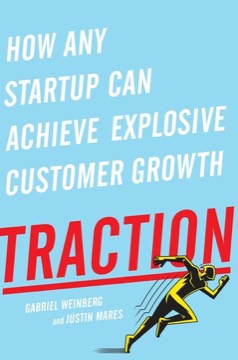
Traction
Gabriel Weinberg and Justin Mares's argument that startups fail as often from neglected distribution as from bad product — and their catalogue of nineteen channels plus a method for finding which one works for you.
- First published
- 2014
- Publisher
- S-curves Publishing
- Pages
- 240
- Shelf
- Business
- Level
- Entry
- ISBN-13
- 9780241242544
Record checked against
Catalogue note
- Reads as
- StrategicAbout choosing between options under uncertainty.
- Level
- Accessible / FoundationalNo prior reading assumed.
- Approach
- Applied
- Written for
- Founders and operators, Newcomers to the subject
- Ideas
Saved in this browser only — no account, nothing sent anywhere. My library
Read this if
- You are starting or growing a company and want the unglamorous parts.
- You are weighing options and want a way to think about the trade-offs.
- You are starting from scratch here and want a way in that assumes no prior reading.
The fifty percent rule
Their central prescription: spend half your time on product and half on traction, from the beginning rather than after launch.
The reasoning is that distribution takes as long to figure out as the product does, that the two inform each other, and that a company which sequences them discovers its distribution problem at the worst possible moment — when the product is finished and the runway is short.
Distribution takes as long to work out as the product. Sequencing them means finding out too late.
Devmark’s reading — not a quotation from the book
Nineteen channels
Their catalogue: viral marketing, PR, unconventional PR, search engine marketing, social and display ads, offline ads, SEO, content marketing, email marketing, engineering as marketing, targeting blogs, business development, sales, affiliate programmes, existing platforms, trade shows, offline events, speaking engagements, and community building.
The list's value is completeness rather than novelty. Its function is to stop a team from considering only the two or three channels they already know.
The Bullseye framework
Their method, in three rings. Outer: brainstorm a plausible idea for every one of the nineteen channels, including the ones that seem obviously wrong. Middle: run cheap tests on the three or four most promising. Inner: focus everything on the one that works.
The insistence on considering all nineteen is the part that does the work, because the channel that ends up working is frequently one the team dismissed without testing.
One channel at a time
Their strongest claim: at any given stage, a single channel usually drives the overwhelming majority of growth, and spreading effort across several produces mediocrity in all of them.
The corollary is that channels saturate and shift. The channel that worked at one stage frequently stops working at the next, which means the Bullseye process is run repeatedly rather than once.
Cheap tests before commitment
Their testing discipline is specific: each test should answer roughly how much a customer costs through that channel, how many customers are available, and whether those are the customers you want — and should cost little enough that a failure is unremarkable.
The common failure they describe is committing a quarter and a budget to a channel on the strength of an assumption, then rationalising the result.
Test cheaply enough that a failed channel is unremarkable. Commitment before evidence forces rationalisation afterwards.
Devmark’s reading — not a quotation from the book
Traction goals
They insist on a single explicit traction goal at any time — a specific number that would represent meaningful progress — and on working backwards from it to what each channel would have to deliver.
This converts channel selection from a preference into arithmetic, and frequently reveals that a favoured channel cannot mathematically reach the goal regardless of how well it is executed.
Engineering as marketing
The chapter most worth reading for technical founders: building free tools, calculators, widgets or micro-sites that attract the audience you want.
Weinberg's own company grew partly this way, and the argument is that engineering capacity is a distribution asset that most technical teams never think to point at acquisition.
Where it is limited
It is a breadth-first book: nineteen chapters, each a short introduction with interview material. No channel is covered deeply enough to execute from, and several have changed substantially since publication — the economics of paid social, SEO and platform channels in particular.
The interview-based structure also means quality varies considerably chapter to chapter.
Where it gets misread
The fifty percent rule is not an instruction to spend half of every day on marketing. It is an argument about attention across the life of the company, and treating it literally produces a half-built product.
The one-channel principle is also sometimes read as "never diversify". Their point is about focus at a stage, not about never developing a second channel once the first is working and saturating.
What to take from it
The Bullseye exercise itself, run honestly — write a specific idea for all nineteen channels including the absurd ones, then rank. It takes an afternoon and reliably surfaces two or three options a team had never considered.
And the arithmetic discipline: state the traction number first, then check which channels could mathematically reach it.
What to take away
- 01Work distribution in parallelIt takes as long to figure out as the product; sequencing them means discovering the problem too late.
- 02Consider all nineteenThe channel that works is frequently one the team dismissed without ever testing it.
- 03One channel dominates at a timeSpreading effort across several produces mediocrity in all of them.
- 04Make failure cheapA test that costs a quarter and a budget forces you to rationalise the result rather than read it.
- 05Start from the numberStating the traction goal first often shows a favoured channel cannot reach it at any level of execution.