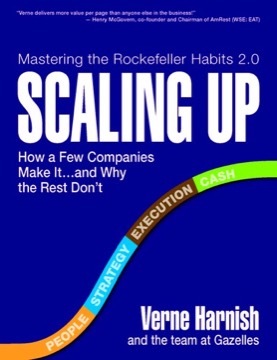
Scaling Up
How a Few Companies Make It… and Why the Rest Don’t
Verne Harnish's operating manual for growing companies, organised around four decisions — People, Strategy, Execution, Cash — and a set of routines for keeping all four moving at once.
- First published
- 2014
- Publisher
- Business Contact
- Pages
- 272
- Shelf
- Business
- Level
- Core
- ISBN-13
- 9780986019555
Record checked against
Only one source carried a publication date for this work, so the year is uncorroborated.
Catalogue note
- Reads as
- PracticalWritten to be applied, not only understood.
- Level
- Core / BuildingAssumes general familiarity with the subject.
- Approach
- Practical
- Written for
- Founders and operators, Readers with some grounding
Saved in this browser only — no account, nothing sent anywhere. My library
Read this if
- You are starting or growing a company and want the unglamorous parts.
- You are responsible for other people's work as well as your own.
- You want something to apply, not only something to think about.
- You know roughly how the subject works and want the fuller account.
The four decisions
Harnish's organising claim is that every growing company is constrained by one of four things at any moment: the right people, a differentiated strategy, flawless execution, or enough cash to survive the growth.
The diagnostic use is the point. A company in trouble usually believes it has an execution problem, and Harnish's framework forces the question of which of the four is actually binding before anyone starts fixing.
Companies almost always diagnose an execution problem. It is usually one of the other three.
Devmark’s reading — not a quotation from the book
The One-Page Strategic Plan
His central artefact: core values, purpose, a long-term target, three-to- five-year goals, annual priorities, quarterly priorities and individual accountabilities, all on a single sheet.
The constraint is deliberate. A plan that does not fit on a page has not had the arguments about priority resolved, and the page forces them into the open rather than allowing everything to be important.
Priorities: the rule of one
Harnish insists on a single top priority per quarter for the company, with three to five supporting ones, and the same structure per person.
His argument is arithmetic rather than motivational: attention is finite, and a list of twelve priorities is a list of zero. The discipline most organisations lack is not the ability to set goals but the willingness to rank them.
The meeting rhythm
The most-adopted part of the book. A daily huddle of five to fifteen minutes, a weekly meeting on one issue, a monthly on learning and development, a quarterly and annual on the plan.
The daily huddle's function is specific and often misunderstood: it exists to surface where people are stuck, not to report status. Harnish's claim is that the speed at which an organisation surfaces and clears blockages determines its growth rate more than any other routine.
The daily huddle is not a status report. It exists to surface where someone is stuck, today.
Devmark’s reading — not a quotation from the book
Data and metrics
His prescription is a small number of leading indicators plus one Critical Number per quarter — the single measure that best represents progress on the top priority.
He pairs it with a counterbalancing metric, on the same reasoning Grove gives: any single number will be optimised in the direction it points, and a company that measures only speed will get speed at the expense of everything else.
Cash, and the cash conversion cycle
The section most often skipped and most often needed. Harnish argues that growth consumes cash, that profitable companies fail for want of working capital, and that the cash conversion cycle is the lever.
His practical instruction is to examine each stage — sales, production, inventory, delivery, billing, collection — for days that can be removed, and to treat that as a standing exercise rather than a crisis response.
People: the topgrading discipline
His hiring guidance borrows heavily from Bradford Smart's topgrading: a structured, chronological interview, scorecards defining outcomes before candidates are seen, and reference checks conducted by the hiring manager.
The related idea is the Function Accountability Chart — one name against every function, on the argument that shared accountability is no accountability.
Where it is derivative
Harnish is a synthesiser, and openly so. Topgrading is Smart's, much of the strategy content descends from Porter and Collins, the meeting rhythm has roots in Patrick Lencioni's work, and the BHAG is from *Built to Last*.
The contribution is assembly rather than origination: a coherent operating system with routines attached. Readers wanting depth on any one component should go to the source.
Where it is limited
It is written for a specific kind of company — roughly ten to several hundred people, growing, in a conventional industry — and the routines assume a degree of stability that early-stage or highly volatile businesses do not have.
It is also heavy. A small team adopting the full apparatus will spend significant time in meetings and on artefacts, and the book does not much acknowledge that the overhead can exceed the benefit below a certain size.
What to take from it
The four-decisions diagnostic is worth an afternoon on its own. So is the cash conversion cycle exercise, which almost no growing company runs routinely and which frequently finds weeks of trapped working capital.
And the daily huddle, adopted in its actual form — blockages, not status — which is the cheapest of the routines and the one with the clearest return.
What to take away
- 01Diagnose which of four is bindingPeople, strategy, execution or cash. Companies reflexively assume execution and are usually wrong.
- 02A plan that needs more than a page…has not had its priority arguments resolved. The constraint forces them into the open.
- 03Twelve priorities is zero prioritiesThe missing discipline is not goal-setting; it is ranking.
- 04Huddle on blockagesHow fast an organisation surfaces and clears what people are stuck on sets its growth rate.
- 05Run the cash conversion cycleProfitable growing companies fail for working capital, and the trapped days are usually findable.