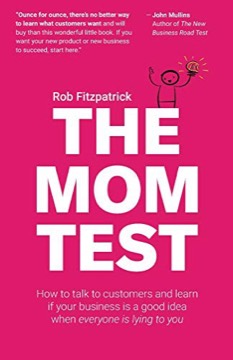
The Mom Test
How to talk to customers and learn if your business is a good idea when everyone is lying to you
Rob Fitzpatrick's short manual on customer conversations: how to ask questions that produce information rather than encouragement, named for the test that even your mother could not lie through.
- First published
- 2014
- Publisher
- CreateSpace
- Pages
- 135
- Shelf
- Business
- Level
- Entry
- ISBN-13
- 9781492180746
Record checked against
Only one source carried a publication date for this work, so the year is uncorroborated.
Catalogue note
- Reads as
- PracticalWritten to be applied, not only understood.
- Level
- Accessible / FoundationalNo prior reading assumed.
- Approach
- Practical
- Written for
- Founders and operators, Newcomers to the subject
Saved in this browser only — no account, nothing sent anywhere. My library
Read this if
- You are building something new and want to know why most new things fail.
- You are starting or growing a company and want the unglamorous parts.
- You want something to apply, not only something to think about.
- You are starting from scratch here and want a way in that assumes no prior reading.
The core rule
The test is simple: frame your questions so that even someone who loves you could not give you a false positive. That means never mentioning your idea, never asking about the future, and never inviting an opinion.
Instead ask about the past, about specifics, and about what the person has already done. "Would you use this?" is worthless; "what did you do the last time this happened?" is evidence.
Ask about their life, not about your idea. The moment you describe it, the data is gone.
Devmark’s reading — not a quotation from the book
What it replaces
Fitzpatrick's target is the validation interview that produces compliments, which founders then report as traction. He is precise about the three bad data types: compliments, generic claims about the future, and hypotheticals.
He also names the fix for each — deflect the compliment, anchor the generic in a specific past instance, and convert the hypothetical into a commitment of time, reputation or money.
Why it is short
The book is under a hundred pages and deliberately without padding. It is a technique, not a framework, and Fitzpatrick has said he kept it short so people would actually finish it before their first interview.
The practical section on advancing a conversation to a real commitment is the part most readers underuse and the part that separates research from polite conversation.
Under a hundred pages, because it exists to be read before a meeting rather than studied.
Devmark’s reading — not a quotation from the book
Good questions and bad questions
The distinction Fitzpatrick keeps returning to is between questions about the respondent's life and questions about your idea. "Do you think it's a good idea?" is unanswerable usefully; "talk me through the last time that happened" is not. The first invites an opinion about a hypothetical, which people supply generously and which predicts nothing. The second asks for a memory, and a memory can be checked against behaviour.
What are you doing about it now
The single question doing most of the work is what the person currently does about the problem. A problem nobody has improvised a workaround for is usually not a problem they will pay to solve. Existing spreadsheets, manual processes, abandoned tools and workarounds are all evidence of real pain; an enthusiastic description of how annoying something is, with no attempt made to fix it, is not.
A problem with no workaround behind it is usually not a problem worth solving.
Devmark’s reading — not a quotation from the book
Commitment as the real signal
Fitzpatrick treats advancement rather than approval as the measurable outcome of a conversation. The currencies he names are time, reputation and money: a scheduled follow-up with preparation attached, an introduction that puts the person's standing at risk, a deposit or a signed intent. A meeting that ends with warm words and no commitment has produced nothing, and he is blunt that founders routinely log it as progress anyway.
Slicing the customer
Much of the book's second half is about segmentation. A group defined as "small businesses" produces contradictory answers because it contains people with nothing in common; the advice is to keep narrowing — by role, by workflow, by the specific moment the problem occurs — until the answers start agreeing with each other. Inconsistent interview results are treated as a symptom of a segment defined too broadly, not of unreliable customers.
When to pitch
The pitch is deliberately placed last. Fitzpatrick's position is that the moment you describe what you are building, the conversation stops being a source of information and becomes a social interaction in which the other person is trying to be kind. That is not an argument against ever pitching; it is an argument for keeping the learning conversation and the selling conversation separate, and for knowing which one you are in.
Where it is limited
This is a book about early qualitative conversations and it does not pretend otherwise. It offers no guidance on sample sizes, on pricing research, on survey design, or on anything quantitative, and its advice is weakest for products where the buyer genuinely cannot describe the need in advance. It also assumes you can reach the right people at all, which for some markets is the harder problem.
What to take from it
Read it before the first customer conversation rather than after twenty of them. The transferable part is not a script but a habit of mind: ask about the past, not the future; treat compliments as a failure signal; and end every conversation by asking for something that costs the other person time, money or reputation. Most of the value arrives in the first sitting.
What to take away
- 01Never mention the ideaDescribing it contaminates everything that follows.
- 02Past, not futureWhat they did is data; what they would do is not.
- 03Three bad data typesCompliments, generic claims and hypotheticals.
- 04Ask for commitmentTime, reputation or money converts talk into signal.
- 05Deliberately shortWritten to be finished before the first customer meeting.