Amp It Up
Frank Slootman's account of raising standards, pace and focus, from a chief executive who led Data Domain, ServiceNow and Snowflake. Blunt, short, and aimed at operators.
- First published
- 2021
- Publisher
- Wiley & Sons, Incorporated, John
- Pages
- 224
- Shelf
- Business
- Level
- Core
- ISBN-13
- 9781394348978
Record checked against
Only one source carried a publication date for this work, so the year is uncorroborated.
Catalogue note
- Reads as
- PracticalWritten to be applied, not only understood.
- Level
- Core / BuildingAssumes general familiarity with the subject.
- Approach
- Practical
- Written for
- Founders and operators, Readers with some grounding
Saved in this browser only — no account, nothing sent anywhere. My library
Read this if
- You are responsible for other people's work as well as your own.
- You are starting or growing a company and want the unglamorous parts.
- You want to understand what makes people willing to follow a decision.
- You want something to apply, not only something to think about.
- You know roughly how the subject works and want the fuller account.
The argument
Slootman's position is that most companies underperform not through strategy error but through tolerance: of slow decisions, of mediocre people, of too many priorities, and of a pace everyone has silently agreed to.
His prescription is to raise expectations before changing anything else, on the grounds that structure, strategy and headcount will not fix a standards problem.
His claim is that most companies are not badly aimed. They are slow, and have agreed to be.
Devmark’s reading — not a quotation from the book
The specifics
Narrow the focus to very few priorities and say so publicly. Increase tempo — he treats speed as a leadership variable rather than a constraint. Align the whole organisation on one mission rather than on departmental goals. Raise the talent bar and act quickly when it is not met.
He is direct about the last point in a way most business books avoid, and readers will divide sharply on it.
Who it is for, and the caveat
This is written for someone running a company or a large function, from experience in high-growth enterprise software. The pattern may not transfer to organisations without that structure or that market.
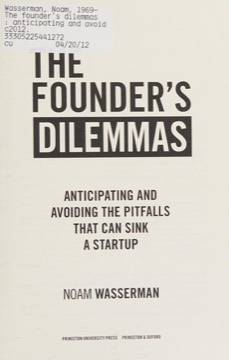
It is also a survivor's account — Slootman succeeded three times and is describing what he did. Read it alongside something evidence-based, such as The Founder's Dilemmas, rather than on its own.
One executive describing what worked for him, three times, in one industry.
Devmark’s reading — not a quotation from the book
Raise standards first
Slootman's sequence matters: standards before strategy, because in his account most organisations already know what to do and are simply doing it at a level they have quietly agreed to accept. His method is to state publicly what good looks like and then decline work that falls below it, on the argument that tolerance is communicated far more clearly by what a leader lets pass than by what they say.
What a leader tolerates is read as the standard, whatever the standard says.
Devmark’s reading — not a quotation from the book
Drivers and passengers
His division of staff is between people who take responsibility for outcomes and people who occupy a role competently. He is unusually direct that a company can carry passengers for a long time without noticing, that the cost shows up as pace rather than as visible failure, and that the correction is uncomfortable and should be made anyway.
Narrowing the focus
The recommendation is fewer priorities than feels responsible — two or three, stated in the same words at every level. His reasoning is that a long priority list is not a plan but a refusal to choose, and that it pushes the choosing downward to people with less context, who then make it inconsistently and invisibly.
Going direct
Drawing on Data Domain and ServiceNow, Slootman argues for controlling the route to the customer rather than delegating it to partners and channels. His case is about information as much as margin: an indirect channel removes the company from the conversation where it would learn what is actually wrong with the product.
Where it is a survivor's account
Everything here is drawn from three enterprise software companies in a favourable market during a long expansion, and the book does not seriously engage with the possibility that some of the outcome was timing. Advice derived from three successes says nothing about how often the same approach preceded a failure, because those companies did not write books.
Where it is limited
The style that makes it fast also makes it thin in places: the treatment of people is blunt to the point of leaving the humane questions unaddressed, and there is little here for anyone outside high-growth enterprise software, or for a leader without the authority to remove people. It is an operator's memo, not a management theory.
What to take from it
The useful residue is small and genuinely portable: name the very few things that matter, say out loud what standard you are holding, and treat speed as a decision someone is making rather than a property of the work. Take the rest as the account of one executive's particular run.
What to take away
- 01Standards firstRaise expectations before restructuring anything.
- 02Pace as a decisionSpeed is treated as a leadership variable, not an external constraint.
- 03Very few prioritiesNarrow the list and state it publicly.
- 04Blunt on talentDirect about acting quickly on underperformance; readers divide on it.
- 05A survivor's accountExperience from one industry, not evidence across many.