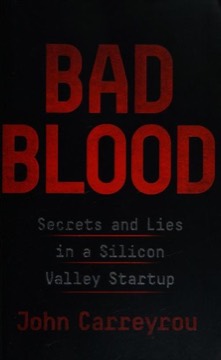
Bad Blood
John Carreyrou's account of Theranos: a blood-testing company valued at nine billion dollars whose core technology never worked, told by the Wall Street Journal reporter who broke the story.
- First published
- 2018
- Publisher
- Penguin Random House USA
- Pages
- 352
- Shelf
- Business
- Level
- Core
- ISBN-13
- 9781509868063
Record checked against
Catalogue note
- Reads as
- ReflectiveChanges how you see rather than what you do.
- Level
- Core / BuildingAssumes general familiarity with the subject.
- Approach
- Theoretical
- Written for
- Founders and operators, Readers with some grounding
Saved in this browser only — no account, nothing sent anywhere. My library
Read this if
- You read for the writing as much as for the argument.
- You want to think harder about what is actually right.
- You are starting or growing a company and want the unglamorous parts.
- You want a book that changes how you see things rather than what you do tomorrow.
- You know roughly how the subject works and want the fuller account.
What happened
Elizabeth Holmes founded Theranos at nineteen promising hundreds of tests from a finger-prick of blood. The company raised enormous sums, built a board of former statesmen, and put its devices into Walgreens pharmacies.
The devices did not work. Most tests were run on modified commercial analysers, results were unreliable, and patients received clinically significant false readings.
The machine never worked. That is not a twist in the story; it is the whole story.
Devmark’s reading — not a quotation from the book
How it held together
Carreyrou's real subject is the machinery of concealment: extreme compartmentalisation so no employee saw the whole picture, aggressive litigation by David Boies against departing staff, non-disclosure agreements, and a board with political weight and no scientific expertise.
The most disturbing thread is the treatment of whistleblowers, particularly Tyler Shultz, whose grandfather George Shultz sat on the board and sided with the company.
Why it matters beyond Theranos
The book is a case study in how venture-stage norms — secrecy, founder deference, valuation as validation — behave when applied to a medical device with patient consequences.
Carreyrou is precise that the ordinary controls all existed and all failed: auditors, regulators, the board, investors, and the press until quite late.
Every control that should have caught this existed. The book is about how each one failed in turn.
Devmark’s reading — not a quotation from the book
How it reads
Reported from the inside with named sources, much of it from people who took real legal risk to talk, and written with the pace of a thriller without fictionalising.
It is the standard account, and the legal outcomes since publication have substantially confirmed it.
Carreyrou also documents what the reporting itself cost, including the pressure applied to him and to the Journal, which makes the book a record of adversarial journalism as well as of corporate fraud.
The device
The technical claim was that a small machine could run hundreds of assays from a finger-prick sample. It never worked. The company ran most patient tests on commercial analysers bought from other manufacturers, diluting the tiny samples to make them usable — which introduced error into the results patients and doctors were acting on.
A board that could not check
The board assembled was extraordinarily distinguished and almost entirely unqualified for the task: former secretaries of state and defence, senior military figures, and no one with expertise in laboratory medicine or diagnostics. Carreyrou treats this as structural rather than incidental — the board supplied credibility to outsiders while being unable to evaluate the core claim.
The board could open any door in Washington and could not read a validation report.
Devmark’s reading — not a quotation from the book
The people who spoke
The book's moral centre is the employees who raised concerns: junior scientists, a lab director, and a young employee whose own grandfather sat on the board. What they faced — surveillance, legal threats, pressure applied through family — is documented in detail, and one senior scientist took his own life while under sustained pressure.
The legal machine
A substantial portion of the narrative concerns the use of aggressive counsel and expansive confidentiality agreements to deter departing staff, silence sources and pressure the reporting itself. Carreyrou is describing tactics used against him while he was reporting, which gives the book an unusual and openly stated position.
Where the regulators were
The company operated partly through a regulatory route with lighter oversight for laboratory-developed tests, and the definitive intervention came only after a federal inspection led to results being voided and the lab's certification withdrawn. The gap the book identifies is between how medical devices are regulated and how laboratory services are.
What happened afterwards
The narrative ends before the legal conclusion, because the book was published while the case was still unfolding. Both principals were subsequently tried in separate proceedings, convicted on multiple counts of fraud, and sentenced to multi-year prison terms. Readers coming to the book now should know that the ending it could not report has since arrived, and that the reporting it contains was substantially vindicated by what followed in court.
What to take from it
The transferable lesson is not that one founder deceived people but that every mechanism designed to catch it failed simultaneously: investors who did not demand validation, a board that could not assess, partners who did not verify, and a regulatory seam. It is a control-failure case study that happens to have a compelling villain.
What to take away
- 01It never workedThe central technology failed throughout, not late.
- 02CompartmentalisationNo employee could see enough to raise a whole objection.
- 03Legal intimidationBoies's firm used against departing staff and sources.
- 04A board without expertisePolitical weight substituted for scientific scrutiny.
- 05Every control failedAuditors, regulators, investors and press, in sequence.