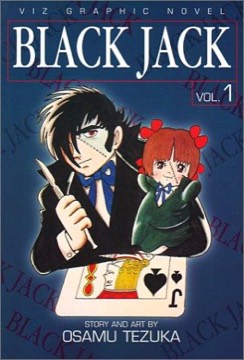
Black Jack
Osamu Tezuka's series, begun in 1973, about an unlicensed surgeon of extraordinary skill who charges enormous fees and answers to nobody. Tezuka's most sustained adult work.
- First published
- 1973
- Publisher
- Vertical
- Pages
- 232
- Shelf
- Anime
- Level
- Core
- ISBN-13
- 9789571319001
Record checked against
Catalogue note
- Reads as
- ReflectiveChanges how you see rather than what you do.
- Level
- Core / BuildingAssumes general familiarity with the subject.
- Approach
- Theoretical
- Written for
- Readers of comics, and anyone curious how the form works, Readers with some grounding
Saved in this browser only — no account, nothing sent anywhere. My library
Read this if
- You read for the writing as much as for the argument.
- You want to understand living things by how they came to be.
- You want to think harder about what is actually right.
- You want a book that changes how you see things rather than what you do tomorrow.
- You know roughly how the subject works and want the fuller account.
What it is
Black Jack is a surgeon who operates without a licence, accepts cases no hospital will touch, and demands sums that are frequently absurd. His face is scarred and partly discoloured from a childhood explosion, and he is assisted by Pinoko, a character with her own strange origin.
Each chapter is a self-contained case, usually running around twenty pages, and the series comprises several hundred of them.
The best surgeon alive, unlicensed by choice, and expensive on principle.
Devmark’s reading — not a quotation from the book
The fee as a device
The enormous prices are the series' central mechanism. Black Jack names a sum designed to establish what the patient or their family actually values, and the answer frequently matters more than the operation.
He also waives the fee without explanation, or spends it immediately on something nobody sees. The money is a diagnostic tool applied to everyone except the patient's body.
Tezuka's medical training
Tezuka qualified as a physician and never practised, and the surgical detail here is grounded in that training: procedures are named, anatomy is drawn with real attention, and the limits of what is possible are usually respected.
When the series departs into impossibility it does so deliberately and signals it, which keeps the grounded cases credible.
The argument with medicine
The series is consistently hostile to institutional medicine — hospital politics, licensing boards, doctors protecting reputations, research prioritised over patients.
Black Jack's illegality is the point. He can act on the patient in front of him because he has nothing to lose, and the series argues that the profession's structures routinely prevent exactly that.
Death and its limits
A recurring counterweight is Dr Kiriko, a physician who performs euthanasia and argues that relieving suffering is a legitimate medical end.
Their encounters are the series' best material. Tezuka does not let Black Jack win these arguments cleanly, and several chapters end with the surgeon's position looking like stubbornness rather than principle.
Pinoko
Assembled by Black Jack from a teratoma removed from a patient, Pinoko has an adult's history, a child's body and a claim to be his wife that he does not accept.
She is a comic character with genuinely disturbing origins, and the series uses her to keep raising the question of what constitutes a person — the same question Astro Boy asks in a different register.
Structure and reading order
The chapters are independent and were not written to be read in sequence, which makes the series unusually easy to sample.
English collected editions present a selection in a partly chronological arrangement with Tezuka's notes, and no chapter depends on knowing another, though a few recurring characters accumulate history.
Tone
It alternates between medical procedural, melodrama, black comedy and outright horror, sometimes inside a single case.
The instability is characteristic of Tezuka and is used well here: a chapter can open as farce and close with a death treated entirely seriously, and the shift is rarely signalled in advance.
The art
Cartoon figures perform surgery drawn with clinical realism, and the juxtaposition is deliberately jarring — a rubbery, round-faced character opening a precisely rendered abdomen.
Tezuka uses the contrast to license material that a realistic style would have made unbearable, which is one of the medium's genuine formal advantages.
What it argues
Across hundreds of chapters a consistent position emerges: medicine cannot decide what a life is worth, patients are owed honesty more than comfort, and institutions reliably protect themselves first.
None of this is delivered as a speech. It accumulates from cases, which is why the series holds up better than a more explicitly polemical work would.
Its standing
It is generally considered Tezuka's most widely read mature work and has been adapted repeatedly for television and film across five decades.
Among practising physicians in Japan it has an unusual reputation, with surveys periodically finding doctors who cite it as an early influence on their choice of profession.
Reading it now
It is the most immediately approachable of Tezuka's adult series: short chapters, clear premises, no continuity to track, and a protagonist whose appeal survives translation intact.
Readers should expect graphic surgical imagery and a number of chapters that end badly. The series is not sentimental about outcomes.
What to take away
- 01The fee as diagnosisEnormous prices are set to establish what a family actually values, and the answer usually matters more than the surgery.
- 02Illegality as the enabling conditionOperating without a licence lets him act for the patient in front of him, which the series argues institutions prevent.
- 03An argument he does not winDr Kiriko's case for euthanasia is given real force, and several chapters leave Black Jack looking merely stubborn.
- 04Cartoon figures, clinical anatomyThe stylistic mismatch licenses material a realistic style could not carry, which is a genuine formal advantage of the medium.
- 05Position built from casesThe series never delivers its ethics as a speech; the argument accumulates across hundreds of independent chapters.
- 06Personhood, asked againPinoko's origin puts the same question as Astro Boy — what makes someone a person — in a comic and more disturbing register.