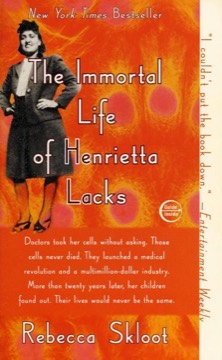
The Immortal Life of Henrietta Lacks
Rebecca Skloot's account of the woman whose cells were taken without her knowledge in 1951 and became the first immortal human cell line — and of the family who learned about it two decades later and could not afford healthcare.
- First published
- 2010
- Publisher
- Crown
- Pages
- 381
- Shelf
- Science
- Level
- Entry
- ISBN-13
- 9780330426237
Record checked against
Catalogue note
- Reads as
- ReflectiveChanges how you see rather than what you do.
- Level
- Accessible / FoundationalNo prior reading assumed.
- Approach
- Theoretical
- Written for
- Curious general readers, Newcomers to the subject
Saved in this browser only — no account, nothing sent anywhere. My library
Read this if
- You want to understand living things by how they came to be.
- You want to think harder about what is actually right.
- You read for the writing as much as for the argument.
- You want a book that changes how you see things rather than what you do tomorrow.
- You are starting from scratch here and want a way in that assumes no prior reading.
Who she was
Henrietta Lacks was a young Black woman, a tobacco farmer's descendant and a mother of five, who went to Johns Hopkins with cervical cancer and died months later. A sample of her tumour was taken during treatment without her knowledge or consent.
The book's first achievement is restoring her as a person. For decades the cell line was known by its code and the woman behind it was misnamed in the literature when she was named at all.
For decades she was a code, and misnamed in the literature when she was named at all.
Devmark’s reading — not a quotation from the book
What HeLa made possible
Her cells were the first human cells to grow indefinitely in culture, and they became the standard material for an enormous amount of biomedical research.
They were used in developing the polio vaccine, in work on cancer, viruses, radiation and gene mapping, in cosmetics and drug testing, and they have been sent into space. It is difficult to overstate how much twentieth- century biology depended on this one line.
Taken without consent
The central fact, and Skloot handles its context carefully. In 1951 there was no requirement to obtain consent for research use of discarded tissue, and the practice was routine rather than exceptional.
The absence of a rule does not dispose of the question. The book's argument is that the practice was built on an asymmetry — between a public-ward patient and a research institution — that the law's silence simply permitted.
Race and the Hopkins context
Her treatment took place in a segregated hospital, in a city and a period with a documented history of medical experimentation on Black Americans without consent.
Skloot neither claims the cells were taken because she was Black nor ignores the context. She documents the family's well-founded suspicion of medical institutions and traces where that suspicion came from, including the Tuskegee study and the local rumours that preceded it.
The family
Roughly half the book is the present-day narrative: Skloot's decade-long relationship with Henrietta's children, particularly her daughter Deborah, who wanted to understand what had happened to her mother.
This is the book's real subject. The family learned about the cells in the 1970s when researchers sought their blood, were never told clearly what was happening, and lived with a mixture of pride, confusion and anger while unable to afford medical care themselves.
Deborah
Her daughter is the book's central figure after Henrietta. Her search for information about a mother she could not remember, her fear about what the cells meant, and her difficulty getting straight answers from the institutions involved drive the narrative.
Skloot's decision to include her own role — the negotiation, the trust built slowly, the moments where she was part of the story — is what makes the reporting honest rather than extractive.
Skloot includes her own presence in the story, which is what keeps the reporting from repeating the extraction.
Devmark’s reading — not a quotation from the book
The consent question in law
Skloot traces the legal developments, including the Moore case, in which a court held that a patient did not retain property rights in cells removed from their body.
The resulting position — that tissue can be commercialised without the donor sharing in the proceeds — remains substantially the law, and the book lays out the arguments on both sides rather than asserting an answer.
What changed afterwards
The book's publication brought sustained attention, and subsequent developments included an agreement giving family members a role in decisions about access to the HeLa genome data.
Those changes came more than sixty years after the cells were taken, which is the fact the book leaves the reader holding.
The criticism
Some critics have questioned whether a white journalist telling this story reproduces the dynamic it describes, and whether the family's cooperation was fully informed about what the book would become.
Skloot established a foundation directing proceeds to the family and to descendants of others in similar situations, which is a partial answer rather than a complete one, and the question is worth carrying while reading.
Why it matters beyond the case
It made research ethics a subject of general public attention rather than a specialist concern, and it is now standard reading in medical and bioethics education.
Its underlying question — who benefits from research conducted on material taken from people who were never asked — has become more pressing rather than less as biobanks and genomic databases have grown.
What to take away
- 01No rule existed, which does not settle itThe practice was legal and routine, and rested on an asymmetry the law simply permitted.
- 02Enormous science from one unasked womanPolio vaccine work, virology, cancer research and gene mapping all depended on this line.
- 03The family could not afford careThat contrast, held for decades, is the fact the book is organised around.
- 04Tissue can be commercialised without youThe Moore decision left that position substantially in place, and it has not been revisited.
- 05The suspicion was earnedThe family's distrust of medical institutions has a documented history behind it, which the book traces.