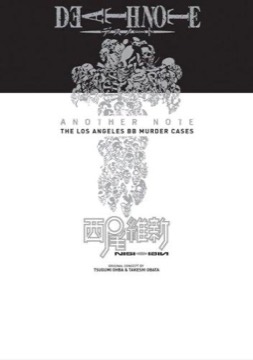
Death Note
Tsugumi Ohba and Takeshi Obata's series, begun in 2003, in which a gifted student finds a notebook that kills anyone whose name is written in it. A thriller conducted almost entirely in argument.
- First published
- 2003
- Publisher
- Shueisha, Viz Media
- Pages
- 176
- Shelf
- Anime
- Level
- Entry
- ISBN-13
- 9781421518831
Record checked against
Catalogue note
- Reads as
- ReflectiveChanges how you see rather than what you do.
- Level
- Accessible / FoundationalNo prior reading assumed.
- Approach
- Theoretical
- Written for
- Readers of comics, and anyone curious how the form works, Newcomers to the subject
Saved in this browser only — no account, nothing sent anywhere. My library
Read this if
- You read for the writing as much as for the argument.
- You want to think harder about what is actually right.
- You want to be kept up late, and made uneasy about who to believe.
- You want a book that changes how you see things rather than what you do tomorrow.
- You are starting from scratch here and want a way in that assumes no prior reading.
What it is
Light Yagami, a high-achieving and profoundly bored student, picks up a notebook dropped deliberately by a bored god of death. Anyone whose name he writes in it dies, provided he knows their face.
He begins killing convicted criminals, the world notices a pattern, and an anonymous detective known as L is assigned to find him. The series is the contest between them.
A notebook that kills, and two extremely clever people trying to out-think each other with it.
Devmark’s reading — not a quotation from the book
A thriller made of reasoning
There is almost no physical action. The series proceeds through deduction, counter-deduction, surveillance, entrapment and the anticipation of an opponent's anticipation, frequently several layers deep.
Ohba's construction is genuinely tight for the first half: each move is established before it is used, and the reader is given the information needed to follow rather than merely to be surprised.
The rules
The notebook's mechanics are specified in detail — conditions, time limits, the effect of writing a cause of death — and the rules are printed in the volumes themselves.
This is the series' most important structural decision. A power with exact limits can be defeated by ingenuity, and almost every turn in the plot is a consequence of somebody reading the rules more carefully than someone else.
Light as protagonist
He is intelligent, vain, and convinced that his judgement about who deserves to live is sound, and the series lets him be the viewpoint character without endorsing him.
The reader is placed in the uncomfortable position of following his reasoning, hoping his plans work, and watching him become something considerably worse than the criminals he began with.
L
The detective is eccentric, physically peculiar, socially impossible and the only person in the world capable of matching Light.
He is also willing to use methods that are indefensible — surveillance without warrant, detention without charge, the use of people as bait — and the series is careful that the reader's sympathy for him is not comfortable either.
The moral argument
The question is whether a sufficiently effective extrajudicial killing programme could be justified by results, and the series is more balanced on this than its reputation suggests.
Crime does fall. Ordinary people do support it. The book does not make the case easy by having the policy fail, and the objection it eventually mounts is about what the policy requires of the person running it.
Obata's drawing
Realistic, meticulous and heavily rendered, with a great deal of attention to hands, posture and the small physical business of thinking.
The visual style is doing serious work: a series of conversations needs dramatic staging, and Obata supplies it with extreme angles, dense shadow and the occasional full-page composition of someone simply deciding something.
The shinigami
Ryuk, the god of death who dropped the notebook, is bored, amoral and explicitly not on anyone's side, and his commentary is the series' only consistent humour.
He also functions as a formal device, since his presence lets the narrative explain rules and observe Light without anyone in the story knowing what he sees.
The second half
After a major turn roughly halfway through, the series introduces new antagonists and a longer investigation, and the general view is that the tension never fully recovers.
Ohba has acknowledged that the original plan was shorter. The later volumes are still well constructed and have a noticeably harder time generating the same pressure.
Its cultural position
It is among the most widely read manga outside Japan and has been banned in several schools and jurisdictions after students produced imitation notebooks.
The reaction is a reasonable index of its effect. Very few comics have provoked institutional responses on that scale, and the anxiety was about the moral premise rather than about violence.
Adaptations
A thirty-seven-episode animated series follows the manga closely and is the form most international readers encounter first. There are also Japanese live action films, a musical, and a Netflix adaptation that relocates the story to Seattle and is generally regarded as a failure.
The manga remains the best version, chiefly because its pacing lets each deduction be laid out fully rather than summarised.
Who it is for
Readers who want a tightly plotted intellectual thriller and do not require action, and readers curious about how much tension can be generated by two people thinking at each other.
It is twelve volumes, entirely self-contained, and requires no knowledge of the medium's conventions. It is one of the most common first manga for adult readers arriving from crime fiction, and the recommendation is sound.
What to take away
- 01Deduction instead of actionThe series generates its tension almost entirely through reasoning and anticipation, with barely any physical confrontation.
- 02Exact rules make ingenuity possibleThe notebook's mechanics are specified precisely, so nearly every plot turn comes from someone reading them more carefully.
- 03A viewpoint without endorsementThe reader follows Light's plans and hopes they work, while watching him become worse than the people he started with.
- 04Neither side is comfortableL's methods — warrantless surveillance, detention, using people as bait — deny the reader an easy alternative to root for.
- 05The argument taken seriouslyCrime does fall and the public does approve, so the objection has to be about what the policy requires of its operator.
- 06Drawing that stages thoughtObata's extreme angles and dense shadow supply dramatic weight to what is structurally a series of conversations.