Blade of the Immortal
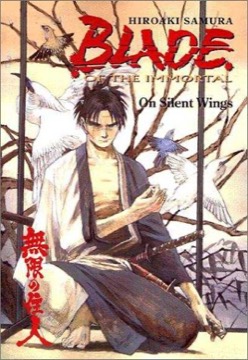
Hiroaki Samura's series, begun in 1993, about a swordsman cursed with immortality who agrees to kill a hundred evil men to be released from it.
- First published
- 1993
- Publisher
- Dark Horse Manga
- Pages
- 192
- Shelf
- Anime
- Level
- Core
- ISBN-13
- 9781415612156
Record checked against
Catalogue note
- Reads as
- ReflectiveChanges how you see rather than what you do.
- Level
- Core / BuildingAssumes general familiarity with the subject.
- Approach
- Theoretical
- Written for
- Readers of comics, and anyone curious how the form works, Readers with some grounding
Saved in this browser only — no account, nothing sent anywhere. My library
Read this if
- You read for the writing as much as for the argument.
- You want to think harder about what is actually right.
- You want a book that changes how you see things rather than what you do tomorrow.
- You know roughly how the subject works and want the fuller account.
What it is
Manji cannot die: an infestation of sacred bloodworms repairs any injury, including decapitation. Cursed with this after killing a hundred men, including his sister's husband, he is told he may be released by killing a hundred evil ones.
He becomes bodyguard to Rin, a teenage girl pursuing the school of swordsmen who murdered her parents, and the series follows their long revenge.
Immortality offered as a punishment, with a hundred killings as the way out.
Devmark’s reading — not a quotation from the book
Samura's drawing
The art is unusual in the medium: pencil textures left visible, heavy cross-hatching, figures that shift between careful realism and deliberate crudity.
Samura studied fine art and the influence is direct. Several sequences use techniques closer to printmaking than to commercial comics, and the roughness is a choice rather than a limitation.
Violence and dismemberment
The combat is exceptionally graphic, with limbs removed and reattached, and the series takes clinical interest in what an immortal body looks like after sustained damage.
The immortality permits a level of injury the genre otherwise cannot show, and Samura uses that licence fully. Samura draws the reassembly as carefully as the damage, which is considerably more disturbing than the fights themselves.
The antagonists
The Ittō-ryū, the school Rin is hunting, is given a coherent philosophy about the corruption of swordsmanship into ritual, and several of its members are more sympathetic than the protagonists.
This is the series' best structural decision. The revenge target is a group of individuals with arguments, and killing them becomes progressively harder to feel good about.
Rin
She is fourteen at the start, physically overmatched in every confrontation, and the series is honest that her revenge is a child's project pursued by an adult's means.
Her development away from it, and her growing discomfort with what Manji does on her behalf, is the emotional spine of the work.
Immortality as a subject
Manji cannot be released by death and has no expectation of peace, and the series treats the inability to end as a genuine horror rather than as a power.
The bloodworms are described with enough physiological detail to be unpleasant, and the condition is written as a chronic illness as much as a curse.
Historical setting
The late Tokugawa period supplies the swordsmanship schools, the shogunate's interest in controlling them, and a bureaucracy that becomes increasingly important as the series proceeds.
The history is loose — Samura has been open about anachronism, including clothing and weapons that did not exist — and the setting is atmosphere rather than reconstruction.
Structure
Thirty volumes, with long arcs that periodically stall and a substantial prison sequence in the middle that divides readers sharply.
The pacing is uneven. The first ten and last six volumes are the strongest, and the middle section is where most readers who abandon it do so.
Women in the series
Several of the strongest characters are women with genuine agency, and the series is more interested in them than most period action manga.
It also contains sexual violence used as backstory more than once, handled with varying degrees of care, and readers should expect it.
The ending
It resolves the revenge plot and the immortality question, and the final volumes are considerably quieter than what precedes them.
Samura brings it to a genuine conclusion rather than a pause, which is not something every long series in this section manages. The last volumes trade spectacle for consequence, and several long-running characters are given quiet exits rather than duels.
Editions
Dark Horse published it over many years in volumes that were originally flipped to read left-to-right, with panels rearranged.
Later omnibus editions restore the original orientation. The flipped edition is best avoided, since Samura's page compositions are frequently asymmetric by design. The omnibus volumes are also better printed, and Samura's greys survive the reproduction in a way the early paperbacks never managed.
Who it is for
Readers who want the most visually distinctive drawing in period action manga and can accept extreme graphic content.
Readers looking for historical accuracy should be aware that the series is not attempting it, and readers looking for consistent pacing across thirty volumes will not find that either.
What to take away
- 01Immortality as chronic conditionThe bloodworms are described physiologically and the inability to die is written as an illness rather than a power.
- 02Antagonists with a philosophyThe Ittō-ryū have a coherent argument about swordsmanship becoming ritual, and several are more sympathetic than the leads.
- 03A child's revenge by adult meansRin is fourteen and overmatched, and her growing discomfort with what is done on her behalf is the emotional spine.
- 04Fine-art technique in a weeklyVisible pencil, heavy hatching and printmaking methods make the drawing unlike anything else in the genre.
- 05Licence to show damageAn immortal body permits injuries the genre otherwise cannot depict, and Samura uses that fully.
- 06A genuine endingThirty volumes reach an actual conclusion rather than a hiatus, which several comparable series never manage.