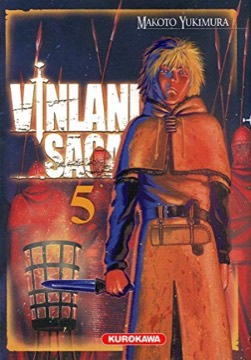
Vinland Saga
Makoto Yukimura's series, begun in 2005, following a boy raised among Viking mercenaries to avenge his father, and what he does after revenge stops being possible.
- First published
- 2005
- Publisher
- KUROKAWA
- Pages
- 208
- Shelf
- Anime
- Level
- Core
- ISBN-13
- 9782351423592
Record checked against
Catalogue note
- Reads as
- ReflectiveChanges how you see rather than what you do.
- Level
- Core / BuildingAssumes general familiarity with the subject.
- Approach
- Theoretical
- Written for
- Readers of comics, and anyone curious how the form works, Readers with some grounding
Saved in this browser only — no account, nothing sent anywhere. My library
Read this if
- You read for the writing as much as for the argument.
- You want to think harder about what is actually right.
- You want a book that changes how you see things rather than what you do tomorrow.
- You know roughly how the subject works and want the fuller account.
What it is
Thorfinn is the son of a former Jomsviking who left the warrior life for a farm in Iceland. When his father is killed by a mercenary commander, the boy attaches himself to the killer's band, demanding duels as payment for service.
The series follows him through eleventh-century Scandinavia and England, and then somewhere the premise does not predict.
He spends years serving the man who killed his father, waiting for a duel that will settle nothing.
Devmark’s reading — not a quotation from the book
The turn
Roughly a third of the way through, the revenge narrative ends, and what follows is a much longer story about a man with no purpose attempting to build one.
The shift is the series' defining decision and the reason it is held in the regard it is. The second part is slower, quieter and considerably more ambitious.
Askeladd
The mercenary commander is intelligent, cynical, politically ambitious and by some distance the most compelling character in the first part.
He is also a genuine antagonist rather than a misunderstood one, and the series resists softening him even while making him impossible to dismiss. His relationship with Thorfinn is the series' best writing, and his eventual exit reshapes the entire work.
Violence and its rejection
The first part is extremely violent and the second is substantially about refusing violence, with Thorfinn adopting a position that the setting makes almost unworkable.
Yukimura takes the difficulty seriously. Pacifism here is not presented as easy or as obviously correct, and it costs the people who attempt it a great deal.
The historical material
The Danish conquest of England, Cnut's rise, Scandinavian farming and slavery, and the economics of a mercenary band are all researched carefully.
Several major figures are historical, and the series takes real positions on their motivations while remaining clear about where it is inventing. Yukimura includes afterword notes discussing his sources and his departures from them, which is unusual and welcome.
Slavery
The middle section is set on a farm worked by slaves, and the series treats the institution as central to the period's economy rather than as background.
This arc is among the series' best material and is where its argument about violence, ownership and worth is made most directly.
Cnut
The young prince's transformation across the series — from a timid boy into something much harder — runs parallel to Thorfinn's and moves in the opposite direction.
The pairing is deliberate. Both are responding to the same losses and arrive at incompatible conclusions about what a person should do with power.
The art
Yukimura's drawing is detailed, weighty and exceptionally good at landscape, weather and the physical labour of the period.
The action is brutal and legible, and the farming sequences are drawn with the same care as the battles, which is itself an argument. The faces in particular carry a great deal, and Thorfinn's changes across the series are tracked almost entirely through his expression.
Pacing
The second part is slow, and the farm arc in particular spends many volumes on agricultural work and on conversations.
Readers who came for the Viking material sometimes abandon it there. Those who continue generally regard it as the series' strongest section. Yukimura has been explicit that the shift was planned from the start, and the first part reads differently once that is known.
Vinland
The title refers to the Norse settlement in North America, and the eventual ambition to found a society without slaves or war is the goal the second half moves toward.
The series is clear-eyed about how unlikely this is, and about the fact that the land in question is already occupied.
The adaptation
The animated series covers the first part and the farm arc across two seasons, with a change of studio between them, and is well regarded.
It is faithful, and the second season's willingness to adapt the slow farming material rather than skip it was an unusual production decision.
Who it is for
Readers who want historical fiction with a serious moral argument and are prepared for a series that deliberately abandons its own premise.
It is one of the most respected works in this section and among the few long-running series whose ambition increases rather than decreases as it proceeds.
What to take away
- 01A premise abandoned on purposeThe revenge narrative ends a third of the way through, and the longer, quieter story that follows is the point.
- 02Pacifism made difficultRefusing violence in this setting is shown as nearly unworkable and expensive, not as an obvious moral upgrade.
- 03An antagonist not softenedAskeladd remains genuinely ruthless while being impossible to dismiss, and the series declines to redeem him.
- 04Slavery as economyThe farm arc treats the institution as central to the period rather than as background, and makes the book's argument most directly.
- 05Two responses to the same lossCnut and Thorfinn move in opposite directions from comparable grief, and the pairing is deliberate.
- 06Labour drawn like battleFarming sequences receive the same care as combat, which is itself part of the argument.