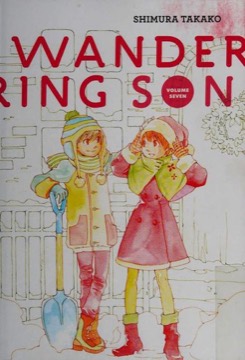
Wandering Son
Takako Shimura's series, begun in 2002, following two children from primary school into their teens: a boy who wants to be a girl and a girl who wants to be a boy.
- First published
- 2002
- Publisher
- Fantagraphics
- Pages
- 215
- Shelf
- Anime
- Level
- Core
- ISBN-13
- 9781606997505
Record checked against
Catalogue note
- Reads as
- ReflectiveChanges how you see rather than what you do.
- Level
- Core / BuildingAssumes general familiarity with the subject.
- Approach
- Theoretical
- Written for
- Readers of comics, and anyone curious how the form works, Readers with some grounding
Saved in this browser only — no account, nothing sent anywhere. My library
Read this if
- You read for the writing as much as for the argument.
- You want to think about how gender shapes a life, including your own.
- You want to be kept up late, and made uneasy about who to believe.
- You want a book that changes how you see things rather than what you do tomorrow.
- You know roughly how the subject works and want the fuller account.
What it is
Shuichi Nitori and Yoshino Takatsuki meet in their fifth year of primary school and recognise something in each other. Shuichi wants to be a girl; Yoshino wants to be a boy.
The series follows them and their friends across eight years, through puberty, school changes, first relationships and the progressive narrowing of what each can do.
Two children who recognise each other immediately, and eight years of everything getting harder.
Devmark’s reading — not a quotation from the book
Time passing
The series covers a genuinely long period and the characters age visibly, with bodies changing in ways that are central rather than incidental.
Puberty is the antagonist. The series is precise about how each physical development closes an option that had previously been open, and the accumulating pressure is the plot.
Restraint
Shimura's method is understatement. Major developments occur in a panel, conversations trail off, and a great deal of the most important material is in what characters decline to say.
The quietness is not evasion. It reflects how the subject is actually experienced by children who lack the vocabulary and the safety to be direct.
The supporting cast
Friends, siblings, parents and teachers are all given interiority, and their responses range from support through incomprehension to casual cruelty.
The series is particularly good on people who mean well and are unhelpful, which is a more common experience than outright hostility and is rarely depicted.
Yoshino
Her arc is given equal weight and is in several respects harder, since the social latitude available to her narrows sharply as she ages.
The series is careful not to treat the two experiences as mirror images, and the differences between what each faces are part of the point.
The art
Soft, thin-lined and deliberately understated, with pale tones and a great deal of white space.
The style is unusual for the subject and is well chosen: a more dramatic drawing would have made the material feel like an issue rather than a life. Shimura also draws the two children's bodies changing over eight years without ever making the change the subject of a panel, which is a considerable technical restraint.
Pace
It is slow and episodic, with fifteen volumes covering eight years and many chapters in which very little happens.
Readers who want incident will find it frustrating. The accumulation is the method, and the effect depends on having been present for the ordinary days as well as the difficult ones.
Its position
It is among the earliest manga to treat transgender children seriously and at length, and it was significant in the English-language market for the same reason.
It is not a perfect book, and some of its terminology and framing reflect its period. Its attentiveness and patience remain unusual.
The ending
The conclusion is quiet and partial, resolving some situations and leaving others open, with the characters in early adulthood and still in progress.
The refusal to supply a complete resolution is consistent with everything preceding it, and readers who wanted a settled ending have found it unsatisfying.
The English edition
Fantagraphics published it in hardcover volumes, which is an unusually handsome presentation for a contemporary series.
The edition is complete, which matters considerably given how many comparable works in this section are not. The hardcovers are printed at a generous size with the colour pages preserved, and the translation includes notes on terminology that has shifted since the series was written.
Shimura's other work
She has written extensively on similar themes, including Sweet Blue Flowers, a series about two girls at neighbouring schools.
Readers who respond to the register here will find the other work uses the same restraint applied to different situations. Sweet Blue Flowers is shorter and somewhat gentler, and it makes a reasonable introduction for readers uncertain about committing to fifteen volumes of anything.
Who it is for
Readers who want a long, quiet, cumulative book about growing up, and who do not require plot.
It is one of the most emotionally careful works in this section and asks patience rather than attention. Readers who find slow comics difficult should be honest with themselves about that before beginning fifteen volumes.
What to take away
- 01Puberty as the antagonistEach physical development closes an option that was previously open, and the accumulating pressure is the plot.
- 02Understatement as accuracyConversations trail off and major moments pass in a panel, reflecting how children without vocabulary or safety actually experience this.
- 03People who mean well and are unhelpfulThe series is unusually good on well-intentioned incomprehension, which is more common than hostility and rarely depicted.
- 04Not mirror imagesThe two children's experiences are given equal weight and are carefully not treated as symmetrical.
- 05Drawing chosen against dramaPale tones and thin lines keep the material feeling like a life rather than like an issue.
- 06A partial endingThe conclusion resolves some situations and leaves others open, consistent with everything that precedes it.