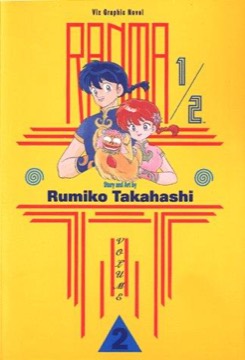
Ranma 1/2
Rumiko Takahashi's series, begun in 1987, about a martial artist who transforms into a girl when splashed with cold water. Farce built on a single reliable mechanism.
- First published
- 1987
- Publisher
- Tandem Library
- Pages
- 223
- Shelf
- Anime
- Level
- Entry
- ISBN-13
- 9780752208619
Record checked against
Catalogue note
- Reads as
- ReflectiveChanges how you see rather than what you do.
- Level
- Accessible / FoundationalNo prior reading assumed.
- Approach
- Theoretical
- Written for
- Readers of comics, and anyone curious how the form works, Newcomers to the subject
Saved in this browser only — no account, nothing sent anywhere. My library
Read this if
- You read for the writing as much as for the argument.
- You want to think about how gender shapes a life, including your own.
- You want a book that changes how you see things rather than what you do tomorrow.
- You are starting from scratch here and want a way in that assumes no prior reading.
What it is
Ranma Saotome and his father fall into cursed springs in China: Ranma becomes a girl when splashed with cold water, his father becomes a panda, and hot water reverses both.
They arrive at the Tendo dojo, where Ranma has been engaged since infancy to one of three sisters, and the series proceeds as escalating farce among martial artists with their own curses and grievances.
Cold water turns him into a girl, hot water turns him back, and everyone he meets wants to fight him.
Devmark’s reading — not a quotation from the book
The engine
The transformation is a perfect comic device: reliable, instant, triggered by the most ordinary substance in the world, and impossible to conceal for long.
Takahashi uses it with enormous economy. Rain, tea, a spilled drink or a bath can turn a scene over, and the series never exhausts the possibilities.
Structure
It is almost entirely episodic, with a new rival, curse or contrivance every few chapters and very little cumulative development.
The lack of progression is deliberate and is both the series' appeal and its limitation: it is enormously readable and it goes nowhere across thirty-eight volumes.
Gender
The series is not a considered treatment of gender and does not attempt to be, using the transformation for farce and for the discomfort of characters around Ranma.
It is nevertheless read that way by a substantial number of readers, and the matter-of-factness with which the transformation is eventually accepted by the cast has been genuinely meaningful to some.
Martial arts
The combat is absurd by design — martial arts tea ceremony, martial arts figure skating, a school based on stealing — and is treated with complete seriousness by everyone involved.
The joke is the seriousness. The fights are also genuinely well choreographed, and Takahashi's action is clearer than many artists who are trying harder.
The cast
Akane, Shampoo, Ukyo, Ryoga and Kuno each want something incompatible from Ranma, and the series keeps all of them in play simultaneously for decades.
The management of a large permanently unresolved cast is the series' structural achievement, and it is why the format sustained as long as it did.
Takahashi's comic timing
The page rhythm is exceptional: reaction shots held exactly long enough, reveals placed on page turns, and physical comedy staged with total clarity.
She is among the best gag writers the medium has produced, and the technical skill is easy to overlook because the material is so light.
What has dated
There is a substantial amount of nudity involving the female form of a teenage character, and several running jokes about a character's inappropriate behaviour that are presented as comic.
These are genuine problems rather than period charm, and readers should expect them throughout. Takahashi's later work handles similar material with considerably more care, which suggests the issue is the period rather than the author's settled view.
Length
Thirty-eight volumes of an essentially unchanging formula is a great deal, and the later volumes are noticeably more mechanical.
Most readers sample rather than complete it, and the series supports that entirely: any volume works as an entry point and nothing is lost by stopping.
The art
Clean, fast and enormously legible, with a strong sense of movement and character designs that are instantly distinguishable in silhouette.
Takahashi's efficiency is the relevant skill here. She was producing a weekly serial at very high volume and the drawing never suffers for it. Her creature and costume designs are also strong, and the Chinese Amazon characters in particular have designs that survive being seen thousands of times.
Its reach
It was among the works that carried manga to Western audiences in the 1990s and was many readers' first exposure to the medium.
Its influence on the romantic-comedy harem format is direct, and a great deal of what followed is working inside conventions this series established.
Who it is for
Readers who want farce executed at a very high technical level and are not looking for development or resolution.
It is the least serious thing in this section and among the most skilfully made. Readers should treat it as a collection of comic set pieces rather than as a narrative.
What to take away
- 01A perfect comic mechanismA transformation triggered by ordinary water is reliable, instant and impossible to hide, and the series never exhausts it.
- 02Seriousness as the jokeMartial arts tea ceremony and figure skating are treated with total gravity by everyone involved, which is the entire gag.
- 03An unresolved cast held in playFive characters with incompatible claims are sustained for decades without resolution, which is the structural achievement.
- 04Timing over contentReaction shots, page-turn reveals and clear physical staging make this some of the best gag construction in the medium.
- 05Episodic by designThirty-eight volumes with almost no cumulative development, which is both the appeal and the limitation.
- 06Problems that are not period charmSustained nudity involving a teenage character and jokes about inappropriate behaviour are genuine objections, not dated sensibility.