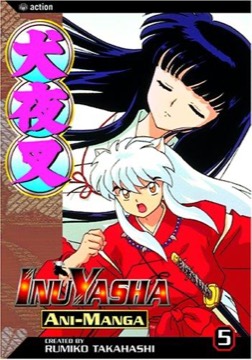
Inuyasha
Rumiko Takahashi's series, begun in 1996, in which a modern schoolgirl falls into a well and arrives in the Sengoku period. Long-running fantasy adventure.
- First published
- 1996
- Publisher
- VIZ Media LLC
- Pages
- 211
- Shelf
- Anime
- Level
- Entry
- ISBN-13
- 9781591165927
Record checked against
Catalogue note
- Reads as
- ReflectiveChanges how you see rather than what you do.
- Level
- Accessible / FoundationalNo prior reading assumed.
- Approach
- Theoretical
- Written for
- Readers of comics, and anyone curious how the form works, Newcomers to the subject
Saved in this browser only — no account, nothing sent anywhere. My library
Read this if
- You read for the writing as much as for the argument.
- You want to understand why people attach to each other the way they do.
- You want a book that changes how you see things rather than what you do tomorrow.
- You are starting from scratch here and want a way in that assumes no prior reading.
What it is
Kagome Higurashi is pulled into a well at her family's shrine and emerges in feudal Japan, where she learns she carries a reincarnated sacred jewel. The jewel shatters, and its fragments scatter across the country.
She travels with Inuyasha, a half-demon, and an accumulating party, collecting fragments and opposing a shapeshifting antagonist who wants them.
A schoolgirl, a half-demon, and a jewel broken into fragments scattered across a century.
Devmark’s reading — not a quotation from the book
The structure
It is a collection quest, which supplies an endlessly extensible format: each fragment is an episode, and the series ran to fifty-six volumes on that basis.
The format is efficient and repetitive in equal measure. It generates adventures indefinitely and means the series has no natural length.
Two periods
Kagome moves between the Sengoku era and contemporary Tokyo throughout, which gives the series a comic register the fantasy alone would not have.
Her school obligations, family and examinations continue in parallel with the quest, and the juxtaposition is used well — a demon fight interrupted by a mathematics test.
Inuyasha
The half-demon is aggressive, insecure and divided between two heritages that both reject him, and his position is the series' most consistent theme.
The subjugation device, by which Kagome can force him to the ground with a word, is played for comedy and is also a genuinely uncomfortable dynamic the series never fully examines.
The ensemble
Miroku, Sango and Shippo each bring their own grievance against the antagonist, and the party's formation across the early volumes is well handled.
Sango in particular is given substantial material, and the series is better at its supporting cast than at its leads. Miroku's cursed hand and Sango's destroyed village give both of them a stake independent of the protagonists, which the series uses well in the early volumes.
Naraku
The antagonist is a shapeshifter who manipulates rather than confronts, and who is responsible for nearly every character's original injury.
Centralising all grievances in one figure is efficient and eventually constraining, since it means almost nothing in the series happens for any other reason. He is also difficult to defeat by design, since he detaches parts of himself and operates through proxies, which supplies the series with antagonists indefinitely.
Length
Fifty-six volumes, with a substantial middle section in which the same situations recur and the plot advances very little.
The length is the most common complaint. The series is generally agreed to have continued well past the point where its material was exhausted. Takahashi was working weekly throughout, and the schedule is visible in the recurrence of certain situations and in the number of chapters that end without advancing anything.
Tone
It balances comedy, romance and genuinely dark material — including massacres, possession and bodily violation — more unevenly than Takahashi's other work.
The shifts are less controlled here than in Maison Ikkoku, and the darker material sometimes sits awkwardly against the running gags. Sango's backstory in particular is considerably grimmer than anything in Ranma, and the series never quite decides how much weight to give it.
The art
Clean and fast, with strong creature design and clear action, and the period detail handled efficiently rather than researched exhaustively.
Takahashi's demons are among her best designs, and the series is visually consistent across its enormous length. The Sengoku setting also allows costume and architecture that Takahashi clearly enjoys drawing, and the landscapes are more detailed than in her contemporary-set work.
Romance
The central relationship progresses very slowly and is complicated by Inuyasha's attachment to a previous incarnation, which the series sustains for most of its run.
The triangle is maintained longer than it can bear, and the resolution arrives late enough that many readers had stopped caring.
Its reach
It was enormously successful internationally and was, with Ranma, among the works that established Takahashi's reputation outside Japan.
A long animated adaptation and a later sequel series have kept it in circulation, and it remains among the best-known fantasy manga. It also ran long enough that its animated adaptation caught up with the manga twice, which is part of why the anime's structure is unusually messy.
Who it is for
Readers who want long-form fantasy adventure with a reliable formula and do not mind substantial repetition.
It is complete, which distinguishes it from several comparable series, and it is the least disciplined of Takahashi's major works. Readers new to her should start with Maison Ikkoku or Ranma instead.
What to take away
- 01A collection quest as formatScattered fragments supply an endlessly extensible episode generator, which is why the series has no natural length.
- 02Two periods in parallelKagome's school obligations continue alongside the quest, supplying a comic register the fantasy alone would lack.
- 03Divided heritage as the themeInuyasha is rejected by both the human and demon worlds, which is the series' most consistent and best-developed idea.
- 04All grievances centralisedMaking one antagonist responsible for every character's injury is efficient and eventually leaves nothing else to happen.
- 05A dynamic left unexaminedThe subjugation command is played for laughs and is genuinely uncomfortable, and the series never addresses it.
- 06Continued past its materialFifty-six volumes with a repetitive middle is the standard complaint, and it is a fair one.