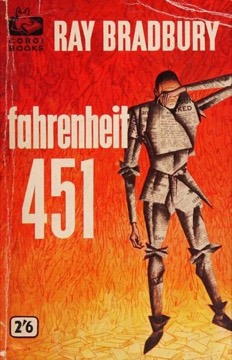
Fahrenheit 451
Ray Bradbury's novel of a fireman whose job is burning books — set in a society that stopped reading before the burning started, and that is more concerned with distraction than with suppression.
- First published
- 1953
- Publisher
- Infobase Publishing |isbn=978-1-60413-439-1 |page=148 |chapter-url=https://books.google.com/books?id=N5NDMxfkum8C&q=%22While+Fahrenheit+451+begins+as+a+dystopic+novel+about+a+totalitarian+government+that+bans+reading%22&pg=PA148 |chapter=Fahrenheit 451 |quote=While ''Fahrenheit 451'' begins as a dystopic novel about a totalitarian government that bans reading, the novel concludes with Montag relishing the book he has put to memory.
- Pages
- 189
- Shelf
- Fiction
- Level
- Entry
- ISBN-13
- 9780745171067
Record checked against
Catalogue note
- Reads as
- ReflectiveChanges how you see rather than what you do.
- Level
- Accessible / FoundationalNo prior reading assumed.
- Approach
- Theoretical
- Written for
- Readers of literature, Newcomers to the subject
Saved in this browser only — no account, nothing sent anywhere. My library
Read this if
- You want a thought experiment you can live inside for a while.
- You want to understand what technology is doing to how we live.
- You want a book that changes how you see things rather than what you do tomorrow.
- You are starting from scratch here and want a way in that assumes no prior reading.
The premise
Montag is a fireman in a future where houses are fireproof and firemen burn books. He is competent, unreflective and content until a conversation with a young neighbour begins to unsettle him.
The setup appears to be about state censorship and turns out to be about something else, which is the novel's most important structural feature.
It appears to be about state censorship and turns out to be about a public that stopped wanting to read.
Devmark’s reading — not a quotation from the book
Beatty's history lesson
The fire chief's explanation of how things came to be this way is the novel's central passage. Books were not banned first. Attention shortened, summaries replaced texts, minorities of every kind objected to content, and publishers and the public simplified until there was nothing left to object to.
The burning came afterward, as a formality. The public had already abandoned reading, and the state merely completed a process that demand had begun.
Mildred and the parlour
Montag's wife, absorbed in wall-sized interactive screens she calls her family, with earpieces at night and no memory of her own overdose.
Bradbury's depiction of a person fully occupied and entirely empty was written in the early 1950s, and the accuracy of the specific details — immersive screens on every wall, earpieces, participatory programming — is the reason the book is continually rediscovered.
Clarisse
The neighbour who asks whether he is happy, notices things, walks instead of driving, and disappears.
She is less a character than a catalyst, and her function is to introduce the possibility of attention. Bradbury's later stage adaptation gave her more presence, which suggests he was aware of the limitation.
Faber and the book people
The former professor who explains what books actually offer — texture, detail, the record of a mind at work — and argues that the books themselves are not the point but what they contain.
The closing community of people who have each memorised a book, becoming the text they carry, is the novel's answer: if the object can be burned, the content can be moved somewhere that cannot.
If the object can be burned, move the content somewhere that cannot be. That is the novel's answer.
Devmark’s reading — not a quotation from the book
What Bradbury said it was about
He stated repeatedly and with some irritation that the book is not primarily about government censorship but about television destroying interest in reading.
Readers and teachers have generally preferred the censorship reading, and the text supports both. His own insistence is worth knowing because it changes which passages are central: Beatty's history and Mildred's parlour rather than the burning scenes.
The prose
Bradbury writes in a heightened, image-driven style closer to prose poetry than to the plain register of most dystopian fiction.
This divides readers sharply. The style carries genuine force in the fire descriptions and can feel overwrought elsewhere, and it is the main reason some readers prefer Orwell's or Huxley's treatments of similar material.
The irony of its publishing history
A version of the book was published for years in an edition with numerous words and passages altered for school use, without Bradbury's knowledge.
When he discovered it he insisted the unexpurgated text be restored. The episode is now routinely taught alongside the novel, for obvious reasons.
Where it is weakest
The plot is thin and the final act relies on coincidence. Montag's transformation is rapid and underexplained, and the mechanical hound is more atmosphere than mechanism.
The society's economics and politics are unexamined — there is a war happening throughout that the novel never explains — which makes it less coherent as world-building than as warning.
Why it remains useful
Because its diagnosis locates the danger in demand rather than supply: a population that has stopped wanting difficult things does not need to be prevented from having them.
That argument is harder to dismiss now than when it was written, and it does not require the burning to be literal.
What to take away
- 01Demand preceded suppressionAttention shortened and summaries replaced texts long before anyone lit anything.
- 02The parlour predicted the detailsWall-sized participatory screens and constant earpieces, written in the early 1950s.
- 03Bradbury said it was about televisionNot primarily censorship, which changes which passages are the central ones.
- 04Move the content out of the objectPeople who memorise a book become the text, which is the only defence the novel offers.
- 05Its own text was expurgatedFor years, for school use, without the author's knowledge, until he discovered it.