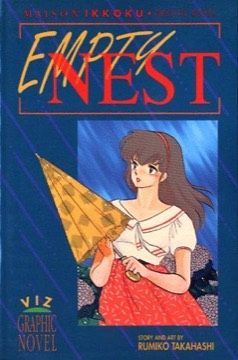
Maison Ikkoku
Rumiko Takahashi's series, begun in 1980, about a student in a decaying boarding house and the young widow who becomes its manager. Romantic comedy with unusual patience.
- First published
- 1980
- Publisher
- Tandem Library
- Pages
- 189
- Shelf
- Anime
- Level
- Entry
- ISBN-13
- 9781417662166
Record checked against
Catalogue note
- Reads as
- ReflectiveChanges how you see rather than what you do.
- Level
- Accessible / FoundationalNo prior reading assumed.
- Approach
- Theoretical
- Written for
- Readers of comics, and anyone curious how the form works, Newcomers to the subject
Saved in this browser only — no account, nothing sent anywhere. My library
Read this if
- You read for the writing as much as for the argument.
- You want to understand why people attach to each other the way they do.
- You want a book that changes how you see things rather than what you do tomorrow.
- You are starting from scratch here and want a way in that assumes no prior reading.
What it is
Yusaku Godai is a failing examination candidate living in Ikkoku House, a run-down boarding house whose other residents make studying impossible. He is on the point of leaving when Kyoko Otonashi arrives as the new manager.
She is a widow in her twenties, still grieving, and the series follows seven years of their circling each other while the house's residents interfere.
A boarding house, a failing student and a widow, over seven years of not saying anything.
Devmark’s reading — not a quotation from the book
Duration
The series covers a genuinely long span, and Godai moves from failing examinations through university, job hunting and eventual employment while Kyoko works through her grief.
The length is the point. Both characters are given time to change, and the obstacle between them is not a misunderstanding but the fact that neither is ready.
Grief
Kyoko's first husband is dead before the series begins, and her attachment to him is treated as real and unresolved rather than as an obstacle to be cleared.
Takahashi is careful about this. The series never suggests that moving on means having loved less, and Kyoko's ambivalence is sustained across most of its length.
The residents
Ichinose, Yotsuya and Akemi are broad comic creations — drunk, mysterious, shameless — who exist to obstruct and to comment, and they are among Takahashi's best.
They also provide the series' structural engine. Almost every misunderstanding is manufactured by someone in the house, which keeps the plot running without either lead behaving badly.
Comedy and register
The humour is broad, physical and frequently crude, and it coexists with genuinely tender material without either cancelling the other.
Takahashi's control of this is the series' technical achievement. A chapter can open with a farce about rent and close on something quiet and serious without the shift feeling forced.
The period
It is closely observed 1980s Japan: the economics of a shared house, the examination system, job-hunting conventions, and a social order in which a widow's remarriage is a matter for other people's opinions.
The social texture is more specific than romantic comedy usually bothers with, and much of the tension is genuinely structural.
Godai
He is indecisive, frequently pathetic and occasionally dishonest, and the series does not excuse him.
His development into someone capable of being relied on is slow and includes real failures, which is what makes the eventual resolution feel earned rather than granted. Takahashi also lets him be wrong about Kyoko repeatedly, and several of the series' better chapters turn on him misreading her entirely.
The art
Clean, economical and extremely legible, with expressive faces and a strong sense of domestic space — the house itself is drawn consistently enough to be mapped.
Takahashi is a very efficient storyteller, and the pages carry a great deal of information without appearing busy. The house is also a character in its own right, and its gradual deterioration across the series quietly marks the passage of the seven years.
Length and pacing
Fifteen volumes, which is long for a romantic comedy, and the middle section repeats its situations more than it needs to.
The repetition is a genuine weakness. Several arcs restage the same misunderstanding, and the series would be stronger at two-thirds the length. Readers who stall generally do so around the middle volumes, and skipping forward costs less than it would in a more tightly plotted work.
The ending
It resolves properly, with both characters having changed and the resolution addressing the grief rather than sidestepping it.
It is among the more satisfying conclusions in this section, and the final volume is genuinely moving in a way the comic register does not prepare for.
Takahashi's position
She is among the most commercially successful manga authors in history and the most successful woman in the industry by a wide margin, with several long-running series across different genres.
This is her most realistic work and the one most frequently named by readers as her best, though Ranma and Inuyasha reached larger audiences.
Who it is for
Readers who want romantic comedy that takes its time and treats its characters as adults, and who can tolerate broad humour alongside serious material.
It is complete and self-contained, and requires no knowledge of anything. It is the strongest argument in this section for the romantic comedy as a serious form.
What to take away
- 01Duration as the mechanismSeven years lets both characters genuinely change, so the obstacle is readiness rather than misunderstanding.
- 02Grief left unresolvedKyoko's attachment to her dead husband is treated as real throughout, and moving on is never framed as having loved less.
- 03Obstruction outsourcedThe boarding-house residents manufacture the misunderstandings, which keeps the plot moving without either lead behaving badly.
- 04Registers held simultaneouslyA chapter can move from farce to something quiet and serious without the shift feeling forced, which is the technical achievement.
- 05Social structure as tensionExamination systems, job-hunting conventions and opinions about a widow's remarriage supply genuine obstacles.
- 06A protagonist not excusedGodai is indecisive and occasionally dishonest, and his slow development includes real failures.