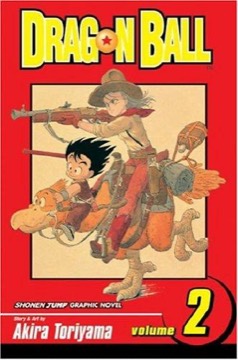
Dragon Ball
Akira Toriyama's series, begun in 1984, which starts as a comic quest for wish-granting orbs and becomes the template for the modern action serial.
- First published
- 1984
- Publisher
- Orion Publishing Group, Limited
- Pages
- 208
- Shelf
- Anime
- Level
- Entry
- ISBN-13
- 9789875629288
Record checked against
Catalogue note
- Reads as
- ReflectiveChanges how you see rather than what you do.
- Level
- Accessible / FoundationalNo prior reading assumed.
- Approach
- Theoretical
- Written for
- Readers of comics, and anyone curious how the form works, Newcomers to the subject
Saved in this browser only — no account, nothing sent anywhere. My library
Read this if
- You read for the writing as much as for the argument.
- You want a book that changes how you see things rather than what you do tomorrow.
- You are starting from scratch here and want a way in that assumes no prior reading.
What it is
Son Goku, a small boy with a tail and improbable strength, meets a girl searching for seven scattered orbs that summon a wish-granting dragon. The early volumes are a comic adventure loosely modelled on the Chinese novel Journey to the West.
Over its run the series shifts almost entirely into martial arts tournaments and then into escalating battles against increasingly powerful opponents, and the wish-granting premise recedes.
It begins as a comedy about finding some magic marbles and ends as the blueprint for thirty years of action manga.
Devmark’s reading — not a quotation from the book
Toriyama's design sense
His character and object design is the series' most durable contribution: clean shapes, immediately legible silhouettes, vehicles and creatures that are funny and functional at once.
He came from a design background rather than a comics one, and the clarity shows. A Toriyama character is recognisable in outline at any size, which is part of why the property merchandised so successfully.
The tournament structure
The World Martial Arts Tournament arcs established a shape that the entire genre adopted: a bracket, an escalating series of opponents, and a clear measure of relative strength.
It solves a genuine storytelling problem by supplying stakes, structure and a schedule, and it is the single most copied device in the medium.
Escalation, and its trap
Each antagonist must exceed the last, which produces the series' signature problem: power levels inflate until earlier threats become trivial and the numbers stop meaning anything.
Toriyama was open about improvising, and the series repeatedly solves the problem by introducing a new transformation or a stronger enemy — a pattern now so standard that it has its own vocabulary.
Comedy
The early volumes are broadly, sometimes crudely funny, with slapstick, running gags and a great deal of toilet humour.
The comic register never entirely disappears, and the series is considerably lighter than its reputation among readers who know only the later fighting arcs. Toriyama's gag timing is genuinely good, and several early volumes work as straight comedy with fighting attached.
Fight choreography
Toriyama's action is exceptionally legible: clear spatial relationships, strong silhouettes, and impacts drawn so that the reader always understands what connected with what.
The clarity is the craft. Later series inherited the escalation without always inheriting the readability, and the comparison is usually unflattering to them.
Goku
He is cheerful, uninterested in power for its own sake, and motivated almost entirely by wanting to fight stronger opponents rather than by justice.
The simplicity is deliberate. He is not a moral centre and the series does not ask him to be, which distinguishes him from most of the protagonists who followed.
Its commercial effect
The series turned its publisher's weekly magazine into an enormous business and established the pattern by which a successful manga becomes an animated series, a film programme, a game franchise and a merchandising operation.
The industrial model that anime now runs on was substantially shaped by what this property demonstrated was possible.
Women in the series
The treatment is poor. Female characters are consistently sidelined once the fighting becomes serious, and the early volumes contain a persistent strand of sexual harassment played for laughs.
This is a genuine limitation rather than a matter of taste, and it is the element most likely to stop a new reader.
The later arcs
The final stretch is where the series is most influential and least disciplined, with long fights, frequent power inflation and plotting that is visibly being invented weekly.
Many readers prefer the first half; most of the imitation descends from the second. Toriyama has said he repeatedly tried to end the series and was asked to continue, which explains a good deal about its shape.
Editions and order
English publication has appeared in several formats, including a two-part split that separated the early adventure from the later fighting, which confuses newcomers. The complete series is available in large three-in-one volumes that restore the original sequence.
Reading it as one continuous work is strongly preferable, since the shift in register is part of what makes the series interesting.
Who it is for
Readers who want to see where the modern action manga came from, and readers who enjoy comic adventure and are willing to follow it into something different.
It is long, and it is not necessary to finish it to understand its importance. The first tournament arc alone demonstrates most of what the series contributed, and the early comedy is genuinely charming in a way the later volumes are not.
What to take away
- 01Design over drawingToriyama's clean silhouettes and legible shapes came from a design background and are why the property merchandised so well.
- 02The tournament as a solutionA bracket supplies stakes, structure and a schedule at once, which is why it became the genre's most copied device.
- 03Escalation that eats itselfEach antagonist must exceed the last until earlier threats become trivial and the numbers cease to mean anything.
- 04Legibility as the real craftThe action is always spatially clear, which later series inherited the escalation without inheriting.
- 05A protagonist who is not a moral centreGoku fights because he wants stronger opponents, not because of justice, and the series never asks more of him.
- 06The industrial templateManga to anime to film to games to merchandise — the model anime now runs on was shaped by what this property proved possible.