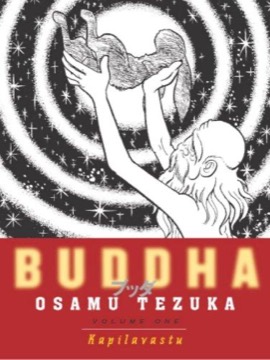
Buddha
Osamu Tezuka's eight-volume life of Siddhartha, serialised from 1972, retelling the founding of Buddhism as a long historical narrative with substantial invention.
- First published
- 1972
- Publisher
- HarperCollins Publishers Limited
- Pages
- not established
- Shelf
- Anime
- Level
- Core
- ISBN-13
- 9780007942480
Record checked against
No page count is recorded, so no reading estimate is shown for the book itself.
Catalogue note
- Reads as
- ReflectiveChanges how you see rather than what you do.
- Level
- Core / BuildingAssumes general familiarity with the subject.
- Approach
- Theoretical
- Written for
- Readers of comics, and anyone curious how the form works, Readers with some grounding
Saved in this browser only — no account, nothing sent anywhere. My library
Read this if
- You read for the writing as much as for the argument.
- You want a book that changes how you see things rather than what you do tomorrow.
- You know roughly how the subject works and want the fuller account.
What it is
An account of the life of Siddhartha Gautama from before his birth to his death, taking in the caste system of the period, the politics of the kingdoms around him, and the followers and opponents he accumulated.
Tezuka treats it as historical narrative rather than as scripture, and a substantial proportion of the characters and incidents are his own invention.
A life of the Buddha in which most of the supporting cast were made up.
Devmark’s reading — not a quotation from the book
Invention alongside doctrine
Several of the most prominent figures — the bandit Tatta, the warrior Chapra, the outcast Naradatta — have no basis in the traditional accounts and carry much of the emotional weight.
Tezuka's method is to use invented lives to dramatise the conditions the historical teaching responded to: caste, violence, grief and the ordinary unfairness of the period.
Caste as the subject
The series is far more interested in the social order of ancient India than in metaphysics. Characters are destroyed by their birth category repeatedly and systematically.
Siddhartha's significance in Tezuka's telling is less his enlightenment than his willingness to treat the caste order as arbitrary, which the narrative presents as the genuinely radical act.
Tone
It contains slapstick, anachronistic jokes, direct addresses to the reader and sudden cartoon gags, interleaved with torture, war and mass death.
Readers expecting reverence are frequently thrown. Tezuka regarded the comic register as a way into serious material rather than as a compromise of it.
Animals and the natural world
Some of the strongest sequences involve animals — a rabbit's self-sacrifice, a boy who can inhabit other creatures — and the series treats non-human life as morally continuous with human life.
This is doctrinally grounded and also simply one of Tezuka's abiding interests, and it produces several of the most affecting passages in the eight volumes.
Length and pace
Eight substantial volumes, with a great deal of political manoeuvring among kingdoms that occupies long stretches without Siddhartha appearing at all.
The middle volumes are the slowest and the most conventional, given over largely to court intrigue among neighbouring kingdoms. Readers who stall usually do so there, and the final two volumes recover the seriousness completely.
The teaching
Doctrinal content is delivered sparingly, usually as short statements in response to a specific situation rather than as sustained exposition.
Tezuka avoids sermon almost entirely. The ideas are shown working on individual people, which makes the series usable as an introduction without being a catechism.
Historical accuracy
The period detail is researched but loose, and Tezuka moves freely between different traditions, adds material, and compresses chronology.
It should not be read as history or as a reliable account of doctrine. Several Buddhist readers have objected to specific liberties, and the objections are reasonable.
The art
The landscapes and crowd scenes are among the most detailed Tezuka drew, and the animal figures in particular are rendered with obvious pleasure.
The character designs remain resolutely cartoonish, including Siddhartha himself, which is part of the argument: the founder is drawn no more grandly than a bandit.
Death
The series is preoccupied with dying — how it is faced, what it does to those left, and whether any account of it can be consoling.
The final volume's treatment of Siddhartha's own death is the strongest sustained writing in the work and the clearest statement of what Tezuka wanted the whole thing to be for.
Reception
The English edition won two Eisner awards and is one of the most widely recommended entry points to Tezuka for readers outside Japan.
It is also the work most often criticised on grounds of respect, and both responses are worth holding at once: it is ambitious, generous and occasionally careless with what it is retelling.
Who it is for
Readers who want a long narrative rather than short chapters, and who can tolerate tonal swings between farce and atrocity within a few pages.
It requires no knowledge of Buddhism and supplies what it needs. Readers seeking doctrinal instruction should treat it as a novel, because that is what it is.
What to take away
- 01Invented lives carrying the argumentThe most emotionally central characters are Tezuka's inventions, used to dramatise the conditions the teaching answered.
- 02Caste before metaphysicsThe series is far more interested in the social order that destroys people by birth than in doctrine.
- 03The radical act redefinedSiddhartha's significance here is treating caste as arbitrary, rather than the enlightenment itself.
- 04Comedy as an entranceSlapstick and anachronism sit beside atrocity, because Tezuka regarded the comic register as a way into serious material.
- 05Drawn no grandlier than a banditThe founder keeps the same cartoon design as everyone else, which is itself part of the argument.
- 06A novel, not a scriptureChronology is compressed and traditions are mixed, and the liberties have drawn reasonable objection.