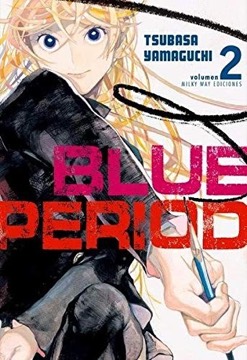
Blue Period
Tsubasa Yamaguchi's series, begun in 2017, about a high-achieving student who discovers painting late and attempts the entrance examination for Japan's most competitive art university.
- First published
- 2017
- Publisher
- Kodansha Comics
- Pages
- 194
- Shelf
- Anime
- Level
- Core
- ISBN-13
- 9788417820817
Record checked against
Catalogue note
- Reads as
- PracticalWritten to be applied, not only understood.
- Level
- Core / BuildingAssumes general familiarity with the subject.
- Approach
- Practical
- Written for
- Readers of comics, and anyone curious how the form works, Readers with some grounding
Saved in this browser only — no account, nothing sent anywhere. My library
Read this if
- You read for the writing as much as for the argument.
- You make things, and want to understand the work rather than wait for inspiration.
- You want something to apply, not only something to think about.
- You know roughly how the subject works and want the fuller account.
What it is
Yatora Yaguchi is a second-year student with good grades, a social life he finds hollow and no idea what he wants. He paints a view of early-morning Shibuya for an art class, and the experience of someone understanding it changes his direction entirely.
He decides to sit the examination for Tokyo University of the Arts, which admits a very small fraction of those who apply.
He is good at everything and interested in nothing, until a painting of a blue morning.
Devmark’s reading — not a quotation from the book
Art education, specifically
The series is exact about the process: cram schools for art students, charcoal drawing fundamentals, colour theory, critique sessions, the examination's structure and the cost of materials.
It functions as a genuine introduction to how visual art is taught, and the technical material is delivered through practice rather than through explanation.
Starting late
Yatora begins at seventeen against classmates who have drawn since childhood, and the series is honest that this is a serious disadvantage rather than an obstacle sincerity will overcome.
His route through is analytical: he treats painting as a problem to be studied, which is both his advantage and a limitation the series examines.
Critique
Scenes of work being assessed — by teachers, by peers, by the examiners — are the series' best material, and the criticism offered is specific and technical rather than encouraging.
Yamaguchi understands that the useful part of a critique is uncomfortable, and the series does not soften it.
Class and money
Art education is expensive, and the series is attentive to what each character can afford: cram school fees, materials, the difference between public and private universities.
Yatora's family circumstances constrain his options throughout, and the financial pressure is a constant rather than a hurdle cleared once.
Yuka
A classmate who paints, wears women's clothing and is negotiating their own gender is the series' second major character, and the treatment is careful and unresolved.
Their situation supplies a counterweight to Yatora's: someone with genuine talent and no clear idea what to do with the rest of their life.
The art
Yamaguchi draws the students' work in distinct individual styles, which is a substantial technical undertaking and essential to the series functioning at all.
The paintings have to be good enough for the reader to believe in the judgements made about them, and they are, which is the single hardest problem the book had to solve.
Anxiety
Yatora's self-doubt is persistent and is not cured by success, and several arcs concern the period after achieving something when the feeling has not changed.
The series is accurate about ambition as a condition rather than as a trajectory, and it does not promise that getting in will fix anything.
Structure
The examination arc occupies a substantial portion of the early volumes, and the series continues into university, where the problems become less defined and correspondingly harder.
The shift from a clear goal to an open situation is deliberate and is where the later volumes do their work.
What art is for
The series keeps returning to why anyone makes anything, and offers several incompatible answers through different characters.
It declines to settle on one. The position it comes closest to is that the question cannot be answered in advance and must be worked out by making things.
Adaptations
A 2021 animated series adapts the examination arc and is competent, with the usual difficulty of depicting painting in motion.
The manga remains the better version, since the still image can simply show a finished painting in a way animation must contrive. The adaptation is also considerably shorter than the manga's run, covering only the examination and leaving the harder university material untouched.
Who it is for
Readers interested in how a craft is learned, and readers who want a coming-of-age narrative about work rather than about romance.
It is ongoing but each arc concludes, and the first six volumes form a complete story about the examination that can be read on its own with full satisfaction.
What to take away
- 01A craft taught on the pageCharcoal fundamentals, colour theory and critique structure are delivered through practice rather than exposition.
- 02Late starting as real disadvantageBeginning at seventeen against lifelong drawers is treated as a serious problem, not an obstacle sincerity clears.
- 03Critique kept uncomfortableThe assessments are specific and technical, and the series understands that the useful part is the part that stings.
- 04Money as a constant constraintFees, materials and the public–private distinction shape every character's options throughout.
- 05Paintings that must be convincingYamaguchi draws each student's work in a distinct style, which the book cannot function without.
- 06Ambition as a conditionSelf-doubt persists through success, and the series refuses to promise that achievement resolves it.