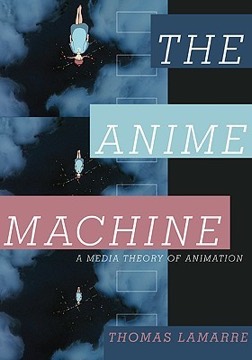
The Anime Machine
Thomas Lamarre's 2009 study, which analyses anime through the physical technology of animation itself: layered celluloid and the movement between planes.
- First published
- 2009
- Publisher
- University of Minnesota Press
- Pages
- 408
- Shelf
- Anime
- Level
- Deep
- ISBN-13
- 9780816651559
Record checked against
Catalogue note
- Reads as
- ReflectiveChanges how you see rather than what you do.
- Level
- Advanced / AdvancedAssumes you have read around the subject already.
- Approach
- Theoretical
- Written for
- Readers of comics, and anyone curious how the form works, Specialists and serious readers
- Ideas
Saved in this browser only — no account, nothing sent anywhere. My library
Read this if
- You make things, and want to understand the work rather than wait for inspiration.
- You want a book that changes how you see things rather than what you do tomorrow.
- You have read around this already and want a book that assumes it.
What it is
A theoretical study arguing that anime's distinctive qualities follow from the multiplanar apparatus used to produce it — transparent celluloid layers moved relative to one another beneath a camera.
Lamarre calls the resulting aesthetic the animetic, and distinguishes it from the cinematic in precise technical terms.
An argument that anime's whole aesthetic follows from sheets of celluloid sliding over each other.
Devmark’s reading — not a quotation from the book
The central distinction
Cinematism uses depth and movement into the image, as in ballistic perspective; animetism uses lateral movement across layered planes, as in a view from a moving train.
The distinction is the book's core contribution and it is genuinely illuminating, giving a vocabulary for something viewers register without being able to name.
The apparatus
Lamarre describes the multiplane camera, cel layering, and the specific labour of compositing in detail, and treats the technology as the determinant.
The approach is materialist: the argument is that a machine with particular affordances produces particular images, and that criticism which ignores the machine misses the explanation.
Limited animation reconsidered
Where limited animation is usually treated as a deficiency imposed by budget, Lamarre argues it produced a distinct and productive aesthetic with its own possibilities.
This reframing is the book's most useful intervention for general readers, since it converts a compromise into a technique. Lamarre also connects it to the specific labour of compositing, so the aesthetic argument stays anchored in what the people making the images actually did.
Case studies
Extended analyses of Miyazaki, Anno's Neon Genesis Evangelion, and the otaku material around them anchor the theory in specific works.
The Miyazaki chapters on flight and the Evangelion material on compositing are the strongest, and they demonstrate that the framework does real work. The chapters on Evangelion in particular connect Anno's compositing choices to the series' famous late episodes, which is a more concrete account than the psychological readings usually offered.
Difficulty
It is genuinely difficult: the book engages with Deleuze, with media theory and with Japanese critical writing, and assumes familiarity with all three.
Readers without a background in film or media theory will find substantial portions hard going, and the book makes few concessions. The organisation is also unconventional, with the argument developing across chapters rather than being stated and then applied, which increases the demand on a reader.
Otaku
Lamarre engages with Japanese otaku criticism, including Azuma, and treats fan practice as a legitimate object of analysis rather than as pathology.
The section on character design and its detachability from narrative is particularly good and connects to the media-mix material other books in this section cover.
Against interpretation
The book is implicitly critical of approaches that read anime for national meaning, offering a technical explanation where cultural ones had been assumed.
It is therefore a useful corrective to Napier's method, and the two make an instructive pair for a reader wanting to see the field's central disagreement.
Illustrations
The argument depends on visual examples and the book includes many, though reproduction quality varies and some sequences are difficult to follow in still images.
Readers will get considerably more from it with the films available to watch alongside. Lamarre's diagrams of layer movement are clearer than the film stills, and readers should attend to them closely since they carry the core of the argument.
Its standing
It is among the most cited works in anime studies and is generally regarded as the field's most theoretically ambitious book.
Its influence is largely academic; it has had less reach among general readers than Napier or Clements, which reflects its difficulty rather than its quality.
What it is not
It is not a history, not a survey, and not an introduction. It assumes the reader already watches anime and wants an explanation of its formal properties.
A reader beginning here without background will struggle and should start elsewhere. It also does not survey the industry, and a reader wanting to know who made what and when will need Clements or the encyclopedia alongside it.
Who it is for
Readers with a theoretical background who want the most rigorous available account of what makes anime formally distinct.
It is the hardest book in this section and the one that repays effort most directly, since its central distinction changes how the material looks afterwards. Readers approaching it should be prepared to read slowly and possibly twice, and should not treat difficulty in the opening chapters as a reason to abandon it.
What to take away
- 01The machine as determinantSliding celluloid layers beneath a camera are argued to produce the aesthetic, and criticism that ignores the apparatus misses the cause.
- 02Animetic against cinematicLateral movement across planes rather than motion into depth is the core distinction and gives viewers a name for what they already notice.
- 03Limitation converted to techniqueLimited animation is reframed from budget deficiency into a distinct aesthetic with its own possibilities.
- 04Fan practice analysed seriouslyOtaku criticism is engaged with as theory, and character detachability connects to the media-mix literature.
- 05A corrective to cultural readingOffering technical explanation where national meaning had been assumed makes it a direct counterweight to Napier.
- 06Rigorous and difficultIt engages Deleuze and Japanese media theory and makes few concessions, which limits its reach outside the academy.