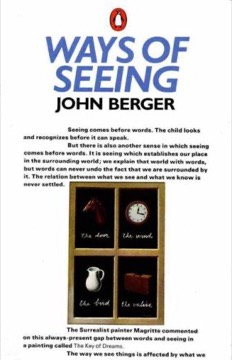
Ways of Seeing
Based on the BBC Television Series
John Berger's 1972 book, adapted from his BBC television series, which argues that the way we look at images is shaped by assumptions we do not notice — about beauty, ownership, gender and class — and that learning to see those assumptions is a political act.
- First published
- 1972
- Publisher
- Penguin Books
- Pages
- 166
- Shelf
- Design
- Level
- Core
- ISBN-13
- 9780140216318
Record checked against
Catalogue note
- Reads as
- PracticalWritten to be applied, not only understood.
- Level
- Core / BuildingAssumes general familiarity with the subject.
- Approach
- Practical
- Written for
- Designers and makers, Readers with some grounding
Saved in this browser only — no account, nothing sent anywhere. My library
Read this if
- You make things, and want to understand the work rather than wait for inspiration.
- You want to understand what makes people willing to follow a decision.
- You want something to apply, not only something to think about.
- You know roughly how the subject works and want the fuller account.
What the book is
Seven essays, four written and three consisting only of images, adapted from a four-part television series. The picture essays are not illustrations of the arguments; they are arguments made in a different medium, and Berger intends them to be read as such.
It is short, cheaply produced by design, and openly polemical. Berger's opening move is that the book is meant to start a process of questioning rather than to deliver conclusions.
The picture essays are not illustrations. They are the same argument made without words.
Devmark’s reading — not a quotation from the book
Seeing comes before words
The opening claim is that seeing establishes our place in the world before language does, and that what we see is always affected by what we know and believe.
From this follows the book's central method: to ask, of any image, what assumptions had to be in place for it to be made and for it to be understood. Berger treats the apparently natural act of looking as thoroughly learned.
Reproduction changes the work
Berger's first essay develops Walter Benjamin's argument about mechanical reproduction. When a painting can be photographed, printed, cropped, put on a wall or interrupted by an advertisement, its meaning is no longer fixed by its location.
His point cuts two ways. Reproduction democratises access, breaking the monopoly of the few who could stand in front of the original. It also makes images infinitely manipulable, so that the reproduction can be used to say almost anything.
The nude and the naked
The most influential chapter, and the source of the book's most quoted formulation: that men act and women appear, and that a woman is brought up to watch herself being looked at.
Berger's distinction is between being naked — being oneself — and being a nude, which is a way of being seen by someone else. He argues that the European oil-painting tradition of the nude is constructed around a male spectator-owner who is outside the frame, and that the woman in the picture is composed for him.
Oil painting and ownership
The essay on oil painting argues that the medium's particular capacity to render the texture of things — fur, silk, metal, flesh — made it uniquely suited to depicting possessions.
Berger's claim is that a great deal of European painting between 1500 and 1900 functioned as a record of what its commissioners owned, including land, objects and people, and that art history's language of beauty and composition has obscured this by refusing to discuss the transaction.
Publicity and the future tense
The final essay connects oil painting directly to advertising, which Berger calls publicity. Both, he argues, address a spectator and make a promise about what they could become through possession.
His sharpest observation is about tense. Oil painting showed what the owner already had; publicity shows what the viewer does not have, and so operates on envy. It proposes that we transform ourselves by buying, and it must therefore keep us dissatisfied to keep working.
Oil painting recorded what its owner had. Advertising depends on your continuing not to have it.
Devmark’s reading — not a quotation from the book
Where it is contested
Art historians have objected substantially. Berger's readings are selective; his account of the oil-painting tradition passes over a great deal that does not fit; and the argument that the medium is essentially about property is asserted more than demonstrated.
The Marxist frame is explicit and will be a limitation or a strength depending on the reader. Berger is not concealing it, and the book is better read as an argument to engage with than as a survey to trust.
How it changed things
Its influence on the study of images has been enormous, particularly the nude chapter, which anticipated and shaped feminist film and art criticism including the later development of the concept of the male gaze.
It also changed who art criticism was for. Written in plain language, published cheaply, and adapted from television, it was explicitly aimed at people that art writing had previously excluded — and that intention is part of its argument.
How it reads now
Some of it has been so thoroughly absorbed that it can read as obvious, which is the fate of successful arguments. The advertising essay, written before digital media, is if anything more applicable now than when it was written.
Its treatment of gender is binary and of its period, and a contemporary reader will notice the absence of considerations the book had no vocabulary for. That does not much weaken the core observation about who images are composed for.
What to take from it
A method, not a set of conclusions. Berger's durable contribution is the habit of asking, of any image: who is this composed for, what does it assume I want, and what had to be true for it to be made?
Applied to a painting it is art criticism. Applied to an advertisement, a product page or an interface, it is a straightforwardly useful professional discipline, which is why the book still appears on design reading lists half a century on.
What to take away
- 01Looking is learnedWhat we see is shaped by what we already believe, which makes the apparently natural act thoroughly cultural.
- 02Reproduction unfixes meaningOnce an image can be moved, cropped and juxtaposed, it can be made to say almost anything.
- 03Ask who the image is composed forThe spectator a picture assumes is outside the frame, and identifying them explains most of the composition.
- 04Advertising runs on the future tenseIt depends on your continuing not to have the thing, which is why satisfaction would end it.
- 05Use it on interfacesThe method transfers directly from paintings to product pages: what does this assume I want?