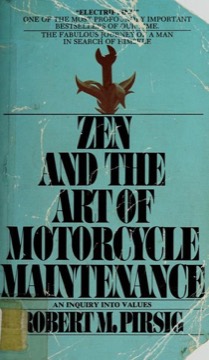
Zen and the Art of Motorcycle Maintenance
Robert Pirsig's account of a motorcycle journey across America with his son, interleaved with a philosophical inquiry into Quality — and with the recovery of the author's own earlier self, who went mad pursuing it.
- First published
- 1974
- Publisher
- Fischer (Tb.), Frankfurt
- Pages
- 421
- Shelf
- Philosophy
- Level
- Core
- ISBN-13
- 9780552993784
Record checked against
Catalogue note
- Reads as
- ReflectiveChanges how you see rather than what you do.
- Level
- Core / BuildingAssumes general familiarity with the subject.
- Approach
- Theoretical
- Written for
- Reflective readers, Readers with some grounding
Saved in this browser only — no account, nothing sent anywhere. My library
Read this if
- You make things, and want to understand the work rather than wait for inspiration.
- You want to examine an assumption you have never examined.
- You read for the writing as much as for the argument.
- You want a book that changes how you see things rather than what you do tomorrow.
- You know roughly how the subject works and want the fuller account.
The two narratives
The book runs on two tracks. One is a physical journey from Minnesota to California with Pirsig's eleven-year-old son Chris and, for part of the way, a couple who are friends.
The other is what he calls a Chautauqua — a series of philosophical discourses delivered over the journey, which gradually reveal that the narrator is recovering the thought of a person he used to be, before electroconvulsive therapy, whom he calls Phaedrus.
The narrator is reconstructing the philosophy of the person he was before the treatment that erased him.
Devmark’s reading — not a quotation from the book
Classical and romantic understanding
His organising distinction, set up through the contrast between himself and his friend John, who refuses to maintain his own motorcycle.
Classical understanding sees underlying form, mechanism and structure. Romantic understanding sees immediate surface, appearance and feeling. His argument is that the modern world has split them, that each finds the other unbearable, and that technology is where the split does the most damage.
The problem with technology
His diagnosis of why people hate technology: not the machines themselves but the sense of alienation from things one cannot understand or repair, and the ugliness of designs produced without care.
His claim that the Buddha resides comfortably in the circuits of a digital computer or the gears of a motorcycle is the book's most quoted line, and its point is that the division between spiritual and technical is one we imposed.
Quality
The concept the whole book is built around. Phaedrus, teaching rhetoric, finds that he cannot define Quality but that students recognise it reliably, and that attempting to define it destroys it.
His conclusion is that Quality is prior to both subject and object — the event at which awareness of both arises — rather than a property of things or a reaction in people. This is the metaphysical claim the book stands or falls on, and it is the point at which Phaedrus's pursuit becomes destructive.
Gumption traps
His practical chapters, and the most immediately usable material. Gumption is the enthusiasm and engagement required to do work well, and gumption traps are the things that drain it.
His taxonomy — setbacks like the stripped screw, and internal traps like anxiety, boredom, impatience and ego — is genuinely useful, and his prescriptions are specific. His treatment of the stuck screw as a problem requiring a change of perception rather than more force is the book in miniature.
The stuck screw does not need more force. It needs a change in how the problem is being seen.
Devmark’s reading — not a quotation from the book
Peace of mind as the real objective
His claim that the quality of a repair is inseparable from the state of the person making it, and that the mechanic who is anxious or resentful produces worse work than one who is settled.
His instruction to stop when frustrated rather than push through is counter to most work advice and is consistent with what is known about error rates under stress.
The relationship with Chris
The emotional core, and the part that makes the book more than a treatise. The narrator's difficulty in reaching his son is tied directly to the absence of Phaedrus, whom Chris remembers and the narrator does not.
The resolution near the end, and the afterword Pirsig added later about what subsequently happened to Chris, give the book a weight that its philosophy alone would not carry.
The madness
Phaedrus's pursuit of Quality ends in a breakdown and institutionalisation, and the book is honest that the philosophy and the collapse are not separable.
This complicates any straightforward reading. The narrator is both recovering a valuable insight and approaching the thing that destroyed him, and the tension between those is the actual suspense of the book.
Where the philosophy is questioned
Academic philosophers have generally found the historical arguments — particularly the reading of the Sophists and of Aristotle as the villain who separated Quality into form and substance — tendentious and poorly supported.
The metaphysics of Quality is also more asserted than argued, and Pirsig's later book *Lila* attempted a more systematic version that convinced few professionals.
Why it lasted
Because it asks how to live and work with care in a technological world, and because it does so through a form — journey, memory, argument, father and son — that carries the question rather than stating it.
It was reportedly rejected by a large number of publishers before acceptance, and its subsequent readership was enormous. Its endurance owes more to the gumption traps and the relationship than to the metaphysics.
What to take away
- 01Classical and romantic splitOne sees underlying form, the other immediate surface, and technology is where the division hurts most.
- 02Quality resists definitionEveryone recognises it and defining it destroys it, which is where the inquiry turns dangerous.
- 03Gumption traps are nameableExternal setbacks and internal states like anxiety and ego, each with a specific remedy.
- 04Stop when frustratedThe state of the person doing the work is inseparable from the quality of the result.
- 05The philosophy and the breakdown are connectedThe narrator is recovering an insight and approaching the thing that destroyed him, which is the real tension.