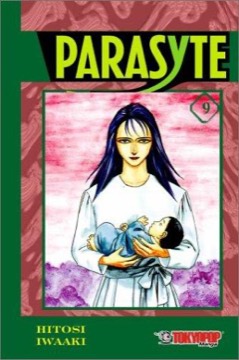
Parasyte
Hitoshi Iwaaki's series, begun in 1988, in which alien organisms take over human heads, and one fails — colonising a teenager's right hand instead.
- First published
- 1988
- Publisher
- TokyoPop
- Pages
- 184
- Shelf
- Anime
- Level
- Core
- ISBN-13
- 9781931514095
Record checked against
Catalogue note
- Reads as
- ReflectiveChanges how you see rather than what you do.
- Level
- Core / BuildingAssumes general familiarity with the subject.
- Approach
- Theoretical
- Written for
- Readers of comics, and anyone curious how the form works, Readers with some grounding
Saved in this browser only — no account, nothing sent anywhere. My library
Read this if
- You read for the writing as much as for the argument.
- You want to understand a place, or what we are doing to one.
- You want to examine an assumption you have never examined.
- You want a book that changes how you see things rather than what you do tomorrow.
- You know roughly how the subject works and want the fuller account.
What it is
Spores arrive and burrow into sleeping humans, replacing the brain and using the body to hunt other humans for food. One reaches Shinichi Izumi late and takes his right hand instead of his head.
He keeps his mind; the creature, which he names Migi, keeps its intelligence and its need to survive. Neither can live without the other, and the series follows their forced cohabitation.
The alien got the hand instead of the brain, and now neither of them can leave.
Devmark’s reading — not a quotation from the book
The central relationship
Migi is not evil, not loyal, and not interested in human ethics. It is rational, curious and entirely instrumental about Shinichi's survival because its own depends on it.
The negotiation between them is the series' great strength. Migi learns, argues and occasionally persuades, and the relationship is closer to a difficult colleague than to a monster.
Ecology as the argument
The series repeatedly places human treatment of other species alongside the parasites' treatment of humans, and declines to find an obvious asymmetry.
Iwaaki is careful not to make this glib. Characters state the comparison and other characters reject it, and the work leaves the disagreement standing rather than resolving it.
Shinichi's change
As the series proceeds, Shinichi becomes physically and emotionally altered — faster, colder, less able to grieve — and the people around him notice.
The loss of his ordinary emotional range is treated as the real horror, considerably more than the creature attached to him, and the arc of recovering it is the emotional spine.
Violence
The killings are graphic and the creature designs — heads opening into blades and mouths — are genuinely unpleasant.
The horror is body horror in the strict sense: what disturbs is the plasticity of flesh rather than the volume of blood, and Iwaaki uses it sparingly enough to retain the effect.
The art
Plain, slightly stiff figures with unremarkable faces, which works enormously in the series' favour: the ordinariness of the drawing makes the transformations more shocking.
Iwaaki is not a virtuoso and the series does not require one. The clarity of the panel-to-panel storytelling is the relevant skill and it is consistently good.
Structure
Ten volumes, tightly plotted, with a genuine escalation from individual encounters to organised parasite activity and eventually a state response.
It is unusually disciplined for a long-running series. There are almost no digressions, and the ending arrives when the argument is complete rather than when sales decline.
Other parasites
Several creatures develop differently — one attempts to raise a child, another becomes a politician — and these are the most interesting parts of the book.
The series is genuinely curious about what a rational non-human intelligence might conclude about living among humans, and the answers vary significantly.
The ending
The resolution is quiet and turns on a conversation rather than a confrontation, and it returns to the ecological argument without settling it.
The final volume's treatment of what Migi has become is among the better endings in the medium and is not what the setup leads a reader to expect.
Adaptations
A 2014 animated series updates the setting to the present and is faithful in plot while considerably glossier in style.
Two live-action Japanese films and a later Korean series set in the same premise also exist, with the Korean version taking the concept in a new direction rather than adapting the manga.
Its reputation
It won the Kodansha Manga Award and the Seiun Award and is consistently recommended as a self-contained entry point to seinen manga.
Its length is a substantial part of the recommendation: ten volumes is short enough to finish and long enough to develop properly. It is also one of the few horror manga that readers outside the genre finish, largely because the argument holds the attention when the gore does not.
Who it is for
Readers who want horror with an argument, and readers looking for a complete series that does not require a long commitment.
The graphic content is real but not relentless, and the book is considerably more thoughtful than its premise suggests. Readers who dislike open endings will find this one unusually satisfying, since the series knows exactly what it wants to say.
What to take away
- 01A parasite that negotiatesMigi is rational and instrumental rather than malevolent, and the relationship reads closer to a difficult colleague than a monster.
- 02An ecological comparison left openHuman treatment of other species is placed alongside the parasites' treatment of humans, and the series refuses to resolve it.
- 03The real horror is emotionalShinichi's loss of ordinary feeling disturbs more than the creature attached to him, and recovering it is the arc.
- 04Ordinariness that amplifiesPlain figures and unremarkable faces make the body transformations considerably more shocking.
- 05Discipline over durationTen tightly plotted volumes end when the argument is complete rather than when sales fall.
- 06Varied non-human conclusionsOther parasites raise children or enter politics, and the series is genuinely curious about what each would decide.