Gyo
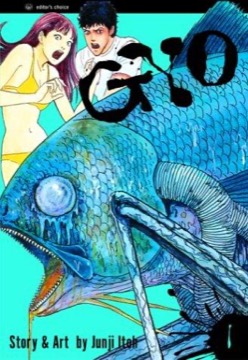
Junji Ito's short series from 2001, in which dead sea creatures come ashore walking on mechanical legs. Horror as escalating absurdity.
- First published
- 2001
- Publisher
- VIZ Media LLC
- Pages
- 200
- Shelf
- Anime
- Level
- Core
- ISBN-13
- 9781591161400
Record checked against
Catalogue note
- Reads as
- ReflectiveChanges how you see rather than what you do.
- Level
- Core / BuildingAssumes general familiarity with the subject.
- Approach
- Theoretical
- Written for
- Readers of comics, and anyone curious how the form works, Readers with some grounding
Saved in this browser only — no account, nothing sent anywhere. My library
Read this if
- You read for the writing as much as for the argument.
- You want to be kept up late, and made uneasy about who to believe.
- You want to understand a place, or what we are doing to one.
- You want a book that changes how you see things rather than what you do tomorrow.
- You know roughly how the subject works and want the fuller account.
What it is
A young couple holidaying on Okinawa encounter a smell, and then a fish walking on a set of metal legs. More follow, in increasing numbers and sizes, until the coastline and eventually Tokyo are overrun.
The two volumes follow Tadashi and Kaori through the collapse, and into an explanation involving wartime biological research.
It begins with one fish on legs. It does not stop there.
Devmark’s reading — not a quotation from the book
The premise's escalation
The idea is initially comic — a fish with a walking frame is funny before it is anything else — and Ito escalates it with complete commitment until it is not.
The trajectory from absurd to horrifying is the work's method, and it is executed faster and more brutally than in Uzumaki.
Smell as horror
The series' most effective device is olfactory: the creatures are propelled by a gas produced by decomposition, and the stench precedes them.
Horror in a visual medium rarely engages smell, and Ito's insistence on it — characters gagging, covering faces, unable to escape it — gives the book a specific physical unpleasantness.
The war material
The explanation involves Japanese biological weapons research and a mechanism developed to deliver pathogens, which places the horror in a specific historical frame.
The connection is thinly developed and functions more as a gesture than as an argument, but it gives the absurdity a grounding that pure invention would not.
The relationship
Tadashi and Kaori's deteriorating relationship runs alongside the disaster, and her transformation is the series' cruellest sequence.
Ito is generally uninterested in character, and this is one of the few cases where a relationship carries genuine weight, largely through how casually it is destroyed. The series is also unusually direct about how quickly affection curdles into disgust when a body stops behaving as expected.
Pace
Two volumes, extremely fast, with almost no downtime between escalations.
It is considerably more relentless than Uzumaki and correspondingly less atmospheric. Readers who found the earlier work slow will prefer this; readers who valued its dread will not. Ito compresses into two volumes what a more patient horror would spread across six, and the result is closer to a disaster film than to a ghost story.
The drawing
The same precise, heavily hatched style, applied to machinery and rotting flesh in combination.
The mechanical legs are a genuinely good design: crude, improvised-looking and plainly not built for the creatures wearing them, which is much of why they unsettle. The contrast between clean mechanical rendering and rotting organic detail is the visual joke the whole book rests on, and it does not wear out.
Comedy and its limits
The series is frequently funny and is aware of it, and the humour is closer to the surface than in Ito's other work.
Whether this helps is contested. Some readers find the tonal instability effective; others find that it prevents the horror from ever fully landing.
The short stories
The English edition includes two unrelated stories, The Enigma of Amigara Fault among them, which is frequently named as the single most disturbing thing Ito has drawn.
Amigara Fault is considerably stronger than the main feature, and a number of readers buy the volume for it alone.
Its standing
It is generally placed below Uzumaki and Tomie in Ito's work, on grounds of thinner characterisation and a weaker ending.
Its admirers argue that the relentlessness is the point and that judging it by the earlier work's standards misses what it is doing. It is nevertheless the Ito work most frequently recommended to readers who found Uzumaki too slow, and the recommendation is a reasonable one.
Editions
A single deluxe hardcover collects both volumes and the accompanying short stories at a good size.
As with the rest of Ito's work, the larger reproduction matters, since the detail in the hatching carries a substantial part of the effect. The collected volume is also the cheapest entry point into his work, which matters for readers testing whether the register suits them at all.
Who it is for
Readers who want fast, escalating, physically unpleasant horror and are not looking for atmosphere or character.
It is short and complete. Readers new to Ito are usually better served starting with Uzumaki or with a short-story collection, and returning to this if they want more.
What to take away
- 01Absurd, then horrifyingA fish on mechanical legs is funny first, and Ito escalates with complete commitment until it is not.
- 02Smell in a visual mediumThe creatures are propelled by decomposition gas, and the stench gives the book a physical unpleasantness comics rarely achieve.
- 03Machinery that looks improvisedThe legs are crude and plainly not built for their wearers, which is much of why the design works.
- 04A relationship destroyed casuallyIto is usually uninterested in character, and here the weight comes from how offhandedly the couple is dismantled.
- 05Relentless rather than atmosphericTwo volumes with almost no downtime, which readers prefer or reject depending on what they wanted from Uzumaki.
- 06A bonus story that outshines itThe Enigma of Amigara Fault is included in the same volume and is frequently named his most disturbing single work.