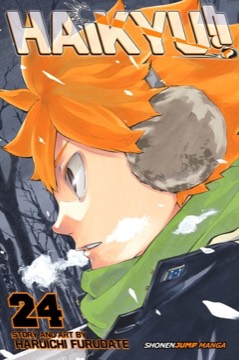
Haikyu!!
初雪
Haruichi Furudate's series, begun in 2012, about a short high-school volleyball player and the team he joins. Sports manga with an unusually generous view of opponents.
- First published
- 2012
- Publisher
- SHONEN JUMP
- Pages
- 183
- Shelf
- Anime
- Level
- Entry
- ISBN-13
- 9781421596112
Record checked against
Catalogue note
- Reads as
- ReflectiveChanges how you see rather than what you do.
- Level
- Accessible / FoundationalNo prior reading assumed.
- Approach
- Theoretical
- Written for
- Readers of comics, and anyone curious how the form works, Newcomers to the subject
Saved in this browser only — no account, nothing sent anywhere. My library
Read this if
- You read for the writing as much as for the argument.
- You want a book that changes how you see things rather than what you do tomorrow.
- You are starting from scratch here and want a way in that assumes no prior reading.
What it is
Shōyō Hinata is short, has no technique and can jump extraordinarily high. He joins his high school's volleyball club and is immediately partnered with Tobio Kageyama, a gifted setter he had previously played against and disliked.
The series follows the team through practice matches, regional qualifiers and national competition.
Too short for the sport, and able to jump higher than anyone in it.
Devmark’s reading — not a quotation from the book
The sport, taken seriously
Volleyball is explained thoroughly: rotation, positions, blocking systems, serve types and the specific tactical problem each opposing team presents.
Furudate teaches the reader progressively and then builds matches on that understanding, so a late-series play is comprehensible and satisfying in a way it could not be without the groundwork.
Opponents given interiority
The series' distinguishing decision is that opposing teams are developed as fully as the protagonists, with their own histories, ambitions and reasons to win.
Matches are therefore genuinely difficult to want either way, and several of the strongest sequences are told partly from the other side of the net.
The ensemble
Every member of the team has a specific role, a specific limitation and an arc, including the players who spend most matches on the bench.
Furudate is unusually attentive to the unglamorous positions — the libero, the pinch server — and to the coaching and management around the team.
Height and limitation
Hinata's height is a permanent disadvantage that is never overcome, only worked around, and the series is consistent about what he physically cannot do.
The refusal to remove the constraint is what keeps the sport credible, and it makes the tactical solutions genuinely interesting rather than inspirational.
Losing
Teams lose, including the protagonists, and losses are given full weight rather than being immediately redeemed.
The series treats defeat as information rather than as motivation, and several arcs are about what a team changes after being beaten. The team that beats them is usually one the reader has also been given reasons to like, which makes the defeats considerably harder.
The art
Furudate's drawing is not conventionally beautiful and is exceptionally good at motion: the reader can always see where the ball is, who is moving and what the court looks like.
The spatial clarity across a six-a-side sport with constant rotation is a considerable technical achievement.
Pace
Matches run long — a single game can occupy several volumes — with frequent cuts to player interiority and to the bench.
Readers who want plot advancement sometimes find this slow. The length is what allows the tactical development to be followed, and most readers adjust quickly.
Growth without power
Nobody acquires an ability they did not train for. Improvement is incremental, specific and frequently marginal, and the series finds real drama in a player getting slightly better at one thing.
It is the least escalation-dependent series in this section. A late-series development for a single blocker, built across dozens of volumes, carries more weight than most transformations in this section.
The ending
It concludes with a time skip that follows several characters into professional and adult life, and resolves the central rivalry in a setting the series had been pointing toward throughout.
The epilogue is unusually generous and is frequently cited as one of the better endings in the format.
The adaptation
The animated series is well regarded and covers most of the manga, with a film duology completing the run.
The manga is faster and the animation adds considerably to the match sequences, so neither is clearly preferable; readers often use both. The animation's handling of the ball's flight and of the rallies adds something the page cannot supply, which is why many readers use both.
Who it is for
Readers who want sport as subject rather than as backdrop, and who value ensemble writing over a single protagonist.
No interest in volleyball is required and none is assumed. It is forty-five volumes, complete, and among the most consistently well-constructed long series in this section.
What to take away
- 01Opponents written as fully as the leadsRival teams get histories and reasons to win, which makes matches genuinely difficult to want either way.
- 02The reader taught the sportRotation, blocking systems and serve types are explained progressively, so late plays are comprehensible and satisfying.
- 03A limitation never removedHinata's height is a permanent disadvantage worked around rather than overcome, which keeps the tactics honest.
- 04Defeat as informationLosses are given full weight and are treated as things a team learns from rather than as motivation.
- 05Improvement that stays marginalNobody acquires an untrained ability, and the series finds real drama in someone getting slightly better at one thing.
- 06Clarity across a crowded courtThe reader always knows where the ball and all twelve players are, which is a considerable drawing achievement.