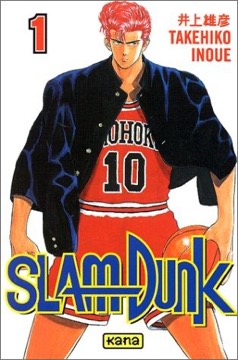
Slam Dunk
Takehiko Inoue's series, begun in 1990, about a delinquent who joins a high-school basketball team to impress a girl. The work that made basketball popular in Japan.
- First published
- 1990
- Publisher
- Editorial Ivrea
- Pages
- 192
- Shelf
- Anime
- Level
- Entry
- ISBN-13
- 9780972503792
Record checked against
Catalogue note
- Reads as
- ReflectiveChanges how you see rather than what you do.
- Level
- Accessible / FoundationalNo prior reading assumed.
- Approach
- Theoretical
- Written for
- Readers of comics, and anyone curious how the form works, Newcomers to the subject
Saved in this browser only — no account, nothing sent anywhere. My library
Read this if
- You read for the writing as much as for the argument.
- You want a book that changes how you see things rather than what you do tomorrow.
- You are starting from scratch here and want a way in that assumes no prior reading.
What it is
Hanamichi Sakuragi is a tall, aggressive, comprehensively unsuccessful first year who joins the basketball club solely because the girl he likes asks whether he plays.
He has no technique, no understanding of the rules and enormous physical ability, and the series follows his team through a season of increasingly serious opponents.
He joins because a girl asks. Everything after that is about the sport.
Devmark’s reading — not a quotation from the book
Comedy first
The early volumes are broad comedy: Sakuragi is vain, stupid and violent, and the humour is entirely at his expense.
Inoue uses this to earn the later material. By the time the series becomes serious about basketball the reader is attached to a character who began as a joke, and the shift is managed without ever discarding the humour.
The basketball
The games are drawn with real technical accuracy: spacing, screens, rebounding position, the specific physical toll of a fourth quarter.
Inoue understands the sport and expects the reader to learn it. Sequences run for entire volumes with genuine tactical development, and the reader's understanding grows alongside Sakuragi's.
Team as structure
Five starters with different temperaments, a coach with a history, and a manager whose role is taken seriously — the series distributes attention across the team rather than centring the protagonist in every game.
Several of the best sequences belong to characters other than Sakuragi, and the captain's arc in particular is given its full weight.
Training and improvement
Progress is shown as repetition. Sakuragi spends volumes on basic shooting form, thousands of attempts, and the series treats that grind as inherently interesting.
This is the sports manga template at its most disciplined: no sudden abilities, no hidden talent revealed, just unglamorous accumulation. Talent exists in the series, but it belongs to other people, and Sakuragi has to be taught everything.
The ending
It concludes at the peak of a national tournament rather than continuing, and the final match is drawn with extended near-silent sequences.
Inoue ended it at the height of its commercial success, which is unusual, and the final volumes are frequently cited as among the best-executed conclusions in the medium.
Its cultural effect
The series is widely credited with a substantial rise in basketball participation in Japan, and the sport's governing body has publicly acknowledged its influence.
Few works of popular fiction have a measurable effect on participation in an activity, and this is one of the clearer cases.
The art
Inoue's figures are athletic and individually proportioned, and the bodies in motion are drawn with an anatomical attention that was unusual for a weekly boys' magazine.
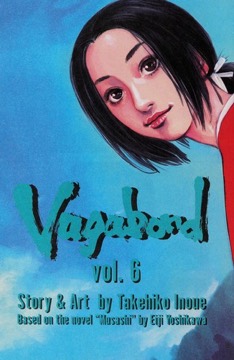
The later volumes show him beginning the transition toward the technique he would use in Vagabond, particularly in the use of white space.
Losing
The series takes defeat seriously and is willing to end a major arc with the team beaten and the loss left unrecovered.
That refusal to guarantee victory is a large part of why the sport in it feels real, and it distinguishes the series from a good deal of what followed.
Romance, mostly absent
The premise is a boy pursuing a girl, and the series drops that thread almost entirely once basketball takes over.
The abandonment is deliberate and is part of the joke: the motivation that started him is comprehensively replaced by the thing itself. Haruko remains present and remains largely unaware, which the series treats as funny rather than as tragic.
The sequel material
Inoue later produced a short continuation drawn on classroom blackboards and a 2022 animated film he wrote and directed, which retells the final match from a different character's perspective.
The film is an unusual case of an author revisiting his own work decades later and finding a genuinely new angle on it.
Who it is for
Readers who want a sports narrative that respects the sport, and readers who enjoy watching a comic character acquire competence slowly.
No interest in basketball is required going in. A substantial number of readers report acquiring one on the way out. It is also among the few long series in this section that ends properly, at the right moment, on its own terms.
What to take away
- 01Comedy that earns the dramaThe early volumes are broad humour at the protagonist's expense, which is what makes the later seriousness land.
- 02The reader learns alongside the characterSpacing, screens and rebounding are taught through the games, so the reader's grasp of the sport grows with Sakuragi's.
- 03Repetition as plotVolumes are spent on basic shooting form, with no hidden talent revealed — just unglamorous accumulation.
- 04Defeat allowed to standMajor arcs can end with the team beaten and the loss unrecovered, which is why the sport feels real.
- 05Stopped at its peakInoue ended the series at the height of its success, and the conclusion is among the best-executed in the medium.
- 06A measurable cultural effectBasketball participation in Japan rose substantially, and the sport's governing body has acknowledged the series' role.