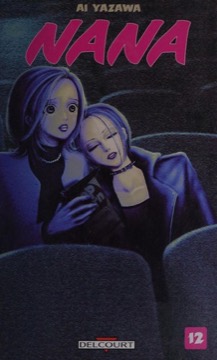
Nana
Ai Yazawa's series, begun in 2000, following two young women with the same name who meet on a train to Tokyo. Josei at its most unsparing about ambition and dependency.
- First published
- 2000
- Publisher
- Delcourt
- Pages
- 189
- Shelf
- Anime
- Level
- Core
- ISBN-13
- 9782840559641
Record checked against
Catalogue note
- Reads as
- ReflectiveChanges how you see rather than what you do.
- Level
- Core / BuildingAssumes general familiarity with the subject.
- Approach
- Theoretical
- Written for
- Readers of comics, and anyone curious how the form works, Readers with some grounding
Saved in this browser only — no account, nothing sent anywhere. My library
Read this if
- You read for the writing as much as for the argument.
- You want a book that changes how you see things rather than what you do tomorrow.
- You know roughly how the subject works and want the fuller account.
What it is
Two twenty-year-olds named Nana meet on a train to Tokyo and end up sharing an apartment. Nana Komatsu has followed a boyfriend and wants to be loved; Nana Osaki is a punk vocalist who has left a band and a relationship and wants to be significant.
The series follows both, their friendship, and the music industry one of them enters.
Two women with the same name, one who wants to be loved and one who wants to matter.
Devmark’s reading — not a quotation from the book
The two Nanas
The contrast is the series' engine: one woman defines herself entirely through relationships and the other refuses to admit she needs anyone, and both positions are shown as costly.
Yazawa refuses to make either the correct one. The friendship works precisely because each supplies what the other lacks, and it damages them for the same reason.
Dependency
The series' real subject is how people attach themselves to others in ways that are not good for them, and how difficult that pattern is to see from inside.
It is unusually clear-eyed. Nana Komatsu's behaviour is presented with sympathy and without any suggestion that she is about to grow out of it.
Fashion
Yazawa trained in fashion design, and clothing is used as characterisation throughout — Vivienne Westwood, specific brands, and outfits that signal exactly where a character is in her life.
The drawing of clothes is among the best in the medium and is a genuine part of the reading experience rather than decoration.
The music industry
The series is specific about how a band actually functions: contracts, management, touring costs, the press, and the way commercial success reshapes relationships between members.
The industry material is neither glamorised nor condemned, and it supplies the pressure that eventually breaks several of the characters.
Structure and narration
Sections are narrated retrospectively by one Nana or the other, frequently hinting at a later catastrophe that the reader has not yet reached.
The device establishes an atmosphere of foreboding from very early, and it is the main reason the series reads as tragedy rather than as drama.
The supporting cast
The band members, the boyfriends and the industry figures are all fully developed, and several of the most affecting arcs belong to characters who are peripheral to the central friendship.
Yazawa is particularly good on men who are weak rather than villainous, and on the specific damage that does.
Sex and its consequences
The series treats sex, pregnancy, abortion and casual relationships directly and without moralising, which was unusual for its market and remains so.
The consequences are material rather than punitive: money, housing, work and time, rather than shame. Yazawa is equally direct about money — rent, wages, what a night out costs — and the two subjects are treated as continuous rather than separate.
The hiatus
Yazawa became seriously ill in 2009 and the series has been suspended ever since, stopping in the middle of an arc and well before the events its narration has been anticipating.
It is unfinished and may remain so. This is the single most important thing for a new reader to know.
The art
Elongated figures, heavy black, elaborate patterning and a strong graphic sense, with panel layouts that are frequently closer to fashion editorial than to comics convention.
It is one of the most visually distinctive series in this section and has been widely imitated in illustration well outside the medium.
Its standing
It is among the best-selling josei series and is frequently named as the work that demonstrated the category could handle adult material seriously.
Its cultural reach in Japan was considerable, including a substantial effect on fashion, and it retains an unusually devoted readership decades after its suspension.
Who it is for
Readers who want adult relationships written without consolation, and who can accept an unfinished work.
It is one of the strongest things in this section and one of the hardest to recommend without qualification, because twenty-one volumes of accumulating dread stop without resolution. Readers who need closure should probably not start, and readers who can accept its incompleteness will find very little else like it.
What to take away
- 01Two failures, neither correctedOne woman defines herself through relationships and the other denies needing anyone, and both positions are shown as costly.
- 02Dependency seen from outsideThe series is clear about patterns its characters cannot see, and offers no suggestion that they will grow out of them.
- 03Clothing as characterisationYazawa's fashion training makes specific garments signal exactly where a character is in her life.
- 04Retrospective forebodingNarration from a later point hints at a catastrophe the reader has not reached, which makes the whole read as tragedy.
- 05Consequences that are materialSex, pregnancy and abortion produce effects measured in money, housing and time rather than in shame.
- 06Unfinished, mid-arcIllness suspended the series in 2009 before the events its narration anticipates, and that is the key fact for any new reader.