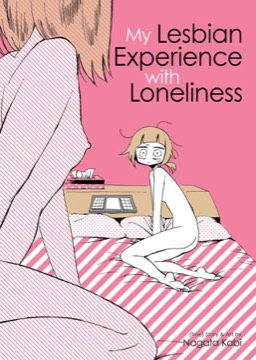
My Lesbian Experience with Loneliness
Nagata Kabi's 2016 autobiographical comic about mental illness, an eating disorder, and hiring a sex worker at twenty-eight. Published first as a web comic.
- First published
- 2016
- Publisher
- J-POP Manga
- Pages
- 142
- Shelf
- Anime
- Level
- Entry
- ISBN-13
- 9788417058098
Record checked against
Catalogue note
- Reads as
- ReflectiveChanges how you see rather than what you do.
- Level
- Accessible / FoundationalNo prior reading assumed.
- Approach
- Theoretical
- Written for
- Readers of comics, and anyone curious how the form works, Newcomers to the subject
Saved in this browser only — no account, nothing sent anywhere. My library
Read this if
- You read for the writing as much as for the argument.
- You want a life told honestly, at full length.
- You want a book that changes how you see things rather than what you do tomorrow.
- You are starting from scratch here and want a way in that assumes no prior reading.
What it is
An account of the author's twenties: leaving university, failing at jobs, living with parents, developing an eating disorder and depression, and eventually booking a session with a female escort as a deliberate attempt to do something.
It was drawn as a web comic, became widely shared, and was published as a single volume.
A book about being twenty-eight, ill, at home, and deciding to do one thing on purpose.
Devmark’s reading — not a quotation from the book
Honesty
The book's quality is its refusal to present the author flatteringly. She records self-deception, self-pity, cruelty toward her parents and the specific dishonesty of her own explanations.
The unsparing quality is what distinguishes it from the large amount of comparable confessional work, and it is frequently uncomfortable to read.
Mental illness, specifically
Depression, an eating disorder and the practicalities of psychiatric care in Japan are all described concretely: what treatment involves, what it costs, and how it fails.
The account is useful precisely because it is unliterary. Nagata describes symptoms as they occurred rather than as they would read well.
Parents
Her relationship with her mother is the book's most difficult material, and the author's need for approval is examined without being resolved.
The parents are not villains and are not exonerated, and the book's inability to settle its feelings about them is presented as the accurate state rather than as a failure.
The escort
The encounter that supplies the title occupies a relatively small portion of the book and is described awkwardly and honestly, including the author's inability to be present for it.
It functions as an attempt to act rather than as a resolution, and the book is clear that nothing is fixed by it.
Sexuality
The author's lesbianism is stated and is not the book's subject, which is loneliness and illness.
The matter-of-factness is part of its value. It is a book by a lesbian about being unwell rather than a book about being a lesbian. It is also notable for being published in a general market rather than in a category defined by its author's sexuality, which was not the usual route at the time.
The drawing
Simple, pink-toned and deliberately plain, with basic figures and a great deal of hand-lettered narration.
The plainness is functional. The book is closer to an illustrated diary than to a comic in the conventional sense, and the drawing exists to carry text rather than to be looked at.
Narration
Text dominates, with dense captions running across most pages, and the comics form is used mainly for pacing and for the occasional image that states something the words avoid.
Readers expecting visual storytelling will find relatively little. The form's contribution is the ability to place an image against a contradicting sentence.
Its reception
It was widely shared online before publication and became a substantial commercial success in English, and it is frequently cited as a gateway to autobiographical manga.
It also attracted criticism for the sex-work material and for the author's presentation of her own family, both of which are fair subjects for argument.
The sequels
Nagata has published several follow-up volumes covering her continued illness, hospitalisation and attempts to live independently.
They are less focused than the first and are valuable mainly as continuation. The original volume is the complete statement. They also document a genuine medical crisis and hospitalisation, which gives them a different kind of value even where the shape is looser than the original's.
What it does not do
It does not recover, conclude or offer advice, and the author's situation at the end is not substantially better than at the beginning.
The refusal of a recovery narrative is its most important decision and the reason it is useful to readers in similar circumstances.
Who it is for
Readers who want an honest account of mental illness without a redemptive shape, and readers interested in autobiographical comics.
It is short, complete and genuinely uncomfortable. Readers currently unwell should consider whether an unresolved account of the same condition is what they want. It is also very short, which lowers the cost of trying it and makes it easy to put down if the register proves wrong for the moment.
What to take away
- 01Unflattering by designThe author records her own self-deception and cruelty, which distinguishes it from most confessional work.
- 02Symptoms as they occurredIllness and psychiatric care are described unliterarily, which is exactly what makes the account useful.
- 03An act, not a solutionThe encounter in the title is an attempt to do something rather than a resolution, and nothing is fixed by it.
- 04Sexuality stated, not examinedIt is a book by a lesbian about loneliness rather than a book about being a lesbian, and the matter-of-factness matters.
- 05Form used for contradictionThe comics element mainly lets an image sit against a sentence that denies it.
- 06No recovery narrativeThe author is not better at the end, and the refusal of that shape is the book's most important decision.