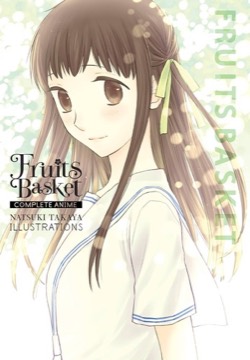
Fruits Basket
Natsuki Takaya's series, begun in 1998, about an orphaned girl taken in by a family whose members transform into zodiac animals when embraced. Shōjo romance as a study of abuse.
- First published
- 1998
- Publisher
- Yen Press LLC
- Pages
- 2376
- Shelf
- Anime
- Level
- Entry
- ISBN-13
- 9781975375850
Record checked against
Catalogue note
- Reads as
- ReflectiveChanges how you see rather than what you do.
- Level
- Accessible / FoundationalNo prior reading assumed.
- Approach
- Theoretical
- Written for
- Readers of comics, and anyone curious how the form works, Newcomers to the subject
Saved in this browser only — no account, nothing sent anywhere. My library
Read this if
- You read for the writing as much as for the argument.
- You want a life told honestly, at full length.
- You want to be kept up late, and made uneasy about who to believe.
- You want a book that changes how you see things rather than what you do tomorrow.
- You are starting from scratch here and want a way in that assumes no prior reading.
What it is
Tohru Honda is living in a tent after her mother's death when she is taken in by the Sohma family. Several Sohmas transform into animals of the Chinese zodiac when hugged by someone of the opposite sex, or when weakened.
The premise reads as comedy and the series uses it to examine a family organised around a curse that has been used to justify decades of cruelty.
The curse is a comedy premise. What the family has built around it is not.
Devmark’s reading — not a quotation from the book
The turn
Early volumes are largely romantic comedy. The series gradually reveals that each transforming member has been damaged by the family's structure — isolation, confinement, physical violence, and a matriarch who maintains control through all three.
The shift is gradual rather than sudden, and it recontextualises the comedy rather than replacing it.
Tohru
She is relentlessly kind, accommodating and self-effacing, and the series eventually identifies these as a pathology rather than a virtue.
The examination of her own grief and her inability to ask for anything is the work's most sophisticated material, and it arrives late enough that it genuinely surprises.
Abuse, specifically
The series is precise about the mechanisms: children told they are loved by the person harming them, families that close ranks, and adults who were themselves damaged reproducing the pattern.
It is one of the most careful treatments of familial abuse in popular fiction, and it does not offer easy forgiveness as a resolution.
The ensemble
The cast is large and each member is given a full history, a specific damage and a distinct route out of it.
Takaya is unusually patient with the supporting characters, and several of the strongest volumes concern people peripheral to the central romance. The zodiac members in particular are distributed across the series rather than introduced in a block, so the reader meets them at the pace the story needs.
Romance
The central romantic plot is real and is not the point. The series is consistently more interested in whether its characters can form any non-destructive attachment than in which pairing prevails.
Readers who come for the romance frequently stay for the family material, which is where the writing is strongest.
The curse as metaphor
The zodiac arrangement functions as a literalised family system: assigned roles, fixed positions, and a hierarchy nobody chose but everybody maintains.
The metaphor is worked through carefully and the resolution addresses the structure rather than simply removing the magic. Takaya also resists letting the magic carry the blame, since the cruellest things in the book are done by people making choices.
The art
Delicate and slightly sparse, with expressive faces and a heavy use of screentone, and layouts that prioritise emotional clarity over visual spectacle.
Takaya's drawing improves considerably across the run, and the later volumes are noticeably more controlled than the early ones. The panel layouts are conventional and the emotional work is done through faces and through silence, with several key scenes running almost without dialogue.
Tone management
The series moves between slapstick and serious material constantly, and the comedy is never abandoned even in its darkest sections.
The tonal mix is handled better than in most works that attempt it, largely because the humour comes from character rather than from set pieces.
Its standing
It was among the best-selling shōjo series of its period and did a great deal to establish the category commercially outside Japan.
It is frequently named by readers as the series that demonstrated shōjo could carry serious psychological material, and its influence on subsequent work is substantial.
Adaptations
A 2001 animated series adapted roughly the first third and diverged; a 2019 adaptation covers the whole work and is generally considered the definitive version.
The complete adaptation matters here more than usual, since the series' argument depends almost entirely on its later volumes. Readers who encountered only the 2001 version will find that the series they remember is roughly a third of the actual work.
Who it is for
Readers who want romance with genuine psychological substance, and readers interested in a careful fictional treatment of family abuse.
It is twenty-three volumes and complete. Readers who find the opening volumes too light should be encouraged that the register changes substantially and that the series is considerably more serious than it first appears.
What to take away
- 01Comedy premise, serious structureThe zodiac curse is played for laughs and turns out to be the mechanism a family uses to justify decades of cruelty.
- 02Kindness diagnosedTohru's relentless accommodation is eventually identified as damage rather than virtue, which arrives late enough to surprise.
- 03Abuse described mechanicallyThe series is precise about children told they are loved by the person harming them, and about families closing ranks.
- 04A literalised family systemAssigned roles and fixed positions that nobody chose and everybody maintains — the metaphor is worked through rather than gestured at.
- 05Attachment before pairingThe question is whether these people can form any non-destructive bond, not which romance prevails.
- 06No easy forgivenessThe resolution addresses the structure rather than offering reconciliation as a substitute for change.