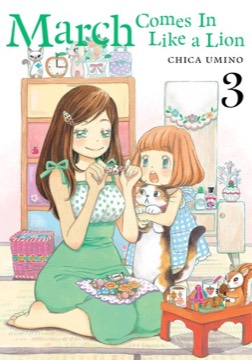
March Comes in Like a Lion
Chica Umino's series, begun in 2007, about a teenage professional shogi player living alone, and the family that takes him in. Depression written with unusual precision.
- First published
- 2007
- Publisher
- DENPA
- Pages
- 195
- Shelf
- Anime
- Level
- Core
- ISBN-13
- 9781634428361
Record checked against
Catalogue note
- Reads as
- ReflectiveChanges how you see rather than what you do.
- Level
- Core / BuildingAssumes general familiarity with the subject.
- Approach
- Theoretical
- Written for
- Readers of comics, and anyone curious how the form works, Readers with some grounding
Saved in this browser only — no account, nothing sent anywhere. My library
Read this if
- You read for the writing as much as for the argument.
- You want to be kept up late, and made uneasy about who to believe.
- You want a life told honestly, at full length.
- You want a book that changes how you see things rather than what you do tomorrow.
- You know roughly how the subject works and want the fuller account.
What it is
Rei Kiriyama is seventeen, a professional shogi player, and living by himself in Tokyo. His parents and sister died when he was a child; he was adopted by his father's colleague, a shogi professional, and that household did not go well.
He is taken up by three sisters who run a wagashi shop, and the series moves between the shogi world and their house.
A seventeen-year-old professional with an income, an apartment, and nobody at all.
Devmark’s reading — not a quotation from the book
Depression, specifically
The series is among the most accurate depictions of depression in fiction: the flatness, the difficulty of eating, the way obligation feels like weight, and the specific exhaustion of being asked how you are.
Umino renders Rei's interior state visually — water, darkness, static — and the technique conveys the condition more effectively than description would.
The Kawamoto household
The three sisters who feed him are not a solution and are not presented as one. Their own situation is difficult: an absent father, a dead mother, a grandfather ageing, a business under strain.
The relationship works because it is reciprocal. Rei is useful to them, which is what allows him to accept anything.
Shogi
The game is explained enough to follow and is used as characterisation: each professional's style reflects something about them, and matches are written as psychological encounters.
No prior knowledge is needed. The series is careful to make the stakes legible through the players rather than the board.
Bullying
A long arc concerning the bullying of one of the sisters is the series' most sustained piece of social observation, and it is unusually precise about how institutions respond.
The school's preference for managing the incident over addressing it is drawn with real anger, and the arc is frequently cited as the series' best.
Adoption and obligation
Rei's adoptive family is not cruel in a simple way. He was taken in out of genuine feeling and then became a competitor to their own children, and everyone involved is damaged by an arrangement nobody chose.
The material is handled with more nuance than the premise suggests, and the adoptive sister's arc is among the most affecting in the work.
The art
Umino uses a wider range than in Honey and Clover: realistic when the material demands it, loose and comic when it does not, and fully abstract for Rei's interior sequences.
The tonal control is the series' technical achievement, and the shifts are never arbitrary. Umino also uses the shogi board itself as a compositional element, with pieces and squares bleeding into the panel structure during matches.
Comedy
It is funny, frequently very funny, and the humour arrives in the middle of the bleakest material without diminishing it.
The cats, the wagashi, the professional players' eccentricities — the comic apparatus is substantial and is load-bearing rather than decorative. Umino is careful that the comedy never arrives to rescue Rei from a feeling, only to sit alongside it, which is why it does not feel like evasion.
Pace
It is slow, episodic, and willing to spend a full chapter on a meal or a walk.
The slowness is the point. Recovery in this book is measured in very small increments, and compressing it would have falsified the thing being described. Several arcs also run in parallel across long stretches, so the series can leave Rei alone for chapters at a time without losing momentum.
Food
Meals are central: what Rei eats alone, what the sisters cook, and the seasonal confectionery the shop produces.
Eating is the series' measure of wellbeing, and the attention to food is a precise and unsentimental way of tracking how someone is actually doing. The wagashi in particular mark the passing seasons, and the series uses them as a calendar that requires no exposition at all.
Adaptations
A two-season animated series and two live-action films exist; the animation is visually ambitious and handles the interior sequences well.
The manga remains ongoing at a slow pace, and readers should be aware that it has not concluded. The live-action films compress the material heavily and lose most of the interior work, which is the part hardest to film and most of what the series is.
Who it is for
Readers who want a serious treatment of depression, loneliness and slow recovery, and who do not require a plot in the conventional sense.
It is one of the most emotionally substantial works in this section and requires no interest in shogi whatsoever. Readers who found Honey and Clover too light will find this considerably heavier.
What to take away
- 01Depression rendered visuallyWater, darkness and static convey Rei's interior state more effectively than description could.
- 02Help that is reciprocalThe sisters are not a solution; Rei is useful to them, which is the only reason he can accept anything.
- 03Eating as the measureWhat and whether he eats tracks his condition precisely, without any need to state it.
- 04Institutions managing rather than actingThe bullying arc is exact about a school preferring to contain an incident over addressing it.
- 05Adoption with nobody at faultRei was taken in out of genuine feeling and became a competitor to the family's own children, damaging everyone.
- 06Slowness as accuracyRecovery is measured in very small increments, and compressing it would have falsified the subject.