Liar's Poker
Michael Lewis's memoir of working as a bond salesman at Salomon Brothers in the mid-1980s — written as he left, and intended as a cautionary account of an industry he expected readers to find appalling rather than aspirational.
- First published
- 1989
- Publisher
- W. W. Norton & Company
- Pages
- 304
- Shelf
- Money
- Level
- Entry
- ISBN-13
- 9780393027501
Record checked against
Catalogue note
- Reads as
- StrategicAbout choosing between options under uncertainty.
- Level
- Accessible / FoundationalNo prior reading assumed.
- Approach
- Applied
- Written for
- Investors and savers, Newcomers to the subject
Saved in this browser only — no account, nothing sent anywhere. My library
Read this if
- You want to see the incentives underneath the headlines.
- You want a life told honestly, at full length.
- You read for the writing as much as for the argument.
- You are weighing options and want a way to think about the trade-offs.
- You are starting from scratch here and want a way in that assumes no prior reading.
The book Lewis thought he was writing
Lewis has said repeatedly that he wrote it expecting to warn young people away from Wall Street, and that it instead functioned as a recruitment brochure — readers wrote to him asking for more tips on getting in.
That gap between intent and reception is the most interesting fact about the book, and it says something about the period that the content itself does not.
He wrote it as a warning. Readers took it as a guide, and wrote in asking how to get hired.
Devmark’s reading — not a quotation from the book
The title game
Liar's poker is a bluffing game played with the serial numbers on dollar bills, and Lewis uses it as the book's organising metaphor: a contest of nerve and deception where the skills that win bear no relation to any underlying value.
The opening account of a proposed enormous wager between two senior figures sets the register — the scale is absurd, the stakes are personal, and the activity produces nothing.
The training programme
The strongest comic material and the sharpest sociology. Lewis's account of the trainee class — the deliberate humiliation, the seating hierarchy, the open contempt for anyone showing interest in the subject matter — describes an initiation designed to select for a specific temperament.
His term for the successful product of that process, Big Swinging Dick, has outlived most of the book's other vocabulary.
Mortgage-backed securities, invented
The genuinely historical content. Lewis describes Salomon's role in creating the mortgage-backed securities market, and the extraordinary profitability of being the only serious participant in a market you effectively made.
Read after 2008 this section is uncomfortable in a way it cannot have been at publication, since it describes the origin of the instruments at the centre of the later collapse.
Information asymmetry as the business
His account of the sales role is unsentimental: the firm's advantage came from knowing more than its customers, and a salesman's job included moving inventory the firm wanted off its books.
His description of being congratulated for a trade that badly damaged a client is the ethical centre of the book, and he does not resolve it — he took the congratulation.
He is congratulated for a trade that ruins a client. He does not resolve this; he records that he took the praise.
Devmark’s reading — not a quotation from the book
The firm's own decline
The later chapters cover Salomon losing its position: talent departing, competitors replicating the mortgage business, and management decisions that Lewis portrays as self-inflicted.
This half is less entertaining and more instructive — a demonstration that an enormous informational advantage in a new market is temporary, and that the firms that create a market rarely keep it.
Lewis's position in it
He is candid that he was unqualified, that he was paid extraordinarily well for it, and that he was reasonably good at the job while not believing in it.
That self-implication is what keeps the book from being merely a hit piece, and it is the quality that distinguishes his financial writing from most insider accounts.
Where it should be read carefully
It is a memoir written by a departing junior employee in his twenties, at speed, about people he names. Several of those people have disputed specific characterisations, and the compression of events for narrative effect is evident.
It should be read as a vivid, partial account of one firm in one period rather than as reporting.
How it reads now
The comedy still works and the excess still shocks, though the sums involved have been so far exceeded since that the numbers no longer land as Lewis intended.
The more durable material is the description of how an institution's culture selects for a temperament, and how a profitable informational advantage shapes everything an organisation does — both of which generalise well beyond finance.
Its place in his work
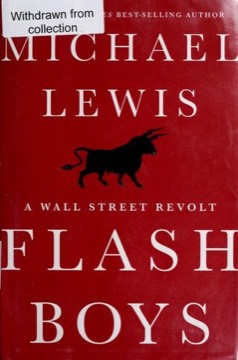
The first of several books on the same industry, and the closest to the inside. *The Big Short* covers the consequences of instruments this book describes being created; *Flash Boys* covers a later structural change.
Read in sequence they form an unusually long observation of one industry by one writer, with the first written from inside it and the rest from outside.
What to take away
- 01Culture selects for temperamentThe training programme's humiliations were a filter, and the book describes exactly what they filtered for.
- 02Informational advantage is temporaryCreating a market produces extraordinary margins and rarely produces a lasting position in it.
- 03The ethical moment is unresolvedHe is praised for a trade that harms a client, and records that he accepted the praise.
- 04Intent does not control receptionWritten as a warning and read as a recruitment brochure, which says more than the content does.
- 05Read it as memoir, not reportingA junior employee's account, written fast, about named people who have disputed parts of it.