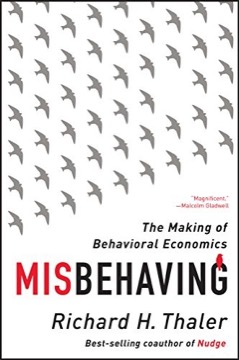
Misbehaving
Richard Thaler's history of behavioural economics told as memoir — how a set of observations about people doing things standard theory said they would not do became, over four decades, a recognised field.
- First published
- 2015
- Publisher
- W. W. Norton & Company
- Pages
- 432
- Shelf
- Money
- Level
- Core
- ISBN-13
- 9780393352795
Record checked against
Catalogue note
- Reads as
- ConceptualExplains how something works before what to do about it.
- Level
- Core / BuildingAssumes general familiarity with the subject.
- Approach
- Theoretical
- Written for
- Investors and savers, Readers with some grounding
Saved in this browser only — no account, nothing sent anywhere. My library
Read this if
- You want to know the specific ways your own judgement misleads you.
- You want evidence about why people behave as they do, not folklore.
- You want to understand how it works before deciding what to do about it.
- You know roughly how the subject works and want the fuller account.
The List
The book's origin story: as a young economist Thaler kept a list on his blackboard of behaviours he had observed that economic theory could not account for — people refusing to sell something they would not have bought, driving across town to save a small amount on a small purchase but not a large one, treating money differently depending on where it came from.
Colleagues treated the list as a distraction. The book is the account of it becoming a research programme.
A list of things people did that the theory said they would not. Everyone told him it was a distraction.
Devmark’s reading — not a quotation from the book
Econs and Humans
His terminology for the gap: Econs are the optimising agents of the models; Humans are the people the models are supposed to describe.
Thaler's argument is not that the models are useless but that the deviations are systematic and predictable, and that a science which ignores predictable error is leaving explanatory power on the table.
The endowment effect
His first substantial contribution. People demand considerably more to give up something they own than they would have paid to acquire it, which standard theory does not permit.
His mug experiments with Kahneman and Knetsch are the canonical demonstration, and the effect has held up well — though later work has refined the conditions under which it appears and shown it is weaker for goods held explicitly for exchange.
Mental accounting
His most distinctive idea: people treat money as belonging to categories rather than as fungible, and make different decisions about identical amounts depending on which mental account they sit in.
This explains behaviour that looks irrational and is quite orderly — keeping savings while carrying credit card debt, spending a windfall differently from salary, and budgeting by category rather than by total.
Self-control and the planner/doer model
His treatment of intertemporal choice: people have a planner who wants long-run outcomes and a doer who wants present gratification, and much of observed financial behaviour is the planner constraining the doer.
The practical descendants are commitment devices — automatic enrolment, locked savings, and the Save More Tomorrow programme he developed with Shlomo Benartzi, which is one of behavioural economics' clearest applied successes.
Fairness as an economic variable
His experimental work showing that people will sacrifice material gain to punish behaviour they consider unfair, and that perceived fairness constrains what firms can charge.
This has real commercial consequence: it explains why companies do not always raise prices when demand spikes, and why doing so damages relationships in ways the immediate transaction does not capture.
Firms often decline to charge what the market would bear, because customers punish perceived unfairness later.
Devmark’s reading — not a quotation from the book
The fight, which is the actual subject
Much of the book is the sociology of a discipline resisting a challenge: seminar hostility, journal rejections, the argument that markets would arbitrage away individual irrationality, and the insistence that the models need only predict, not describe.
Thaler is a generous narrator about opponents and specific about the arguments, which makes this the most interesting account available of how an economic idea gets accepted.
Nudge and the policy turn
The later chapters cover the move into policy — the Behavioural Insights Team in the United Kingdom, default-setting in pensions, and the general application of choice architecture.
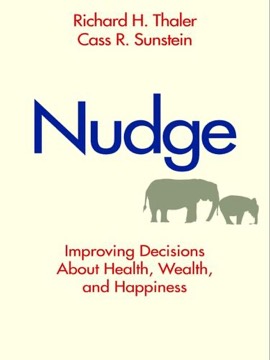
He is more measured here than *Nudge* is, and notes explicitly that some interventions produce much smaller effects at scale than in trials.
What has been contested since
Worth stating. Several findings from the broader behavioural programme have failed to replicate, and the field has had its own reckoning during the replication debates.
Thaler's core results — endowment effect, mental accounting, fairness constraints, present bias — have held up comparatively well. Some peripheral results have not, and the book's confident register predates much of that scrutiny.
What to take from it
Mental accounting is the most immediately useful idea for an individual: noticing that you are treating identical money differently because of where it came from or which pot it sits in.
And the methodological lesson, which is broader than economics — that systematic deviation from a model is information about the model, not noise to be excused.
What to take away
- 01Systematic error is informationPredictable deviation from a model tells you about the model; treating it as noise discards explanatory power.
- 02Money is not fungible in practicePeople decide differently about identical amounts depending on which mental account holds them.
- 03Owning changes the priceThe endowment effect means what you would accept to give something up exceeds what you would pay for it.
- 04Fairness constrains pricingFirms decline profitable price rises because customers punish perceived unfairness afterwards.
- 05Commitment devices beat resolveAutomatic enrolment and locked savings are the field's clearest applied success.