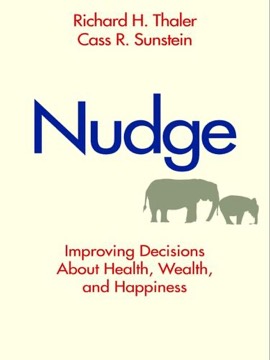
Nudge
Improving Decisions About Health, Wealth, and Happiness
Richard Thaler and Cass Sunstein's argument that because there is no neutral way to present a choice, whoever designs the presentation is already influencing the outcome — and should therefore do it deliberately, in the chooser's interest, without removing any options.
- First published
- 2008
- Publisher
- Yale University Press
- Pages
- 312
- Shelf
- Mind
- Level
- Core
- ISBN-13
- 9780143115267
Record checked against
Catalogue note
- Reads as
- ConceptualExplains how something works before what to do about it.
- Level
- Core / BuildingAssumes general familiarity with the subject.
- Approach
- Theoretical
- Written for
- Curious general readers, Readers with some grounding
Saved in this browser only — no account, nothing sent anywhere. My library
Read this if
- You want to know the specific ways your own judgement misleads you.
- You want to see the incentives underneath the headlines.
- You want to decide better when the information is incomplete.
- You want to understand how it works before deciding what to do about it.
- You know roughly how the subject works and want the fuller account.
The core idea
The book's foundational observation is that there is no such thing as a neutral presentation. A menu has an order, a form has a default, a shop has a layout — and each of these measurably affects what people choose.
Since the influence is unavoidable, Thaler and Sunstein argue the only real question is whether it is exercised thoughtlessly or deliberately. Their term for the person making these decisions is the choice architect.
There is no neutral way to present a choice. The only question is whether the influence is deliberate.
Devmark’s reading — not a quotation from the book
Libertarian paternalism
The deliberately paradoxical label for their position: paternalist because it tries to steer people toward outcomes they would themselves judge better, libertarian because every option remains available at low cost.
The test they propose is specific — a nudge must be easy and cheap to avoid. A default that can be changed in one click is a nudge; a rule that cannot be declined is not, whatever it is called.
Econs and Humans
The framing device separates the idealised agent of economic models — who has stable preferences, perfect self-control and unlimited computational capacity — from actual people, who have none of these.
Their point is that policy designed for the first fails the second in predictable ways, and that the failures are patterned rather than random, which means they can be designed around.
Defaults
The single most powerful tool, and the book's most robust evidence. What happens if someone does nothing is what happens for most people, because inertia, implied endorsement and the effort of deciding all point the same way.
Their canonical demonstrations — automatic enrolment in retirement saving, and the enormous differences in organ donation rates between opt-in and opt-out countries — are among the best-evidenced findings in applied behavioural science.
NUDGES
Their design checklist: iNcentives, Understand mappings, Defaults, Give feedback, Expect error, and Structure complex choices.
The two least discussed are the most useful. Expect error means designing so that the mistake people will make is cheap — the reason a petrol cap is now attached to the car. Understand mappings means translating an option into the terms a person actually cares about, since almost nobody can convert an energy tariff into money without help.
Design for the mistake people will actually make. That is why the petrol cap is attached to the car now.
Devmark’s reading — not a quotation from the book
Where it has been applied
The book led directly to behavioural insights units in several governments, and the best-evidenced results are unglamorous: reworded tax letters, simplified forms, changed defaults on pension enrolment, altered timing of reminders.
That unglamorousness is the point. The interventions that hold up are generally about removing friction and clarifying information rather than about clever psychological manipulation.
Sludge
A later addition and one of Thaler's most useful contributions: sludge is friction deliberately introduced to make something harder — the cancellation that requires a phone call, the rebate with a laborious claim process, the benefit with a form designed to deter.
It is the same science applied against the person's interest, and it is far more common in commercial practice than nudging. Anyone who wants to use this book ethically should read the sludge material first.
The serious objections
Three deserve weight. The first is democratic: who chooses the direction, and by what authority? The authors answer that choice architects already exist, which addresses the fact but not the legitimacy.
The second is the replication problem. Several findings in the original edition come from research programmes that have since been contested, and some specific nudges have produced much smaller effects at scale than in trials. The final edition is noticeably more cautious.
The third is displacement: that behavioural fixes can substitute for structural ones, letting a cheap nudge stand in for an expensive reform that would have worked better.
What the evidence supports
Worth separating clearly. Defaults are extremely well supported across many domains and large populations. Simplification and friction reduction are well supported. Timely, specific feedback is well supported.
Social-norm messaging is supported but with smaller and more variable effects than early results suggested. Some priming-adjacent interventions are on much weaker ground. The gradient matters, and the book's early editions flattened it.
What to take from it
For anyone designing a form, a product, a policy or an interface, the central reframing is the whole value: you are already a choice architect, so the only decision is whether to do it consciously.
Then two practical questions. What happens if this person does nothing — and is that the outcome you would defend? And what mistake is this design inviting, and how expensive is that mistake to recover from?
What to take away
- 01Neutral presentation does not existEvery menu has an order and every form has a default; the influence is unavoidable, only its deliberateness is a choice.
- 02The default is the decisionFor most people, what happens if they do nothing is what happens. It is the most powerful and best-evidenced lever.
- 03Design for the likely mistakeExpecting error and making it cheap to recover from is worth more than trying to prevent it.
- 04Sludge is the same science, reversedFriction deliberately added against someone's interest is far more common commercially than nudging.
- 05Hold the evidence by gradientDefaults and simplification are robust; social-norm and priming effects are weaker and more variable.