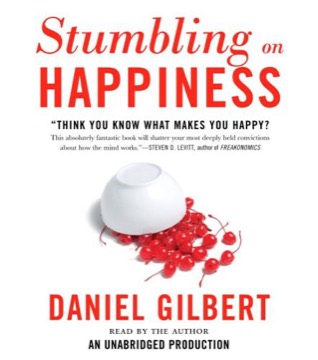
Stumbling on Happiness
Daniel Gilbert's account of affective forecasting — why humans are systematically poor at predicting what will make them happy, and why the errors are predictable enough to be catalogued.
- First published
- 2006
- Publisher
- Knopf
- Pages
- not established
- Shelf
- Mind
- Level
- Core
- ISBN-13
- 9780007240746
Record checked against
No page count is recorded, so no reading estimate is shown for the book itself.
Catalogue note
- Reads as
- ConceptualExplains how something works before what to do about it.
- Level
- Core / BuildingAssumes general familiarity with the subject.
- Approach
- Theoretical
- Written for
- Curious general readers, Readers with some grounding
Saved in this browser only — no account, nothing sent anywhere. My library
Read this if
- You want evidence about why people behave as they do, not folklore.
- You want to know the specific ways your own judgement misleads you.
- You want to decide better when the information is incomplete.
- You want to understand how it works before deciding what to do about it.
- You know roughly how the subject works and want the fuller account.
What the book is actually about
Despite the title it is not a happiness manual and offers almost no advice. It is about imagination: the human capacity to simulate futures, and the specific ways that simulation misleads.
Gilbert's argument is that we are the only species that thinks extensively about the future, that we do it constantly, and that we are reliably bad at the part that matters — predicting how we will feel when we get there.
Not a book about being happy. A book about why your prediction of being happy is wrong in patterned ways.
Devmark’s reading — not a quotation from the book
Imagination fills in and leaves out
His first error class: mental simulations are constructed rather than retrieved, and the construction adds details that will not be there while omitting details that will.
Asked to imagine a future event, people generate a vivid scene missing almost everything that will actually occupy the experience — the interruptions, the ordinary texture, the things that will be on their mind instead.
Presentism
His second: imagination is contaminated by the present. Predictions about future feelings are made from inside a current state, and that state leaks into the prediction.
The demonstration is the supermarket effect — shopping while hungry produces different predictions about future eating than shopping after a meal, and neither predictor notices the influence.
Rationalisation and the psychological immune system
His third error class, and the most consequential. People have a substantial capacity to reframe outcomes positively after they occur, and they do not account for this when predicting.
The result is systematic over-prediction of how bad negative outcomes will feel and how long the feeling will last. His term for the mechanism is the psychological immune system, and its invisibility to its owner is what makes the forecasting error persistent.
Impact bias
The summary finding: people overestimate both the intensity and the duration of future emotional reactions, for good events and bad ones.
The duration component is the larger error. Major life changes that seem like they will define one's happiness — a promotion, a move, a relationship, an illness — have effects that fade much faster than predicted.
The duration error is the big one. Almost everything fades faster than you expect it to, in both directions.
Devmark’s reading — not a quotation from the book
Why we do not learn
His explanation for the persistence of the error: memory of past emotional episodes is itself reconstructed, and reconstructed in a way that preserves the original prediction rather than the actual experience.
We therefore do not accumulate the evidence that would correct us, which is why experience does not improve affective forecasting the way it improves most other skills.
Surrogation, the one piece of advice
His single practical recommendation, which he acknowledges nobody follows: rather than imagining how you would feel, find someone currently in the situation and ask them.
The evidence suggests this predicts better than imagination, including across substantial personal differences. People reject it because they believe they are unusual — a belief Gilbert notes is itself close to universal.
Where the evidence has shifted
Affective forecasting errors are among the better-replicated findings in social psychology and the core results have broadly held.
Some specific studies the book cites come from areas affected by the replication debates, and a reader should hold individual demonstrations more loosely than the general pattern, which is well supported.
The writing
Genuinely funny in a way almost no psychology book manages, with a digressive, joke-dense style that some readers find delightful and others find exhausting.
The humour is not decoration — Gilbert uses it to keep a reader through material that is essentially a catalogue of ways they are wrong about themselves, which is otherwise unpleasant reading.
What to take from it
The impact-bias correction is the most useful single adjustment: when predicting how much something will matter, assume less and shorter than your imagination says, in both directions.
And surrogation, despite the resistance to it. Asking someone who is currently doing the thing beats imagining doing the thing, and the conviction that your case is different is the thing to be suspicious of.
What to take away
- 01Imagination constructs and omitsThe simulated future adds detail that will not be there and leaves out almost everything that will.
- 02The present leaks into the predictionForecasts about future feelings are made from inside a current state, invisibly.
- 03You will cope better than you predictThe psychological immune system is real, effective and invisible to its owner, which is why the error persists.
- 04Duration is the bigger errorBoth good and bad events fade much faster than anticipated, and that is what forecasting misses most.
- 05Ask someone who is thereSurrogation outperforms imagination, and the belief that you are the exception is close to universal.