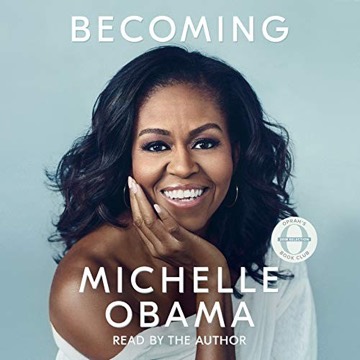
Becoming
Michelle Obama's memoir in three parts — becoming me, becoming us, becoming more — covering a South Side childhood, a legal career abandoned for public work, and eight years in a role she did not choose.
- First published
- 2018
- Publisher
- Crown (North America)Viking Press (Commonwealth)
- Pages
- 464
- Shelf
- History
- Level
- Entry
- ISBN-13
- 9780241982976
Record checked against
Catalogue note
- Reads as
- ReflectiveChanges how you see rather than what you do.
- Level
- Accessible / FoundationalNo prior reading assumed.
- Approach
- Theoretical
- Written for
- Readers of history, Newcomers to the subject
Saved in this browser only — no account, nothing sent anywhere. My library
Read this if
- You want a life told honestly, at full length.
- You want to understand how power is taken, kept and lost.
- You want a book that changes how you see things rather than what you do tomorrow.
- You are starting from scratch here and want a way in that assumes no prior reading.
The structure
Three parts, deliberately named, tracking a life as a sequence of becomings rather than a single arrival.
The framing is the book's thesis: that identity is continuously constructed rather than discovered, and that the question of what you will be is never actually closed. She returns to it explicitly at the end.
Her thesis is that the question of what you are becoming is never closed, which is why the parts are named that way.
Devmark’s reading — not a quotation from the book
The South Side
Her opening section on a family of four in a small upstairs apartment, a father with multiple sclerosis who went to work every day at a water filtration plant, and a mother who prioritised her children's education absolutely.
Her account of her parents' insistence that the children speak up, question and be heard — and of her mother's decision to fight the school system on their behalf — establishes where the confidence came from.
Princeton and Harvard
Her account of arriving at institutions where she was among very few Black students, of the roommate whose mother tried to have her moved, and of the specific experience of being asked to represent a category.
Her observation that she spent years being the only one in rooms, and what that costs in sustained attention, is one of the most quoted passages and is made without self-pity.
Leaving the law
Her chapters on becoming a corporate lawyer, achieving what she had aimed for, and recognising that she was unhappy in work that had no visible effect on anyone.
Her account of the decision to leave a secure high-paying career with student debt outstanding, and of the practical calculations it required, is more useful than most writing on the subject because she includes the numbers and the fear.
Barack
Their meeting when she was assigned to mentor him, and her extended account of what it is like to be married to someone whose sense of purpose routinely overrides ordinary domestic arrangements.
Her candour about marriage counselling, about her frustration at his absences, and about fertility treatment and miscarriage is the part of the book that most distinguishes it from conventional political memoir.
The campaign
Her account of the 2008 campaign and of being characterised — the deliberate distortion of her remarks, the cover depicting her as militant, the persistent framing of an accomplished woman as angry.
Her analysis of how that specific stereotype is deployed, and of the constant self-monitoring required to avoid triggering it, is the book's most direct political writing.
Her account of managing a stereotype she did not choose is the most directly political writing in the book.
Devmark’s reading — not a quotation from the book
The White House
Her chapters on a role with no job description, enormous visibility and no actual authority, and on constructing something useful out of it.
Her initiatives — on childhood nutrition, on military families, on girls' education — are described alongside the constraints, including the criticism that a nutrition campaign attracted and the limits on what a first lady may say.
Raising children there
Her account of normality maintained under conditions that make it nearly impossible: the security detail at school events, the effort to have the girls' friends visit, her mother's presence in the residence.
This material is specific and unusual, and it is the part of the book most readers report finding unexpectedly interesting.
Where it is limited
It is a memoir rather than a political account, and readers wanting analysis of the administration's decisions will not find it. Policy appears only where she was involved.
It is also carefully composed and there are evident boundaries — about particular people, about political disagreements, about the incoming administration beyond a few pointed passages. It is candid within a perimeter she has chosen.
What it is for
As an account of navigating institutions that were not built for you while declining to become someone else in order to do it.
And as a document of a specific and unusual position — married into a role, publicly scrutinised, without authority — described from inside by someone who did not seek it.
What to take away
- 01Becoming is not finishedIdentity as continuous construction rather than a destination, which is why the three parts are named that way.
- 02Being the only one has a costYears of sustained representation in rooms where you are the sole example, described without self-pity.
- 03She includes the numbersThe decision to leave corporate law is told with the debt and the fear, not as a clean epiphany.
- 04The stereotype required constant managementHer analysis of how the angry-Black-woman framing is deployed is the book's sharpest political passage.
- 05Candid within a chosen perimeterIt is genuinely open about marriage and fertility, and deliberately closed about several other things.