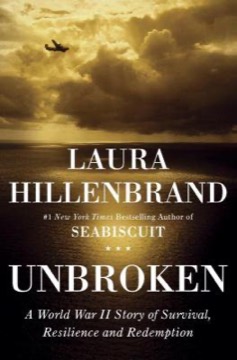
Unbroken
Laura Hillenbrand's account of Louis Zamperini: Olympic runner, bombardier, forty-seven days adrift in the Pacific, and two years in Japanese prison camps.
- First published
- 2010
- Publisher
- April Yaynclk
- Pages
- 500
- Shelf
- History
- Level
- Core
- ISBN-13
- 9780753152898
Record checked against
Two sources agreed on 2010; a third reported differently (openlibrary 2010, wikidata 2001, wikipedia 2010).
Catalogue note
- Reads as
- ReflectiveChanges how you see rather than what you do.
- Level
- Core / BuildingAssumes general familiarity with the subject.
- Approach
- Theoretical
- Written for
- Readers of history, Readers with some grounding
Saved in this browser only — no account, nothing sent anywhere. My library
Read this if
- You want a life told honestly, at full length.
- You want to understand how power is taken, kept and lost.
- You read for the writing as much as for the argument.
- You want a book that changes how you see things rather than what you do tomorrow.
- You know roughly how the subject works and want the fuller account.
What it covers
Zamperini was a delinquent Californian boy who became a distance runner and competed at the 1936 Berlin Olympics. In 1943 his bomber went down in the Pacific; he survived on a raft for forty-seven days before being captured.
The prison camp years, and particularly a guard the prisoners called the Bird, occupy the book's centre. The final section covers what came home with him, which is the part the title is doing the most work on.
The raft is the famous part. The camps and the decades afterwards are what the book is actually about.
Devmark’s reading — not a quotation from the book
How it is reported
Hillenbrand, who has ME and worked largely from home, conducted years of interviews with Zamperini and with other survivors, and drew on diaries and military records.
Her method is to stay with documented detail rather than dramatise — the raft section works because it is specific about water, birds, sharks and arithmetic rather than because it is written up.
The part most accounts skip
The final quarter deals with post-war alcoholism, what would now be diagnosed as PTSD, a marriage close to ending, and Zamperini's religious conversion at a Billy Graham event.
Hillenbrand treats the forgiveness that followed as a fact about his life rather than as a moral for the reader, which is the book's most disciplined decision.
The conversion is reported as what happened to him, not offered as an instruction.
Devmark’s reading — not a quotation from the book
The raft
The forty-seven days adrift after the crash are the book's most extraordinary sustained passage: three men, two of whom survive, on a disintegrating raft with no water, fending off sharks, strafed by an aircraft. Hillenbrand's handling is restrained and specific, and the section works because she has established exactly what each man was like before it began.
The camps
Captivity occupies the book's centre and is the hardest material — starvation, disease, forced labour, and the sustained personal cruelty of one guard in particular who singled Zamperini out. Hillenbrand documents this from survivor testimony and records rather than dramatising, which makes the cumulative weight heavier rather than lighter.
Running as the frame
His athletic career is not a prologue but the book's organising logic. The capacity for sustained suffering that made him a distance runner is presented as the same capacity that kept him alive, and the humiliation of being made to run for the guards' amusement is the point at which the two halves of the book collide.
The thing that made him a runner and the thing that kept him alive are presented as one capacity.
Devmark’s reading — not a quotation from the book
What happened after
The final quarter is the part most retellings omit: nightmares, alcoholism, a marriage close to ending, and a consuming fantasy of returning to kill his former guard — recognisable now as post-traumatic stress and untreatable at the time. Hillenbrand gives it real space, which is what stops the book being a survival adventure.
The religious ending
His recovery followed a conversion at a revival meeting, and he later returned to Japan and publicly forgave his captors. Hillenbrand reports this without either endorsing or distancing herself from it. Readers' reactions to the ending vary considerably, and it is worth knowing in advance that the resolution offered is a religious one.
How it was researched
Hillenbrand has ME and worked largely from her home, conducting years of interviews by telephone and building the account from military records, diaries and survivor testimony. The reporting is dense and the sourcing substantial, which is the answer to the reasonable suspicion that a story this extreme has been improved.
What to take from it
It is narrative non-fiction at the upper end of the form, and its real subject is what happens to a person after the survivable part is over. Read the last quarter with the same attention as the raft; it is where the book is making its actual argument.
What to take away
- 01Three survivalsThe crash, the raft, and then the camps, each a different kind.
- 02Documented, not dramatisedYears of interviews and records; specificity carries the extremity.
- 03The BirdOne guard's sustained cruelty is the centre of the prison section.
- 04What came homeAlcoholism and trauma occupy the final quarter, which most retellings drop.
- 05Forgiveness as factReported as an event in his life rather than as a lesson.